
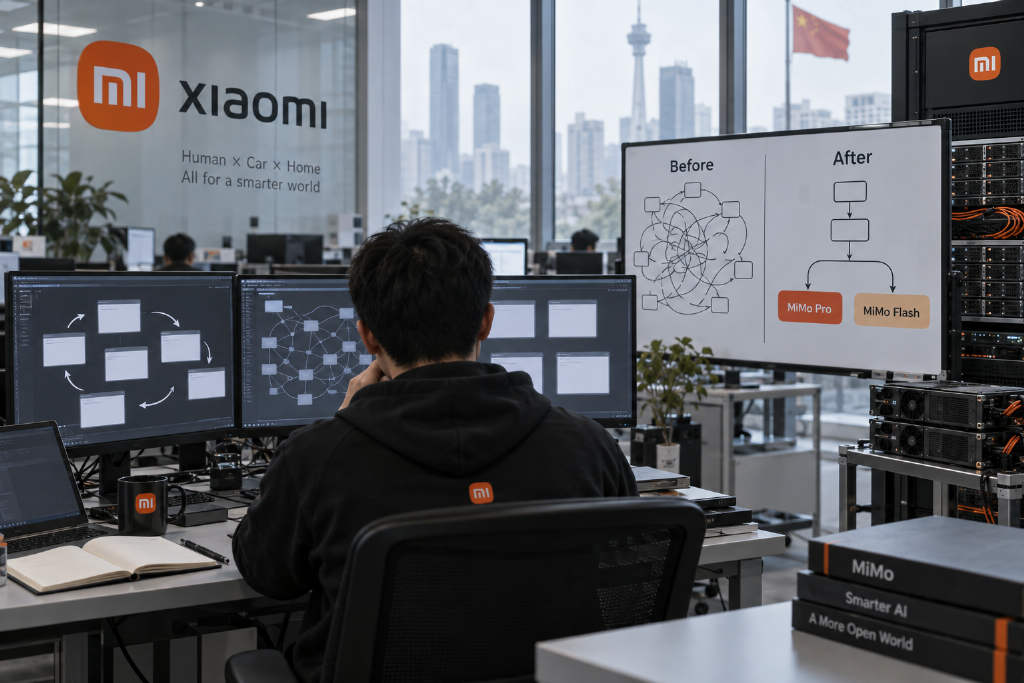
Xiaomi’s MiMo team has published a postmortem on the repeated tool-calling issue that surfaced after MiMo-V2.6 went live. The team said the model would sometimes call the same tool, or highly similar tools, again and again, consuming context while making no progress on the task.
In OpenCode, the share of responses that showed repeated tool calls at one point reached 1.02% for Flash and 0.54% for Pro.
The issue was traced to reinforcement learning reward design
Xiaomi said the root cause was in the reward design used for reinforcement learning. Training mainly rewarded whether the task was completed correctly in the end, while inefficient behavior during the process was not penalized enough.
Under the original rule, a penalty was triggered only when tool calls in a single round exceeded 32. Repeated calls below that threshold received no penalty at all. As RL scale increased, Xiaomi said, that bad habit was reinforced rather than reduced.
After replaying training checkpoints, the team found that in Flash, the share of abnormal samples with more than 10 calls in a single round rose from 11.1% at step 0 to 24.6% at step 20.
A full retraining route was estimated at $2.31 million
Xiaomi said the most direct fix would have been to lower the penalty threshold from 32 to 8 and rerun about 20 MixRL steps. That option, however, was expected to cost $2.31 million.
Xiaomi chose a targeted RL teacher instead
Rather than fully retraining the model, Xiaomi said it trained a dedicated RL teacher focused on correcting repeated calls. The run used 12 steps and about 7,000 samples, and the resulting capability was merged back into Pro and Flash through MOPD.
The company said the full repair cost about $90,000, or roughly 4% of the full retraining plan, while other major benchmarks were largely unchanged.
Updated weights and API are already live
Xiaomi said the fixed MiMo-V2.6-Pro-MOPD and Flash-MOPD weights have been released, and the API has already been switched to the new version without changing the call name.
The company also said it will reset the remaining quota for MiMo Desktop users in the current billing cycle.