
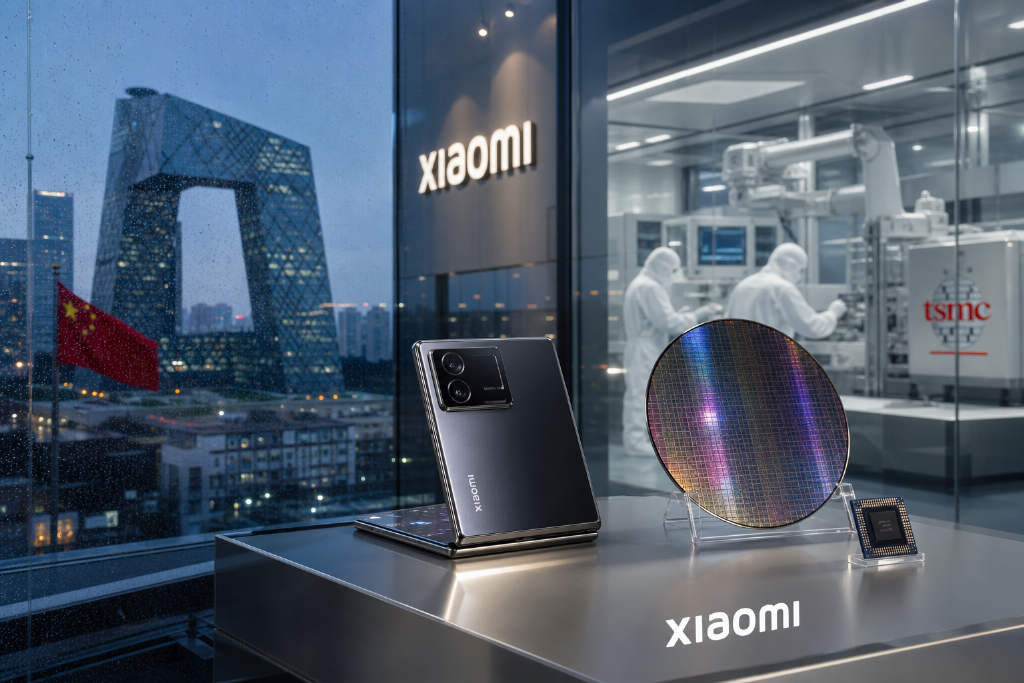
Xiaomi on Monday launched its in-house flagship smartphone processor, Xring O3, built on a 3nm process and manufactured by Taiwan Semiconductor Manufacturing Co. The move takes aim at Qualcomm and MediaTek, which have supplied core mobile components to Xiaomi for more than a decade. Bloomberg said the chip’s reported shipment target is only 200,000 to 300,000 units, pointing to limited near-term scale.
Xiaomi expands its in-house chip strategy
In a post on its official Weibo account, Xiaomi said Xring O3 brings more power-efficient image processing and stronger on-device AI computing. The release is another step in the company’s internal chip effort after the Xring O1 in 2025.
Xiaomi also introduced the Xring O100 and D100 at the same event. A system-on-chip, or SoC, combines the processor, graphics chip and AI computing unit on a single piece of silicon. It is the most expensive core component in a smartphone and one of the main factors shaping device performance. For more than a decade, that part of the market has been dominated by Qualcomm and MediaTek.
3nm process and technical details
Xiaomi founder Lei Jun said in a WeChat post that the Xring O3 uses a 3nm process. The report said that node is close to the technology used in Apple’s latest A19 Pro chip and puts Xiaomi ahead of Huawei’s in-house chip effort on that measure.
According to Reuters, TSMC is producing the chip. The report described this as the first time Xiaomi’s in-house chip program has been clearly tied to TSMC manufacturing.
The Xring O3 has a die size of 133 square millimeters and more than 24 billion transistors. Xiaomi said it is the world’s first mobile processor compatible with LPDDR6 memory, with memory bandwidth of 113.8GB per second, up 48% from the previous Xring O1.
The CPU uses a 10-core design: two C1-Ultra cores clocked up to 4.35GHz, four C1-Premium cores at 3.68GHz, and four C1-Pro cores at 3.15GHz. The GPU is a 16-core G2-Ultra NX. The report said the overall specification places the chip close to flagship-class territory.
Xiaomi’s own benchmark claims
Xiaomi said its internal testing shows about a 60% gain in multi-core performance over the previous generation. It also claimed GPU graphics performance improved by as much as 85%, while energy efficiency rose 64%. Reported benchmark results were 5,228,014 on AnTuTu and 15,221 in Geekbench multi-core.
Those numbers came from Xiaomi’s own testing rather than an independent third-party benchmarking firm. Real-world battery life and user experience will need to be assessed after commercial devices ship. The first model to carry the Xring O3 will be the foldable Xiaomi 18 Fold, which is expected to launch in September 2026.
Bloomberg says Xiaomi still relies heavily on outside suppliers
Bloomberg Intelligence analysts Steven Tseng and Rebecca Wang said Xring O3 remains at 3nm while the next flagship chips from Qualcomm and MediaTek are already preparing to move to 2nm. In their view, that suggests Xiaomi is focusing its resources on architecture and feature upgrades rather than pushing process shrinkage further.
The analysts said redesigned computing units, faster memory and stronger on-device AI capability could help Xiaomi create more differentiation for its flagship phones. If the Xring family expands across more devices, it could also improve R&D efficiency by spreading design costs over a broader product lineup.
Bloomberg also noted that the chip’s reported shipment target of 200,000 to 300,000 units is small compared with the tens of millions of units Qualcomm and MediaTek ship annually. That means Xiaomi is still likely to depend heavily on those two suppliers in the near term. In that framing, the in-house chip looks more like a bargaining lever than a full replacement plan.
Pressure on Xiaomi’s broader hardware business
The report said Xiaomi was once the top smartphone vendor by market share in China, but its smartphone and electric vehicle businesses are both facing weak domestic demand. According to Counterpoint Research, Xiaomi recorded the steepest shipment decline among major hardware vendors in the quarter ending in June this year.
Investors are also concerned that aggressive pricing for Xiaomi’s newest sport utility vehicle could put more pressure on profit margins. Against that backdrop, Xring O3 is not only a product launch. The report cast it as part of Xiaomi’s effort to regain control of the narrative and strengthen its hand in supplier negotiations at a time of rising revenue pressure.