
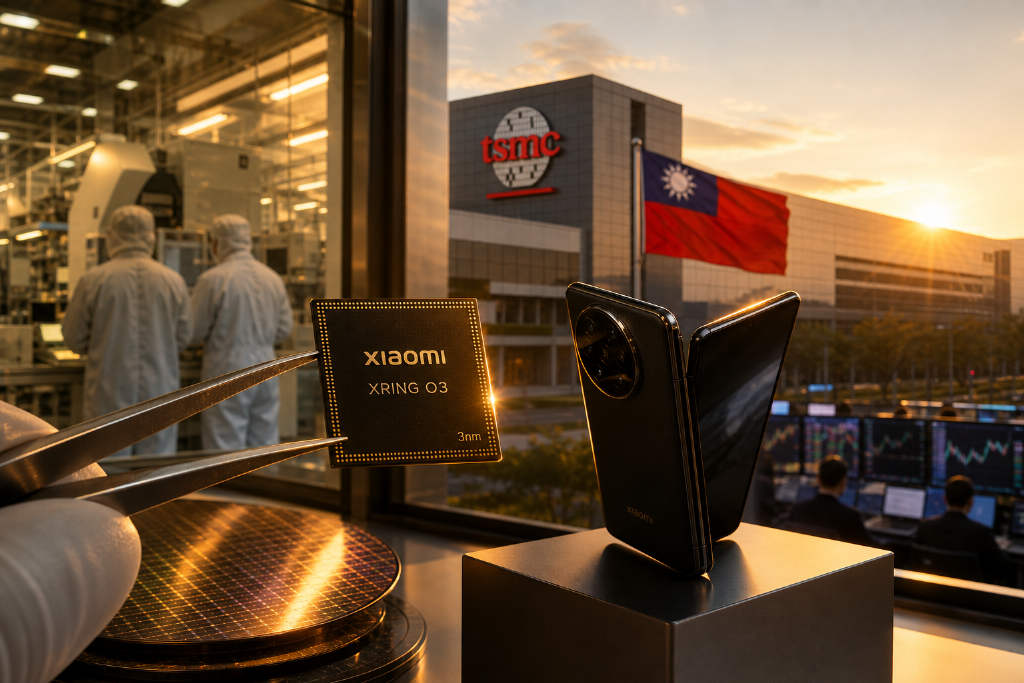
Xiaomi on Aug. 24 introduced its new in-house mobile SoC, the Xuanjie O3, built on Taiwan Semiconductor Manufacturing Co.'s 3nm process and scheduled to debut in the Xiaomi 18 Fold in September. The move puts fresh attention on Qualcomm and MediaTek, which have long supplied mobile processors to Xiaomi.
As of the source article's publication, MediaTek (2454) was down 2.26% to NT$3,680, while Qualcomm (QCOM) had fallen 1.38% in the previous trading session to $158.53.
Xuanjie O3 brings a larger chip and higher performance
At a technology briefing, Xiaomi said the Xuanjie O3 has a die area of 133 square millimeters and integrates 24 billion transistors. Overall chip scale increased 26% from the previous-generation Xuanjie O1.
The company said the chip uses an all-big-core design. CPU performance is up 60% from the prior generation, and GPU performance is up 85%. Xiaomi also said the O3 includes a higher-performance image processing unit and stronger on-device AI inference capabilities.
Alongside the Xuanjie O3, Xiaomi also introduced two other in-house chips: the Xuanjie O100, aimed at device-side AI acceleration, and the Xuanjie D100, designed for smart driving. The three chips target different use cases and show that Xiaomi is widening its in-house silicon lineup.
Lei Jun says chip R&D spending has topped RMB 21 billion
Xiaomi Chairman Lei Jun said the company has spent more than RMB 21 billion on research and development since restarting large-scale chip work five years ago. He described the Xuanjie chip family as a core part of Xiaomi's AI strategy.
Built on TSMC 3nm and positioned against Apple's latest generation
Xiaomi has outsourced production of the Xuanjie O3 to TSMC on its 3nm process. The source said that places the chip in the same process generation as Apple's latest flagship A19 Pro and ahead of the self-developed Kirin chips currently used by Huawei.
The source also cited some industry views saying that, while Qualcomm and MediaTek are moving toward 2nm, Xiaomi has kept the Xuanjie O3 at 3nm for now. That suggests the company's current focus is on widening the gap through architecture and feature upgrades rather than solely chasing process-node leadership.
In terms of competition, the source said September could bring a three-way contest among the Xiaomi 18 Fold with Xuanjie O3, the iPhone 18 series with Apple A20 chips, and a rumored Huawei Kirin 2026 chip expected to debut with "Tao's Law" technology.
Xiaomi 18 Fold to launch first as competition in foldables heats up
The first device to carry the Xuanjie O3 will be the Xiaomi 18 Fold, which Xiaomi expects to launch in September. It will also be the company's first foldable device to use an in-house chip. The source, citing people familiar with the matter, said Xiaomi had set a shipment target of 200,000 to 300,000 units for the model.
Even so, Huawei remains the dominant force in foldables. Data from Smart Analytics Global showed Huawei shipped 1.6 million foldable phones in China in the second quarter, giving it a 68% market share. Honor followed with 13.7%, and OPPO had 8.5%. Other vendors combined, including Xiaomi, accounted for less than 10%.
The source added that if Apple's first foldable phone is confirmed for the same month, that could inject another variable into the market and potentially open unexpected room for Xiaomi.
Pressure on Qualcomm and MediaTek starts with bargaining power
The clearest immediate effect of the Xuanjie O3 on Qualcomm and MediaTek lies in supplier negotiations. For years, the two companies have been Xiaomi's core mobile processor suppliers. Once Xiaomi begins using its own SoC, MediaTek in particular faces added pressure in future bargaining.
Still, the source noted that shipment volumes for Xiaomi's in-house chips remain limited for now, meaning the broader product lineup will continue to rely on Qualcomm and MediaTek in the short to medium term. For both suppliers, the symbolic loss of a flagship design win matters more than the near-term unit impact. The bigger test will be whether Xiaomi later pushes its in-house chips down into mid-range devices.