

Embodied AI company Xingdong Jiyuan said on July 6 that it has completed a new RMB 1 billion financing round. The round was led by Chengtong Fund, a state capital operation platform under China’s State-owned Assets Supervision and Administration Commission, with participation from Jiangxi State Control, Guoyuan Equity, Yufu Zhongxin Fund, Hangzhou Capital, CICC Renault, Jiukun Ventures, Hony Capital, Juntai Capital, Shenghe Capital, and existing investors including Houxue Capital, Qingkong Tiancheng, and Qianshan Capital.
With the latest raise, the company’s cumulative fundraising over the past two months has reached RMB 2.5 billion. Xingdong Jiyuan said it has now assembled a three-layer capital structure consisting of state-level strategic backing, top-tier financial investors, and industrial ecosystem partners, with more than 20 industrial capital participants in total. The company has also been described as the only embodied intelligence company directly held by Tsinghua University.
World models and full-stack development sit at the center of the pitch
Xingdong Jiyuan has framed itself as one of the earliest embodied AI companies to push a world-model route. According to the company, while VLA remained the mainstream industry paradigm in 2024, it had already started research on world models and released PAD in September 2024, describing it as the world’s first World Action Model, or WAM. PAD combines video prediction with action prediction and, by the company’s account, arrived nearly a year ahead of comparable approaches later discussed in the market.
The company said discussion around world models became far more active across embodied AI during 2025. In October of that year, Xingdong Jiyuan and Stanford professor Chelsea Finn’s team introduced Ctrl-World, using a world model as a data simulator to generate training data that better approximates real physical laws. The company claimed this lifted performance by 45% versus Pi0.5. In February this year, it further launched VLAW, a world-model-based VLA reinforcement learning framework designed to let policies and simulators co-evolve, pushing the simulator from merely looking right toward being physically accurate as well.
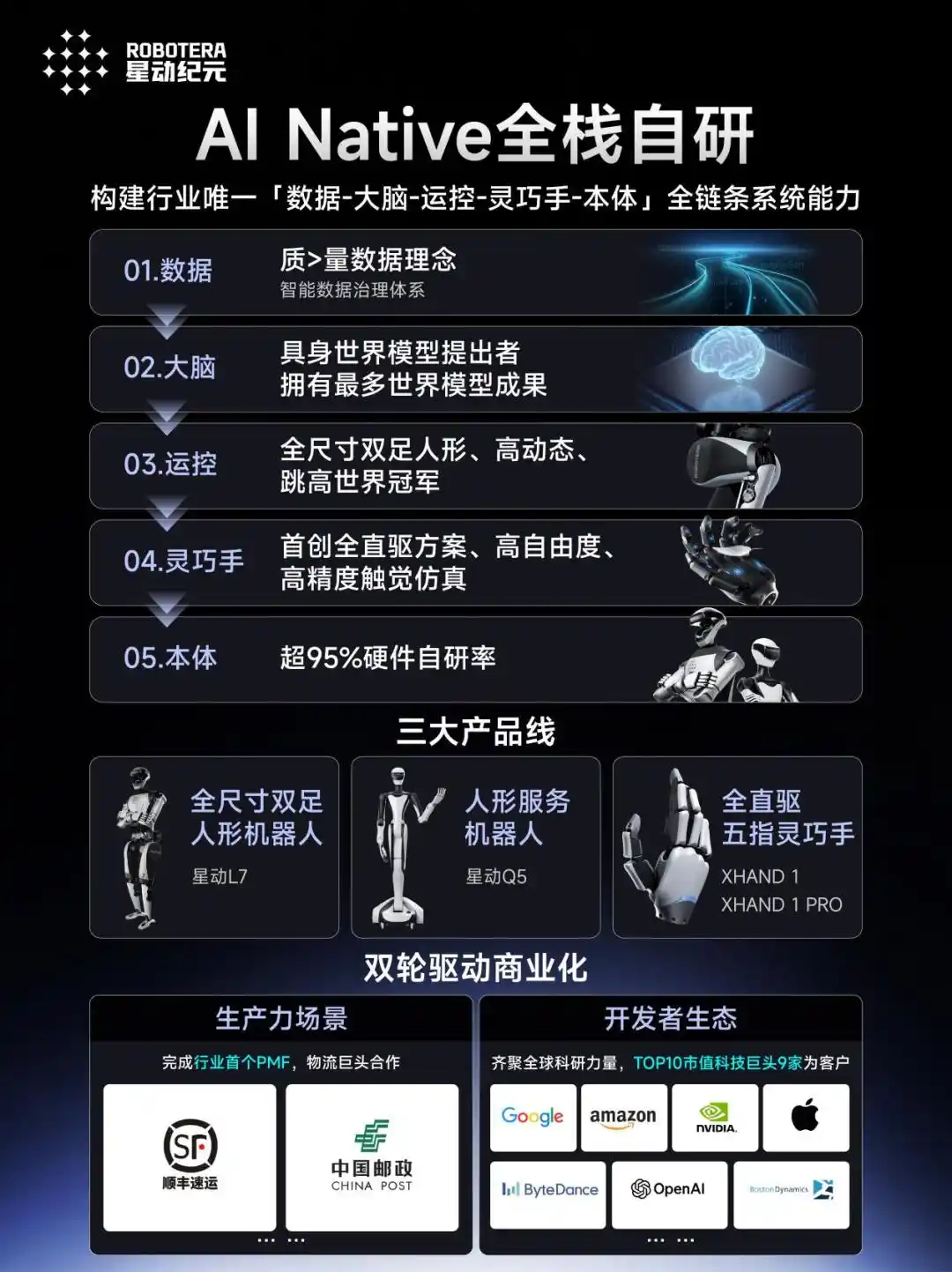
Beyond those model releases, the company previously proposed a fast-slow VLA architecture for robots and later integrated world models and VLA into PAD and VPP, while also introducing ERA-42, an end-to-end native robot foundation model. Xingdong Jiyuan said ERA-42 combines vision, understanding, prediction, and action in a single stack capable of controlling full-body dexterous manipulation. The broader product lineup now includes the L7 full-size bipedal humanoid, the Q5 wheeled humanoid service robot, and the XHAND series of five-finger dexterous hands.
The “strengthen the brain through the hand” strategy focuses on data quality
A defining part of the company’s narrative is that dexterous hands are not just peripheral components but the core gateway for collecting valuable physical-world interaction data. Xingdong Jiyuan argues that grasp success, force feedback changes, and slippage events generate rich high-dimensional signals that directly affect what a robot model can actually learn. That view has shaped its hardware choices: rather than designing hardware from a purely mechanical perspective, it says it works backward from model and data requirements.
To support that approach, the company adopted a fully direct-drive architecture for its dexterous hands. It says the design minimizes transmission gap, elasticity, and friction loss, producing higher-precision, lower-latency, and more reproducible data suitable for model training. Xingdong Jiyuan has rolled out a “dual-hand” product strategy: XHAND 1 PRO is positioned as a high-performance “brain hand” for data capture and algorithm validation, while XHAND 1 is designed as a “working hand” aimed at scaled deployment and broader compatibility with humanoid robot platforms.
According to the company, XHAND 1 has already been used in industrial sorting and routine operations, and has been adopted by overseas players including Skild AI in the U.S., Rainbow Robotics in South Korea, Extend Robotics and Discover Robotics in the U.K., and the humanoid robot HMND 01. Xingdong Jiyuan’s broader thesis is that better hands produce better real-world interaction data, which in turn trains stronger embodied models, and those stronger models then improve robotic execution in a reinforcing loop.
Dataset scale and structure are being positioned as a defensible moat
Xingdong Jiyuan said its self-developed dexterous hands and commercial deployments have helped it build one of the largest real-machine dexterous-hand datasets in the market. The company described a three-tier data system. The first layer consists of long-horizon real-machine interaction data from logistics and industrial settings, which it characterizes as the highest-value source because it is fully grounded in physical reality. The second layer is made up of high-precision teleoperation data that provides standardized action references. The third layer extends breadth using first-person human behavior data and large-scale internet video.
The company disclosed that it has collected more than 12 million real-machine teleoperation data clips, including more than 1.5 million dexterous-hand teleoperation clips. It added that its overall dataset now spans more than 100 real-world scenarios and over 1,000 dexterous manipulation tasks. In Xingdong Jiyuan’s telling, the combination of real industrial interaction data and large-scale human video data forms a dual engine that balances realism and diversity, helping sustain the iteration of a general embodied brain.
Investor roster expands from elite VCs to state and industrial capital
The company’s investor base has broadened rapidly. Earlier shareholders mentioned in the report include Tsinghua University, Alibaba, CDH VGC, Sequoia China, IDG Capital, QL Capital, and CICC Capital. Industrial and strategic backers listed by the company include SF Express, Samsung, Geely Capital, Haier, Lenovo, Singtel, BAIC Industrial Investment, Dongfeng Industrial Investment, CICC Porsche, CICC Renault, funds under China Unicom, and the Beijing AI Industry Investment Fund, among others.
Its financing pace accelerated sharply in 2026. In March, the company completed a RMB 1 billion strategic round that reportedly pushed its valuation above RMB 10 billion and brought in overseas industrial capital such as Samsung and Singtel. Roughly a month later, it closed another USD 200 million round led by SF Group, with Sequoia China and IDG Capital continuing to invest. The newly announced RMB 1 billion financing now marks the third major raise within about three months, making Xingdong Jiyuan one of the fastest-financing names in embodied AI this year.
Commercial rollout is centered on logistics, then manufacturing and services
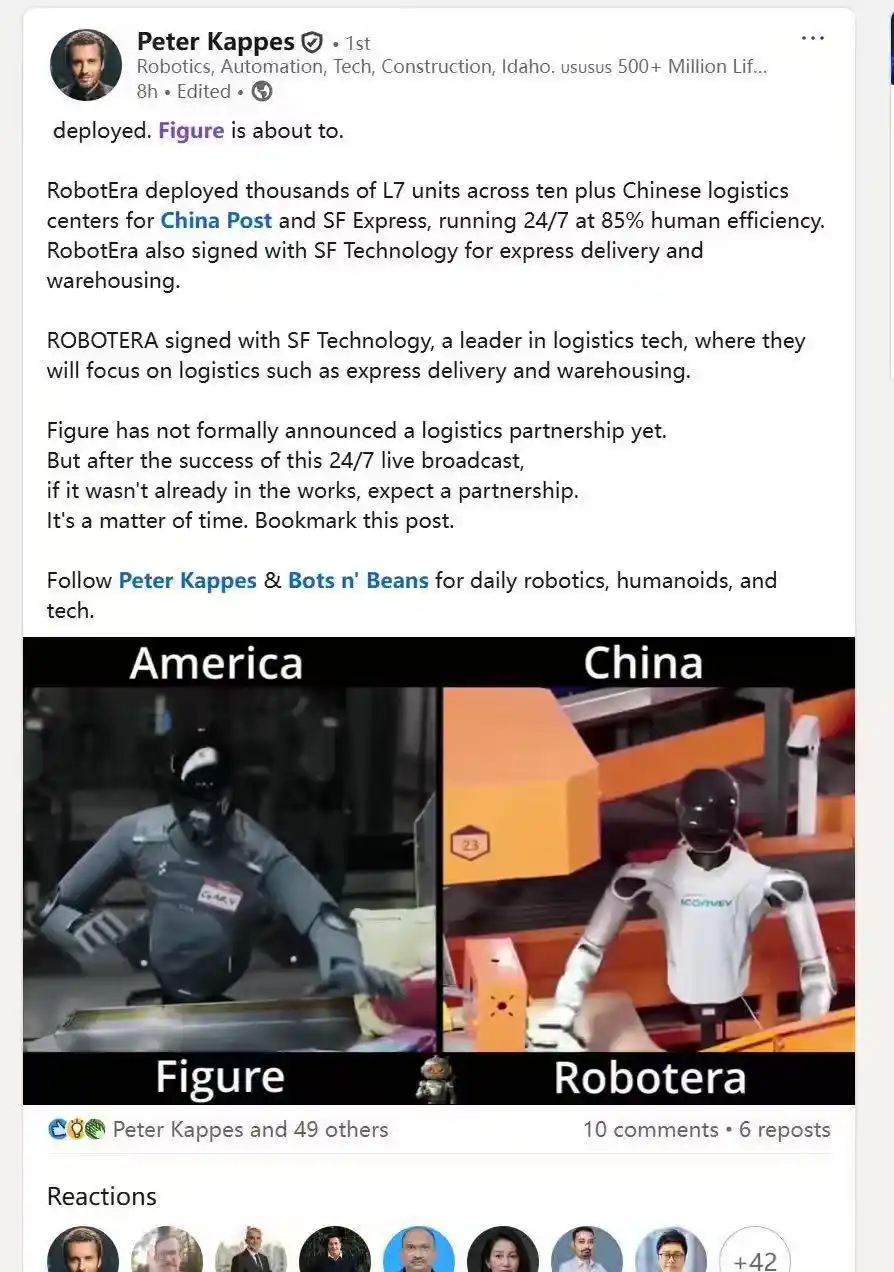
On commercialization, Xingdong Jiyuan said it follows a “B2B first, consumer later” strategy. The company claims it has already reached an early product-market fit in logistics through partnerships with SF Express and China Post. Its robots have reportedly been deployed in batches across more than 10 logistics centers in five provincial-level regions spanning North, East, and South China, with some sites running on a normalized 24/7 basis.
In those logistics environments, the robots are used for parcel grasping, turning waybills face-up, placement, and sorting work involving items of different shapes, materials, and sizes. The company said efficiency in some settings has already surpassed human performance, with throughput reaching more than 1,200 parcels per hour. It also said it plans to broaden coverage across inbound logistics, in-factory logistics, sales logistics, after-sales logistics, and extended express delivery workflows.
Xingdong Jiyuan is also pushing into high-end manufacturing and service scenarios. In 3C electronics and automotive manufacturing, it said it has partnered with Samsung, Lenovo, Haier, and Geely. In commercial services, the Q5 humanoid service robot has been deployed in sites linked to Haier, Lenovo, and Century Golden Resources for customer acquisition, guided tours, explanations, and product delivery. The company argues that data flowing back from these industrial deployments continuously strengthens its embodied model stack.
Global customer references are being used to validate the hardware base
The company further said that its dexterous hands, general-purpose robot body platforms, and R&D kits are not only used internally but have also been shipped globally. It claimed to serve 9 of the world’s top 10 technology companies by market capitalization, while listing customers and users such as OpenAI, Boston Dynamics, Nvidia, Apple, Google, Amazon, ByteDance, MIT, UC Berkeley, Stanford University, Tsinghua University, and the Shanghai Institute for Advanced Study in AI. In the company’s view, feedback from those top-tier research and enterprise users helps it iterate the underlying hardware platform faster.
The broader industry backdrop is also important. The report argues that 2026 is increasingly seen as a watershed year for embodied intelligence: model capability gaps become more visible in the first half, while commercialization gaps widen in the second half. Against that backdrop, Xingdong Jiyuan’s fundraising and deployment momentum suggest that investors are placing greater weight on whether embodied AI systems can move from technical demos to scalable, real-world productivity.