
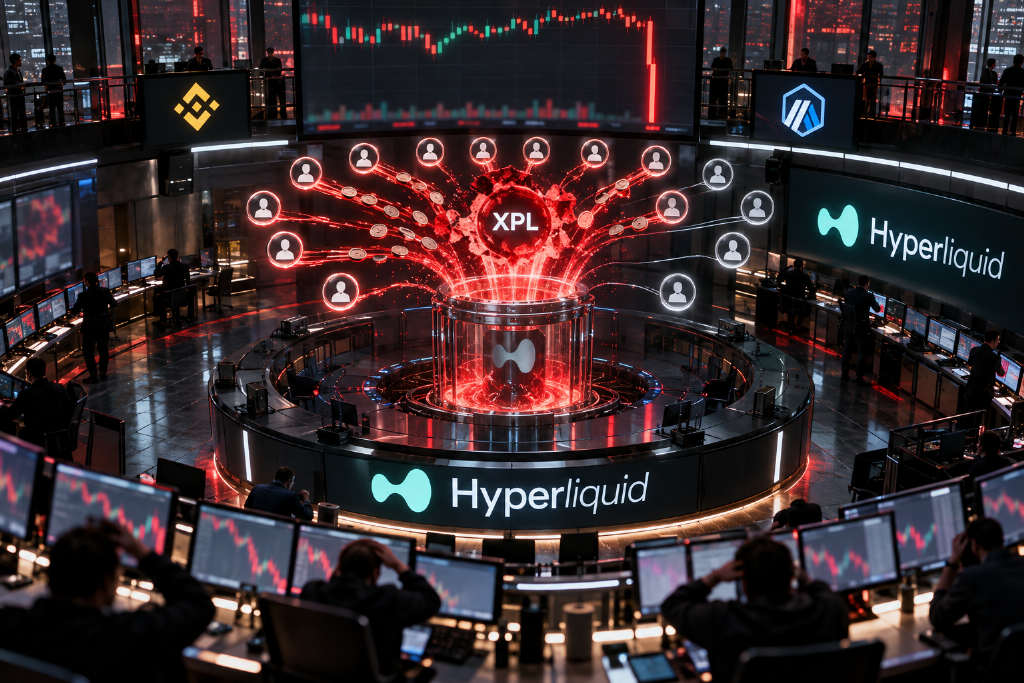
A market reconstruction by Quote team member filo says Plasma (XPL) fell 18% in one minute on Hyperliquid at 12:32 Beijing time on Nov. 1, while BTC was down only 0.04% over the same stretch.
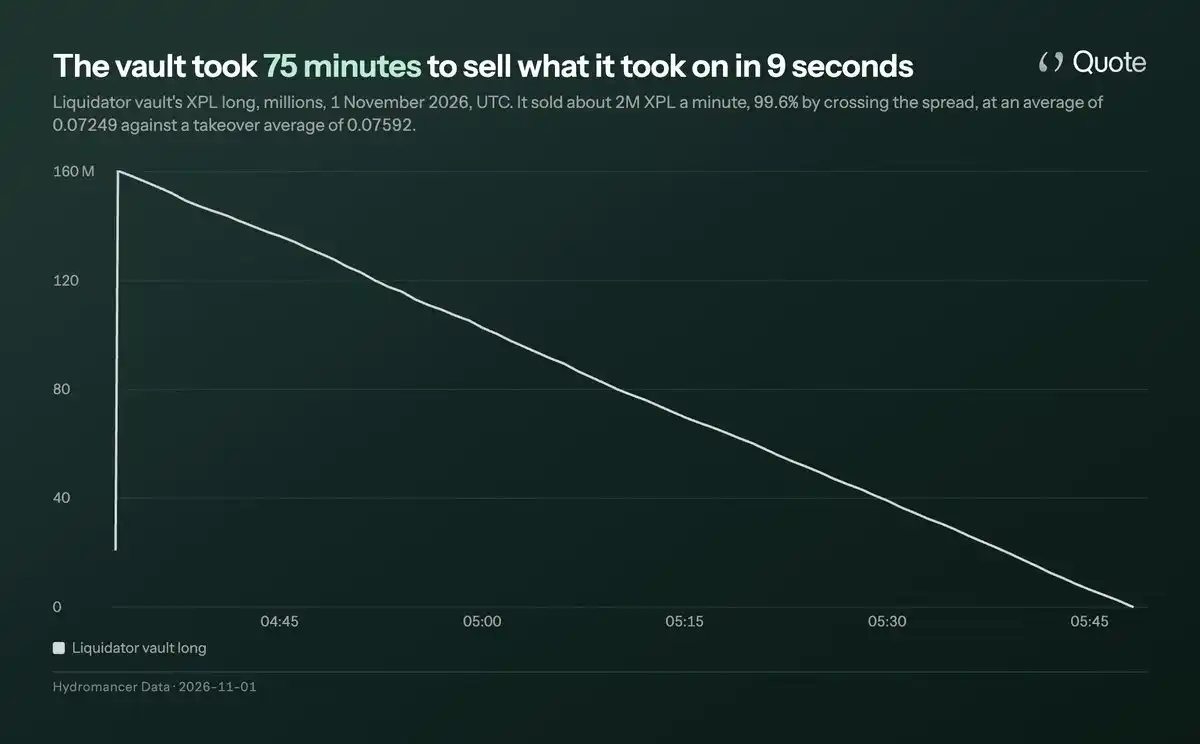
The report says Hyperliquid’s HLP liquidator vault passively absorbed a $12.1771 million XPL long between 12:32:50 and 12:32:59. By the time the vault finished selling out of the position 75 minutes later, it had lost $555,800.
Within hours of the move, on-chain analysts kenni.hl (@kennishjp) and Naeven (@Naeven_) had outlined the broad shape of the event, pointing to a group of wallets that pulled margin minutes before the drop. kenni.hl compared it with an incident in March 2025, when a trader withdrew margin from a large ETH long. Hyperliquid later said HLP lost about $4 million in that case, the trader made about $1.8 million, and there had been no exploit or hack.
filo’s report set out to answer three questions: whether the wallets were actually linked, how losses were transmitted into HLP, and whether the wallets profited. The author says the review pulled all readable trade records, withdrawals and transfer data, including withdrawal requests rejected by Hyperliquid. The short answer: the wallets were linked, the path of loss into HLP was visible, and the wallets lost money on Hyperliquid.
What public data cannot answer, the report says, is who sold XPL during that minute and why.
What the report says it can and cannot prove
The report lays out four headline findings.
- Were the wallets linked? Yes. Fourteen of the 16 wallets sat inside four separate USDC funding trees on Arbitrum. Those trees did not directly transfer funds to one another, but they showed identical order instructions and matching timestamps.
- Did withdrawals accelerate liquidation? Yes. All 12 wallets that withdrew funds started liquidating earlier than the four that did not. Those 12 wallets held 70.3% of the group’s position and accounted for 90.7% of the position later taken over by the vault. The report says it cannot know how much HLP would have lost without those withdrawals, because one wallet that withdrew nothing still ended up transferring a position to the vault.
- Did the wallets cause the crash? The report says that remains unproven. Before the first liquidation on Hyperliquid, XPL had already fallen 6% on its own market, and Binance perpetual volume was higher than Hyperliquid’s at that point. No public dataset identifies the initial seller.
- Did the 16 wallets profit? Not on Hyperliquid. The report estimates they lost about $711,000 on the platform. Whether they held positions elsewhere cannot be observed from public data.
How the 16-wallet cluster was assembled
The analysis started with the 16 addresses published by Naeven and compared them with another 55 accounts liquidated between 12:30 and 12:36 around the same event.
Hyperliquid’s ledger shows most deposits coming from Circle deposit wallets, which obscures the original sender. Arbitrum data, the report argues, makes the funding paths clearer.
On Sept. 12, two wallets received $797,334 and $624,954 within 46 seconds of each other, and a third wallet received $743,730 later that afternoon. On Oct. 29 and Oct. 30, those three wallets sent USDC to nine more wallets, with one transfer routed through an intermediate address. On Oct. 31, a fourth source wallet, 0x3f42…9bf5, funded 0x9a72…adb3. Most receiving addresses sent funds into Hyperliquid within an hour.
Behavioral patterns tied those funding trees together and also pulled in two more wallets with no direct funding link.
Starting at 11:45, 10 wallets made test withdrawals between $501 and $1,185 over a six-minute span. Four more test withdrawals appeared from 12:12. Then, between 12:22 and 12:28, 11 wallets from all four funding trees placed two rounds of TWAP buy orders. The first round ran for 60 minutes and bought about $300,000. A second round ran for about 15 minutes and bought about $200,000. Three of those orders were for the exact same size: 3,502,136 XPL.
Ten of the 16 wallets used the same referral code. Among the other 54 liquidated accounts, the report found only one using that code, though it notes that older referral relationships may not be visible and the code itself may have been public. Those 55 outside accounts also showed no withdrawals in the three hours before the event.
The match was not perfect. Wallet 0x3f42…9bf5 did none of the late-stage actions and was linked only through funding. Two hub wallets did not make test withdrawals or place TWAP orders. In the readable trade history, which begins at 18:02 on Oct. 31, the wallets did not trade against one another.
The report says the evidence points to either one operator or several people acting in coordination, but it does not claim to know who they were.
Positions were split to stay below a single margin tier
By 12:32, the group held about 269 million XPL long, worth $23.0918 million.
Since Oct. 28, open interest had increased by 281 million XPL on a one-sided basis across the market. The report says the group’s long position was therefore close to the entire increase over that period, even though others were also trading. It also says the position was equal to 12.5 times the resting bid depth within 5% above and below the average mid-price over the previous 24 hours.
No single wallet held more than $2.3731 million in notional value. Under Hyperliquid’s XPL margin tier schedule, positions below $3 million can use up to 10x leverage, while positions above $3 million drop to 5x. If the total position had been concentrated in one account, it would have required $2.159 million in maintenance margin. Spread across 16 accounts, it required only $1.155 million.
All 16 wallets staying below that tier threshold is a matter of record, the report says. Whether that was the intended design cannot be proven from public data.
Using an average entry price of $0.07669, the group had $2.475 million in unrealized profit when XPL traded at $0.0859. Hyperliquid allows traders to withdraw unrealized PnL as long as the account keeps margin equal to at least 10% of notional value.
The report adds that the rise in open interest closely tracked the growth of the group’s long position, with both measured in one-sided XPL units.
Withdrawals stopped right at the edge
The first large withdrawal settled at 12:24:47. The last one settled at 12:32:11.
Twelve wallets completed 20 withdrawals totaling $2.039 million. Another seven requests were rejected for insufficient balance. The rejected requests, the report says, show how tightly the wallets were pushing their limits. One wallet tried to withdraw $162,000, was rejected, then immediately retried with $100,000 and $50,000. Another wallet had a final $7,280 request rejected.
The group’s equity-to-notional ratio fell from 22.4% to 13.5%. Among the 12 wallets that withdrew, 10 ended with margin ratios between 9.9% and 11.2%.
They were still buying while funds were leaving. In the final 30 minutes, the group bought 15.2256 million XPL, while total order-book volume on Hyperliquid over the same period was 29.5313 million XPL. Their position was still growing even as margin was being pulled out.
The report says all 12 wallets that withdrew had started entering liquidation before 12:32:50.816. The four wallets that did not withdraw were liquidated later, at 12:32:52, 12:32:55, 12:32:55 and 12:37:44.
The final bar in the chart corresponds to wallet 0xd6e2…423d, which the report treats as the closest thing to a control sample. It was funded by the same hub wallet as two withdrawing wallets, made test withdrawals and placed the same TWAP orders, but did not transfer out additional funds afterward. At 12:37:44, it liquidated 20% of its position into the order book and sent nothing to the liquidator vault.
That comparison has limits. Wallet 0xf0b1…5414 had its only large withdrawal request rejected, yet still transferred 14.5865 million XPL of liquidated position to the vault.
The price drop came before the first liquidation
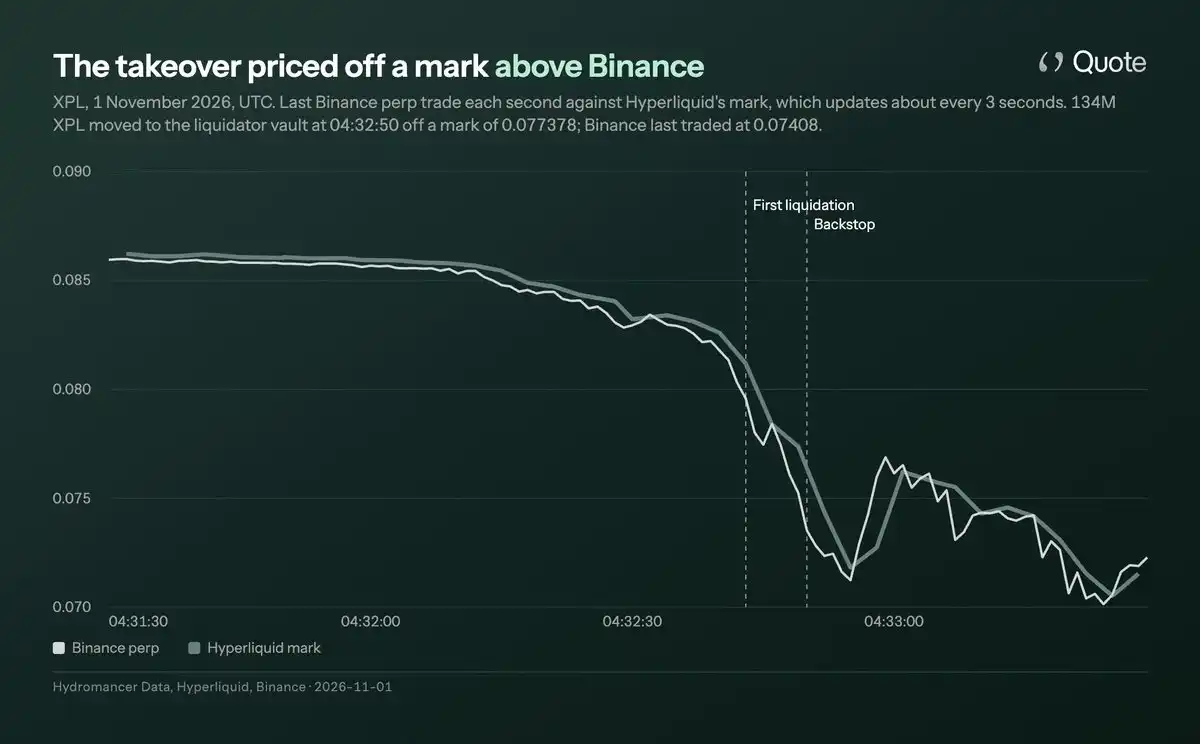
The first liquidation on Hyperliquid occurred at 12:32:43. Before that, prices on both Binance and Hyperliquid had already fallen about 6% from the prior minute, so the report says Hyperliquid liquidations could not have caused the initial drop. Whether forced selling happened on other venues is not observable from public data.
In the first 43 seconds, Binance perpetuals traded 49.2107 million XPL, with 75.9% seller-initiated. Hyperliquid traded 11.4375 million XPL over the same interval.
Binance almost always hit each price level first, usually by less than one second. The report says that lead is so small that clock differences could matter. It measured each venue against its own price because Hyperliquid had been trading 41.5 basis points above Binance before the drop.
Other major tokens barely moved at the same time. At the minute’s low, ETH was down only 0.12%. Among 10 other tokens checked by the author, ENA was the weakest and still fell only 0.54%. The report says it found no XPL news or scheduled token unlock that day, while noting that public search can miss things.
Across the full minute, volume shifted toward Hyperliquid. Its order book traded 167 million XPL, above Binance’s 144 million XPL, and 49% of that Hyperliquid volume came from forced liquidation selling. The report says kenni.hl’s remark that Hyperliquid itself had almost no volume was true only before 12:32:43.
Backstop transfers were excluded from that count because those positions never entered the public order book.
How HLP inherited the loss
Under Hyperliquid’s mechanism, 20% of a large position is first sent to the order book for liquidation. The report says it observed that process in 11 wallets. If account equity falls below two-thirds of maintenance margin, the account is transferred to the liquidator vault, a $1 million sub-component inside HLP.
At 12:32:50, when XPL’s mark price fell to $0.077378, the vault took over 134 million XPL. By 12:32:59, the total had reached 160 million XPL.
The takeover price was below the mark price at the time. The report says the discount equaled the wallet’s remaining equity divided by position size, a rule the author says was derived and reproduced across every wallet with an error of less than $15. The average discount was 108 basis points. At the same time, when those 134 million XPL changed hands, Binance’s last traded price had already fallen to $0.07408, or 4.3% below Hyperliquid’s mark price.
Using Binance prices as the benchmark, the report breaks the loss into three parts, with a stated error of less than $132.
- $282,408 from the difference in takeover pricing, part of which came from Hyperliquid’s pre-existing 41.5 basis point premium in the minute before the crash.
- $260,258 from further declines in XPL on Binance while the vault was unwinding.
- Execution slippage and fees. The vault sold at a pace of about 2 million XPL per minute, with 99.6% of trades crossing the spread. The execution price was a combined $7,771 below Binance prices in the same minute, and the vault also paid $5,218 in fees. The report adds that the vault’s own selling may have pushed prices lower, but that effect cannot be isolated.
As of 18:30 Beijing time, HLP stood at $169.6 million. That means the loss was 0.33% of HLP’s total capital, but 55.6% of the liquidator vault’s own principal.
The report says every execution step it could verify matched Hyperliquid’s public rules, including the 10% withdrawal margin floor and the initial 20% order-book liquidation split. As of 18:30, it had found no public statement from Hyperliquid on the event.
The wallets still lost money on Hyperliquid
The report says the similarities with the March 2025 incident end there.
Excluding one $243,350 transfer from one wallet to another, the cluster sent in $3.21 million, withdrew $2.33 million, and still had $165,775 left on the platform, almost all of it in the still-open position of 0xd6e2…423d.
That leaves the group with an estimated net loss of about $711,000 on Hyperliquid. The withdrawals preserved $2.038 million from liquidation on positions that later lost money, but the group still ended up in the red overall.
The timeline is visible in the data. The first test withdrawal came 47 minutes before the crash. The first large withdrawal came seven minutes before it. The last approved withdrawal request was signed at 12:31:57, just as the decline was beginning.
What that sequence means is another matter. The report says the same pattern could fit hedged positions on other venues, a directional call on price, or an unrelated outside seller hitting the market at the same time. It says it found no evidence supporting any of those explanations, including the existence of short positions.
Why the author measured market depth, and where the analysis stops
The report says its central comparison is straightforward: a 269 million XPL position against resting bid depth only one-twelfth that size.
The author says that focus comes from Quote’s work on execution. Measuring how much impact an order book can absorb is the starting point. Quote scores each market’s liquidity from 0 to 10 in real time, and its trading engine adjusts order size dynamically based on available depth.
The report also lists five limits to the investigation.
- It can read only public data from Hyperliquid and Arbitrum. Binance, Bybit and OKX do not publish account-level information, so the author cannot identify the seller or confirm hedging.
- Only Binance provided tick data for this event. Bybit and OKX had only minute-level candles, which means they could not be placed precisely into the sequence of the drop.
- No transfer record directly linked all four funding trees, and two wallets had no funding-path connection at all. Their inclusion depends on behavioral patterns.
- A public claim says 14 of the wallets were funded through Binance two months earlier, but the author says that has not been confirmed.
- The $165,775 left on the platform will change with XPL’s price because one wallet’s position remains open.
The dataset for the investigation came from Hydromancer, the Hyperliquid explorer, Arbitrum and Binance public data, with the cutoff at 18:32 Beijing time on Nov. 1, 2026.



