

Crypto markets are facing what the source described as their most unfavorable macro setup of the year, and XRP is caught in the middle of it. New Federal Reserve Chair Kevin Warsh is heading into only his second Federal Open Market Committee meeting, with markets largely expecting rates to stay in a 3.50% to 3.75% range. Even so, CME FedWatch showed hike odds near 38% as recently as last weekend, the highest reading of this cycle. A hold with hawkish messaging could still hit risk assets hard.
Bitcoin is sitting near $63,400 to $64,000, well below its June highs around $80,000. Altcoins have absorbed more of the damage, and XRP is one of the tokens under the heaviest pressure after a short-lived burst of optimism earlier this month.
Clarity Act loses momentum in the Senate
XRP, the cryptocurrency developed by the founders of payments company Ripple, briefly benefited from hopes that the Clarity Act might finally move forward. Decrypt reported on July 21 that the token rose 3.25% to $1.1485 after reports said President Donald Trump had agreed to the bill’s long-delayed ethics provision. That news also pushed Senate passage odds on Polymarket up to 43% for a short period. The bounce lasted roughly a week.
On Monday, the Senate formally shelved the Clarity Act and chose to prioritize a Russia sanctions bill and federal nominations instead. With the chamber’s August recess set to begin around August 7, the window for getting the bill approved this year has become narrow. Miss that stretch, and the next realistic opening may not come until 2027.
That matters directly for XRP. The bill would write XRP’s commodity classification into law, which the report described as the legal foundation institutional custodians, banks, and ETF issuers need before building products around the asset. Standard Chartered’s conditional $8 XRP target also depends on that path. According to the report, the bank’s target assumes full Senate passage and $4 billion to $8 billion in new ETF inflows. Without the legislation, that case remains theoretical.
The result is a weaker backdrop not just for the bill itself, but for the institutional thesis that has supported XRP in recent months.
What the chart signals look like now
On Binance, XRP is trading at $1.0641 with a market capitalization of roughly $65 billion. Its 24-hour low was $1.0450 and its high was $1.0679. The token reached nearly $3.40 in mid-2025, then entered a sustained descending channel marked by lower highs and lower lows over several months.
The Average Directional Index, or ADX, is at 11.2, one of XRP’s weakest readings of the summer. ADX tracks trend strength on a 0 to 100 scale, without regard to direction. A reading below 25 usually means there is no confirmed trend, while readings below 20 are often associated with choppy, directionless markets where false breakouts and stop hunts become more common.
Decrypt had already pointed to this setup on July 16, when the reading stood at 13.3. XRP has remained stuck in that same trendless state for most of July. There is one modestly constructive development: the directional indicator is beginning to rotate away from DI-, which reflects bearish control, toward DI+, which points to building bullish pressure.
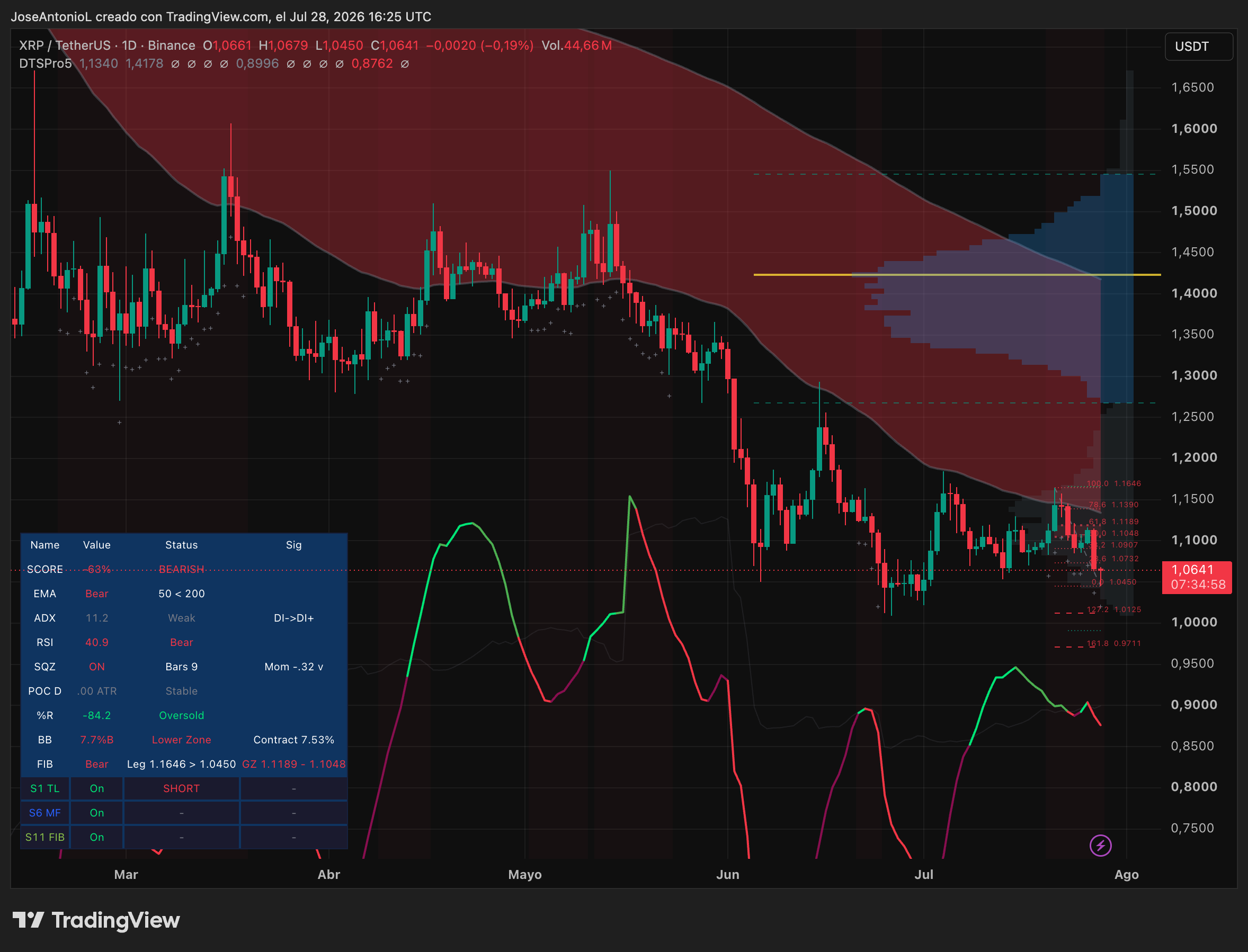
Exponential Moving Averages tell a similar story on the broader trend. The 50-day EMA remains below the 200-day EMA, leaving the so-called death cross intact. When the shorter average stays under the longer one, the medium-term trajectory is still pointing lower, even if short-term rebounds appear. The report says this alignment has been in place since XRP’s retreat from its $3.65 all-time high, and there is still no sign that the two averages are starting to converge.
The Relative Strength Index, or RSI, reads 40.9. On a 0 to 100 scale, RSI readings above 70 are typically treated as overbought and readings below 30 as oversold. At 40.9, XRP remains on the bearish side of the neutral 50 line, but it is not yet at the kind of extreme level that tends to attract aggressive buyers looking for a floor.
On Fibonacci levels, the current bearish leg runs from $1.1646 down to $1.0450. If price breaks below that area, the next Fibonacci support sits at $1.0125, followed by $0.9711.
The next move depends on the Fed and the bill
The report identifies two events that are likely to shape XRP’s next directional move. The first is the Fed decision. If Warsh keeps rates unchanged and strikes a dovish tone, or hints at cuts in September, crypto could get a relief bounce. In that scenario, XRP may test the Fibonacci golden zone between $1.10 and $1.12.
If the statement comes across as hawkish, or if a dissenting vote appears, the sell-off could extend toward $1.01 and then the $0.97 area below that.
The second variable is the fate of the Clarity Act. The Senate’s August recess begins around August 7. If no floor vote happens before then, XRP’s main institutional catalyst would disappear until at least late 2026, and possibly longer because of the midterm election calendar that follows.
The technical picture, as presented in the source, argues for patience rather than urgency. With ADX at 11.2, the Squeeze setup carrying negative momentum, and the death cross still in place, this kind of trendless market can stay compressed longer than many traders expect. Oversold conditions may still produce a short-term bounce, but without a macro catalyst or a legislative surprise, the report says that bounce is more likely to be treated as a selling opportunity than the start of a fresh trend.
The views and opinions cited in the original report are for informational purposes only and do not constitute financial, investment, or other advice.