
The yen has drifted back to the 159 range, giving up ground won during the latest U.S.-Japan intervention. On Aug. 12, the currency briefly fell 0.1% to 159.39 before ending the day little changed. Recent weakness has already erased about half of the gains produced by the joint operation.

According to the original report, citing Wallstreetcn, the U.S. Treasury on July 31 acted through the Federal Reserve Bank of New York and tasked Goldman Sachs and Morgan Stanley with selling euros and buying yen. It was the first direct U.S. participation in yen intervention in nearly 30 years. The move helped lift the yen from around 163 to 155, a rare case of Washington joining Tokyo to buy the Japanese currency. Both sides later signaled that more action could follow if needed.
That support faded quickly. Elevated U.S. Treasury yields, combined with rising international oil prices, restored backing for the dollar and added pressure on Japan as an energy importer. The market is now focused on the Bank of Japan, whose next monetary policy meeting is scheduled for September. Strategists cited in the report say intervention will have only limited impact unless the BOJ pushes harder on policy normalization. The 160 level is now widely treated as a political red line, and another round of intervention could return if the exchange rate moves toward that threshold too quickly.
Yield gap keeps carry trades in control
The central reason the intervention has not held is the persistent interest-rate gap between the United States and Japan.
The 10-year U.S. Treasury yield stands at 4.686%, while the comparable Japanese government bond yield is 2.846%. That leaves a spread of more than 180 basis points, giving investors a strong incentive to borrow low-yielding yen and shift into higher-yielding dollar assets.
Jesper Koll, expert director at Monex Group, said: 「Intervention scared the market, but it cannot stop the laws of finance — capital will always move toward the highest return. As long as Japan’s funding costs stay below overseas returns, carry trades will come back.」
Masahiko Loo, a foreign-exchange strategist at State Street Global, said intervention still had value, but mainly as a way to curb excessive speculation rather than alter the fundamentals behind dollar strength. He said: 「The intervention successfully reset market psychology and showed an unusual degree of policy coordination between the U.S. and Japan, but it has not removed the yield advantage supporting the dollar. A better way to read it is this: intervention worked in slowing speculation, but it has not yet worked in changing the fundamentals.」
160 seen as a political line, intervention acts more like a guardrail
Until those structural pressures ease, the market’s view of intervention is shifting. It may be less about reversing the yen’s decline and more about preventing that decline from turning disorderly.
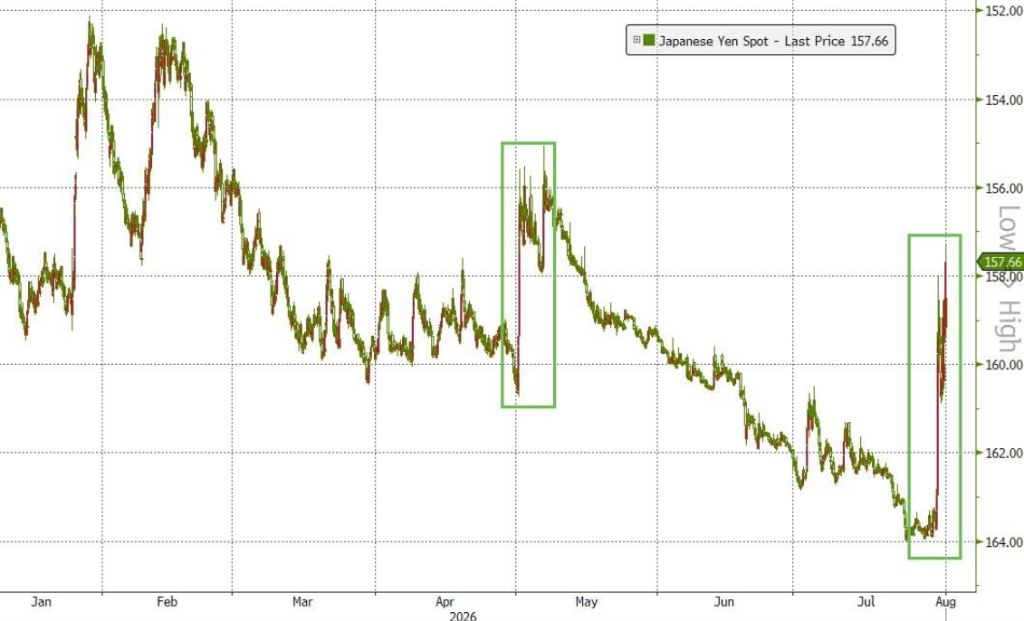
Loo said 160 had become 「a political red line for the authorities.」 If the yen moves back toward that level at speed, the odds of officials stepping in again would rise clearly. He added: 「I would not rule out another intervention, especially if moves become rapid or disorderly. But in the end, intervention can only buy time. The real burden still falls on the Bank of Japan and policy normalization, which could begin as early as September.」
To strengthen the deterrent effect, the U.S. and Japan have also highlighted the Federal Reserve’s foreign and international monetary authorities repo facility. The tool allows Japan to obtain dollar liquidity by pledging U.S. Treasuries as collateral, reducing the need to sell Treasuries to raise funds for intervention. U.S. Treasury Secretary Bessent has signaled support for expanding the mechanism.
Bank of Japan now carries the main burden
With Japanese rates unlikely to rise quickly and no clear short-term decline in U.S. yields, investors still have reason to keep allocating capital overseas.
John Wood, Asia chief investment officer at Lombard Odier, said the latest intervention had 「limited durability」 and that the BOJ might need at least two rate hikes to draw a real line under the yen’s prolonged weakness.
Koll also said the larger shock for investors was not the intervention itself, but the BOJ’s continued reluctance to tighten policy more aggressively. That, he said, has fueled questions over whether concerns around Japan’s banking system or its large public debt burden are constraining policymakers.
Credit Agricole Corporate and Investment Bank took the argument deeper, saying the underlying reason for yen weakness lies in an 「asymmetry in investment capacity」 between the U.S. and Japan. The bank said large-scale U.S. investment in artificial intelligence and other sectors continues to attract global capital, while Japanese Prime Minister Sanae Takaichi’s planned public-private investment program has yet to be fully implemented.
The bank said: 「What is needed to correct yen weakness is not rate hikes, but greater investment. That means any durable rebound in the yen ultimately depends on making Japanese assets more attractive, so domestic savings stay at home rather than continuing to chase returns overseas.」