


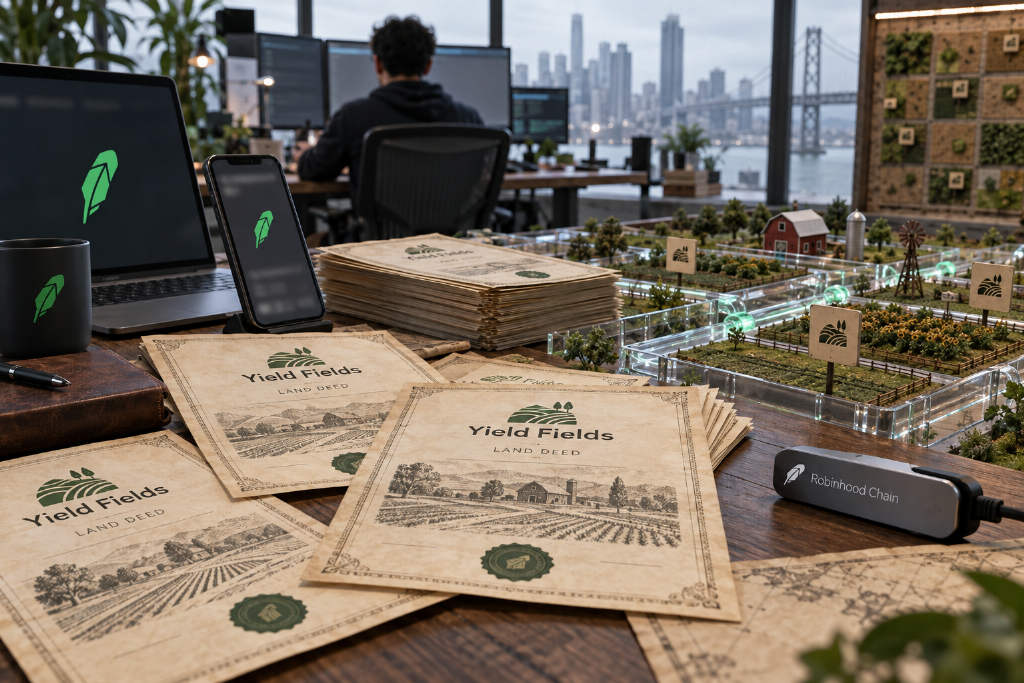
Crypto gaming has gone through a long slump, but an unreleased onchain farming game has managed to break through the lull with a fast NFT sale. On Oct. 13, Yield Fields sold out 3,333 Yield Fields Deeds NFTs on Robinhood Chain about 30 seconds after the public sale opened. Based on the final public sale price, the mint was worth about $8.3 million.
That result stands out in a market where Play-to-Earn has faded over the past few years, game tokens have seen deep drawdowns, and many developers have either shut projects down or shifted to other businesses. Even projects with established intellectual property and mature communities have found it harder to keep operating.
A 30-second sellout put the public sale near $8.3 million
Yield Fields was launched by crypto game developer Skarly, who previously worked on Wolf Game and created Onchain Heroes. The new title is planned for Robinhood Chain and uses a farm-management model built around land, crops, resource production, and player trading.
The Yield Fields Deeds NFTs are, in simple terms, land certificates inside the game. The sale used a Dutch auction that was originally scheduled to last 24 hours. Prices started at 1 ETH and could have fallen as low as 0.069 ETH. Instead, the 3,333 NFTs were snapped up almost immediately once the public sale began, leaving the final price at about 0.999688 ETH.
At that level, the full sale comes to roughly 3,332 ETH, or about $8.3 million at the token price used at the time. PANews noted that the exact settlement price for some whitelist participants was still unclear, so the $8.3 million figure should be treated as an estimate based on the public clearing price.
Demand had been building before the mint
Interest in Yield Fields had shown up earlier. From Sept. 17 to Sept. 28, Skarly ran an event called Deed Season through Maze of Gains, a game tied to the previously developed Onchain Heroes. The event distributed 850 whitelist spots for the new game’s NFT sale.
According to the figures cited by PANews, 7,591 players took part in that campaign and completed 226,904 game challenges in total.
Yield Fields has said regular players will be able to plant and harvest without holding Deeds. Land NFT holders, however, will be able to build extra facilities and produce special resources. One example given by the project is that land holders can use Fert Decks to produce fertilizer and supply those inputs to ordinary farm players who need them.
The team also designed a value accrual system linked to ETH. When regular players trade some in-game output, part of the funds is meant to accumulate as underlying ETH backing for the Deeds. Holders would later be able to burn the NFT and redeem the corresponding value. Under that structure, the land NFT is positioned not only as a collectible, but also as an asset tied to resource supply inside the game and to the value generated by economic activity.
Secondary trading picked up after the sale
Speculative interest moved quickly into the secondary market. OpenSea data cited by PANews showed that, as of Oct. 20, Yield Field Deeds had generated about $2.1 million in cumulative trading volume, with the 3,333 NFTs held by around 1,300 unique wallets.
The collection’s floor price, which had moved from 0.905 ETH to 0.94 ETH in the early period after issuance, later recovered to about 1.142 ETH, or roughly $2,750 by the article’s calculation. That put the floor about 14.2% above the public sale clearing price.
Yield Fields has not officially launched yet, which means current trading is still centered on expectations for future returns and asset prices. In crypto gaming, that kind of speculation is often tied closely to the chain ecosystem where a project is issued. Yield Fields happened to launch its NFT sale on Robinhood Chain just as attention around that network was rising.
From Abstract to Robinhood Chain
For Skarly, this is not the first time he has built around a hot ecosystem. In early 2025, Onchain Heroes was one of the better-known games in the Abstract ecosystem. Now he has brought a new game to Robinhood Chain, while Abstract is preparing to shut down.
Abstract is an Ethereum Layer 2 launched by Igloo, the parent company of Pudgy Penguins. It focused on consumer-facing onchain applications and was once seen as a major contender in consumer crypto because of its well-known IP, simplified wallet experience, and points-based incentive system.
PANews said the network attracted a meaningful number of developers. Its ecosystem had more than 144 applications, over 400,000 users, and partnerships with brands including Disney and the Red Bull racing team. Onchain Heroes entered Abstract during that period and gained market attention with help from the chain’s momentum.
That scale did not turn into enough commercial revenue. On Oct. 6, Igloo, the protocol developer behind Abstract, said the chain would shut down on Dec. 15. CEO Luca Netz said the company had poured substantial capital into Abstract over the past 18 months and had accumulated losses in the tens of millions of dollars. With user growth stalling, onchain liquidity remaining limited, and DeFi development constrained, continuing to operate an independent chain no longer made economic sense.
Abstract’s exit has forced game projects in its ecosystem to rethink where to go next. Pixel-art role-playing game Gigaverse has already ended operations for its old version and plans to deploy its new title, Gigaverse Online, on Robinhood Chain, while some of its existing NFT assets are set to move to Ethereum mainnet. Other projects have chosen ecosystems such as Base. The common issue is the same: teams have to reassess users, liquidity, and operating costs on each chain.
Using old communities and new chains to launch faster
Robinhood Chain was launched by brokerage firm Robinhood and brought its mainnet online in July 2026. The network is focused on tokenized financial assets, DeFi, and onchain trading. Compared with chains built around gaming, Robinhood’s financial business and user channels create a different setup for applications built around asset trading, return expectations, and financialized gameplay.
Yield Fields emerged in that setting. It was not migrated directly from Abstract. Instead, it was developed as a new project by Skarly, who had already built a user base on Abstract, and then issued its NFTs on Robinhood Chain.
PANews argued that the more important point is not simply that the NFT sale was large. The case shows how a team can use users accumulated through an older game, attention around a popular chain, and an NFT issuance mechanism to get a new project off the ground in a relatively short period.
Skarly’s track record fits that pattern. In early 2025, Onchain Heroes gained traction quickly after launching on Abstract. Its Genesis Heroes NFT was issued at 0.069 ETH, and the floor price once climbed to about 0.64 ETH. As market enthusiasm faded, that floor has since fallen back to around 0.07 ETH, down nearly 90% from its peak.
Still, the value of Onchain Heroes did not stop with the old game assets. The team kept Maze of Gains running this year and used it to direct traffic toward Yield Fields. The older game maintained the community and organized player participation. The new game raised startup capital through an NFT sale. A hot chain then supplied a fresh market environment. Together, that created a relatively lightweight launch path.
PANews said this is one practical advantage for smaller crypto game developers. Compared with traditional game companies that need long development cycles and ongoing investment to maintain large game worlds, smaller teams have lower sunk costs and can adjust product direction and deployment networks more quickly.
When an existing ecosystem loses growth momentum, those teams can move to another chain, reorganize their communities, and generate revenue through NFT issuance or other onchain activities. In that sense, a blockchain is not only technical infrastructure for running a game. It also provides user access, trading venues, liquidity, and community culture.
Choosing an ecosystem that sits at the center of market attention may reach paying crypto users faster than simply adding more game features. But that also means a project’s success can depend heavily on the heat of the external ecosystem. In that cycle, short-term speculation keeps repeating as teams search for the next hot chain.