
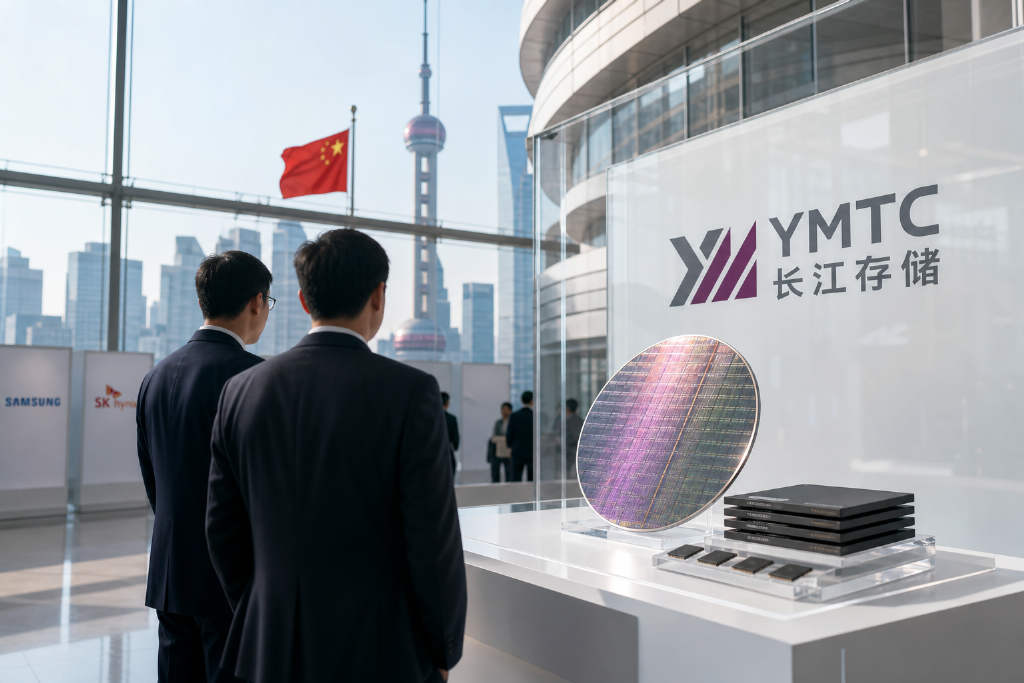
Yangtze Memory Technologies Co. (YMTC) has filed for an initial public offering on the Shanghai Stock Exchange, seeking to raise RMB 33 billion, or roughly $5 billion. The Financial Times, citing two people familiar with the matter, reported that the company told investors at a recent IPO preparation meeting that it wants to become the global leader in the NAND Flash market by the end of 2027, ahead of Samsung Electronics and SK Hynix.
RMB 33 billion fundraising plan puts the deal among China’s biggest IPOs this year
According to YMTC’s prospectus filed with the Shanghai Stock Exchange, the company plans to raise RMB 33 billion. That would make it the second-largest IPO in China this year, behind fellow memory-chip maker ChangXin Memory Technologies, or CXMT.
YMTC has not disclosed a listing timetable. Market expectations cited in the report suggest its market capitalization could top RMB 1 trillion, equivalent to about $150 billion, once it goes public. That figure, however, remains disputed. A banker involved in the IPO preparation said the stock could be priced more conservatively under guidance from regulators, while broader market estimates place the company in a RMB 200 billion to RMB 300 billion valuation range. The final number will not be clear until listing.
First-quarter profit reached RMB 33 billion
YMTC’s filing points to strong momentum in its financial results. The company reported first-quarter revenue of RMB 47 billion and net profit of RMB 33 billion. According to the filing, that quarterly profit was already double its net profit for the whole of 2025.
The company said it plans to use the profit for capacity upgrades and research and development. The report said that move is also being seen as part of China’s push to build a more self-sufficient semiconductor ecosystem and reduce dependence on foreign supply chains, at a time when Western countries continue to impose export and trade controls on China’s technology sector.
IPO push follows CXMT’s listing
YMTC’s accelerated IPO plan comes shortly after CXMT, another major Chinese memory-chip producer focused on DRAM, completed its own listing. CXMT raised $9 billion last month in what the report described as Asia’s largest IPO this year. Since listing, its share price has climbed more than 400% from the offer price. The company now carries a market value of RMB 580 billion and has become China’s most valuable listed company.
The report said the progress made by CXMT and YMTC shows how China’s memory industry is being repriced by capital markets. Unlike logic chips, which have been a primary target of U.S. sanctions, memory-chip manufacturing is seen as less dependent on the most advanced lithography tools. Chinese companies have largely been narrowing the gap with international rivals through stacked-architecture optimization and process improvements, which is one reason investors believe they can catch up in a relatively short period.
TrendForce puts YMTC third worldwide in NAND capacity
Market research firm TrendForce estimated that YMTC ranked third globally in NAND production capacity in the first quarter, behind only Samsung and SK Hynix, while remaining the leading producer in China.
At the same time, concerns are emerging as YMTC and CXMT both move ahead with aggressive expansion plans. Several investors worry that faster capacity growth from the two Chinese companies could push memory-chip prices lower and bring an end to the rally in the memory market that has been fueled by the AI boom.
Joanna Yang, a portfolio manager at Ninety One, said: 「For global investors, one question is how capacity expansion by these Chinese companies will affect the supply-demand dynamics for memory chips. This is a global product with global pricing.」
Cameron Chui, head of Asia-Pacific equity strategy at JPMorgan Private Bank, said: 「Is China adding capacity? Absolutely.」 He added that he remains positive on the sector because demand for memory chips used in AI model training is rising quickly: 「Supply is increasing, but we think demand is growing faster, not enough to rebalance the market.」