
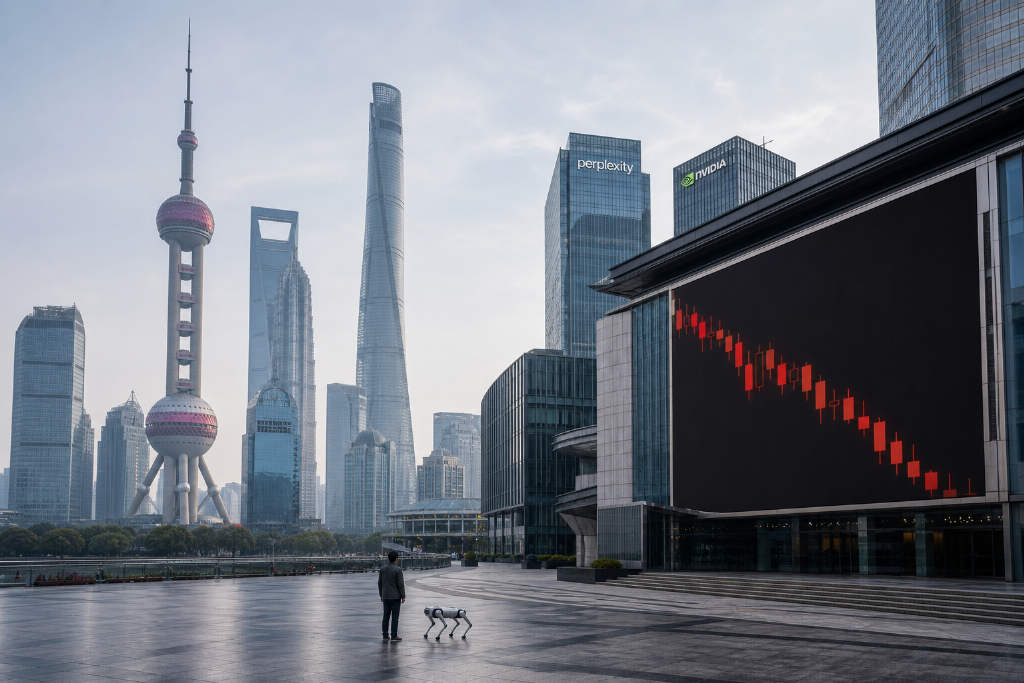
WuBlockchain’s WhiteLine Daily said capital markets are drawing a sharper line across AI names: companies tied to visible revenue growth, compute demand and data-center power demand are still finding funding support, while public markets are re-rating high valuations that lack profit backing.
Yushu gives back part of its post-IPO surge
On Aug. 25, Reuters reported that Yushu Technology has seen sharp price swings since listing on Shanghai’s STAR Market on Aug. 19. The company rose about 460% on its debut session, briefly lifting its valuation to roughly $66 billion.
That move did not hold. Yushu then fell for three consecutive trading days, and by the time Reuters published its report, the stock had pulled back about 45% from its first-day post-listing level. Its market value was down by about $30 billion from the peak.
WhiteLine Daily also cited Yushu’s first-quarter financials. Revenue came in at about 423 million yuan, up 68% year over year, while adjusted net profit fell 53% to about 40 million yuan. The digest said the 45% retreat after the first-day rally shows that once the initial rush faded, investors began valuing robotics companies again on orders, profits and commercial execution.
Perplexity said to be seeking funding above a $30 billion valuation
Perplexity is reportedly working on a new equity financing round that could value the company at more than $30 billion after the raise. Nvidia is discussing whether to participate.
At that level, the valuation would be more than 50% above Perplexity’s roughly $20 billion valuation in 2025. Its annualized revenue has climbed from less than $250 million at the start of this year to more than $750 million, with some of the increase driven by AI agent products including Perplexity Computer.
Perplexity declined to comment on the fundraising round. WhiteLine Daily said the next questions are whether revenue can keep growing at a high rate, whether Nvidia’s investment is finalized, and whether that growth can turn into stable cash flow.
Aggreko files for a U.S. IPO
Aggreko, a global provider of temporary power and energy solutions, has filed IPO registration documents with the U.S. Securities and Exchange Commission. The company plans to list on the New York Stock Exchange under the ticker AGKO.
It has not disclosed the size of the offering or a price range. For the first half of 2026, Aggreko reported revenue of $1.92 billion, up 28% year over year, and profit from continuing operations of about $80 million. In the same period a year earlier, it posted a loss of about $196 million.
For the fiscal year ended Jan. 3, revenue tied to data centers nearly doubled to $391 million. WhiteLine Daily said that points to AI capital spending spreading beyond chips and into power infrastructure. If AGKO completes the listing, it could also provide a fresh public-market valuation benchmark for data-center power service providers.
Suirui Technology launches a nearly $900 million IPO
AI chipmaker Suirui Technology has formally launched its STAR Market offering. The company plans to issue about 43.04 million shares, equal to 10% of its enlarged share capital, and aims to raise 6 billion yuan, or about $890 million.
The timetable in the filing sets preliminary price inquiry for Aug. 28 and subscription for Sept. 2. Proceeds will be used for research, development and industrialization of fifth- and sixth-generation AI chips, as well as an advanced AI software-hardware collaborative innovation project.
Tencent Technology directly holds 19.9493% of Suirui, making it the company’s largest shareholder. WhiteLine Daily said Suirui is still unprofitable, yet is seeking 6 billion yuan to keep investing in next-generation AI chips, with competition among domestic AI chip companies shifting from fundraising capacity toward product iteration, volume delivery and customer expansion.
Main takeaway from the digest
WhiteLine Daily concluded that capital is still providing an opening for AI companies with visible revenue growth, compute demand and data-center electricity demand, but public investors are already reassessing rich valuations that do not have profit support underneath them.
The next checkpoints, according to the digest, are agent revenue, chip shipments and data-center power demand. If those do not continue to come through, pullbacks like Yushu’s could become a pricing reference for more newly listed AI companies.