

Chinese AI lab Z.ai on Thursday released GLM-5.3, a coding-focused large model that the company is pitching as the strongest open-weight coding model on the market.

The model is available now through the GLM Coding Plan subscription and ZCode. API access and downloadable weights are not live yet; Z.ai said both will be released in stages after a safety review.
In its launch post, the company wrote: 「Scaling post-training is all we did for GLM-5.3. With GLM-5.2 we built the stack... Over the past month we kept scaling on this stack: more environments, more diverse tasks, and more compute spent training on them.」
A larger model built around token efficiency
Z.ai’s framing was not about chasing raw dominance alone. The team put more emphasis on token efficiency, according to the report, with GLM-5.3 using far fewer tokens per task than its predecessor while expanding model scale to 743 billion parameters.
The article explains parameters as the internal dials a model uses while processing information, while tokens are the basic units of information a model can consume or generate.
On Z.ai Code Bench, the company’s in-house benchmark, GLM-5.3 scored 34.5% at Max effort while using roughly 75,000 output tokens per task. GLM-5.2 scored 23.4% and used 96,000 output tokens under the same setting.
Against closed models, Z.ai said in the blog post that GLM-5.3 beats Claude Opus 4.8 on token economy but 「remains behind Claude Fable 5, which reaches 39.5% at Max effort.」
Coding results improved, though top closed U.S. models still lead key boards
On coding performance, the report describes GLM-5.3 as a strong performer and says it beats fellow Chinese model Kimi K3 on the most relevant benchmarks.
On Terminal Bench 3.0, which tests autonomous shell and tool use in real Linux environments, GLM-5.3 scored 28.3. That trailed the closed models Fable 5 at 33.7 and GPT-5.6 Sol at 34.6.
On DeepSWE v1.1, a benchmark for resolving real GitHub issues end to end, open rival Kimi K3 scored 67.5 and Fable 5 reached 69.7, both ahead of GLM-5.3’s 66.9.
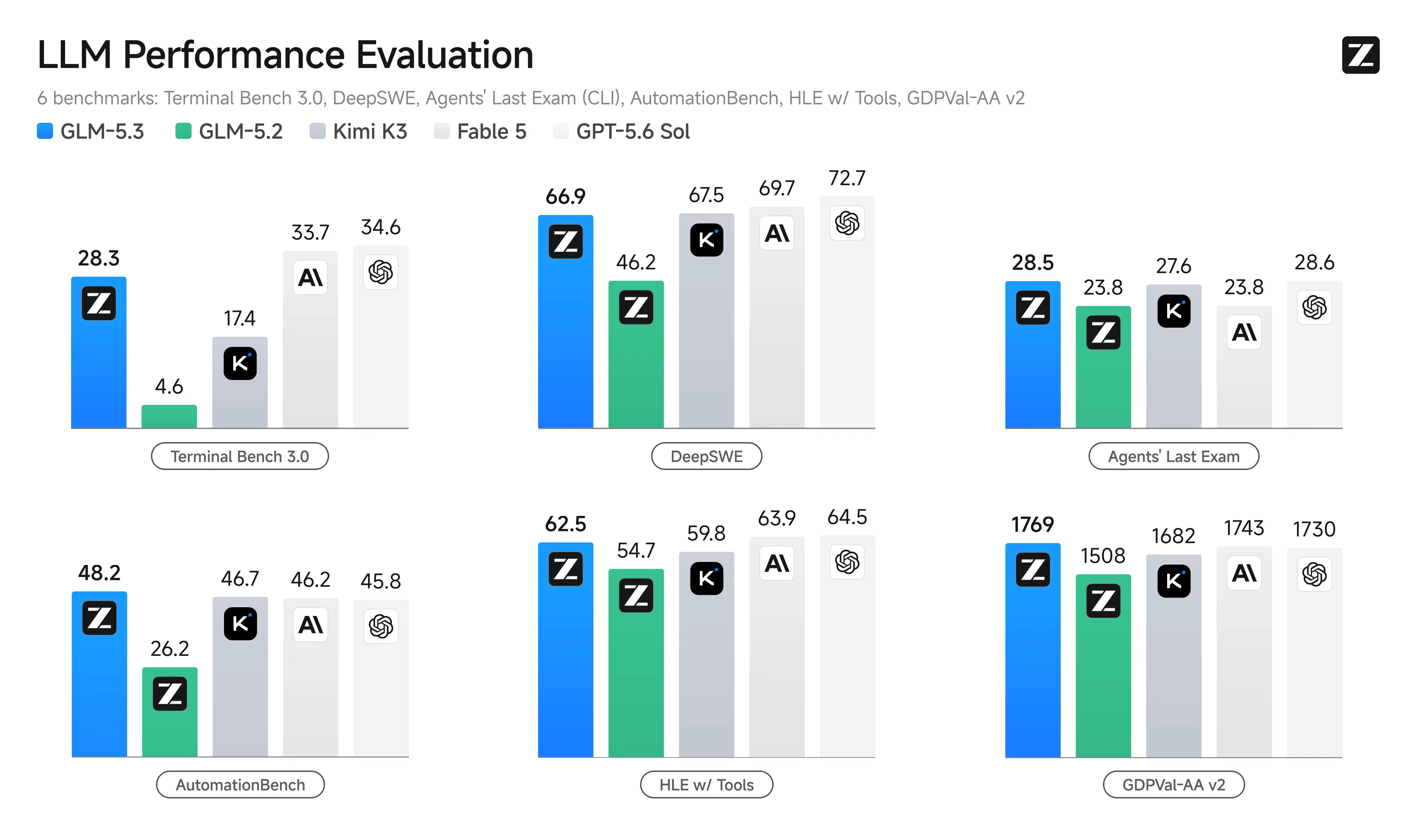
The piece sums up the broader pattern this way: GLM-5.3 clears its own predecessor and some open competitors, but closed U.S. models still hold the lead on the most visible coding leaderboards.
Cybersecurity benchmarks show a sharper jump
Cybersecurity was another area where gains stood out. The report says GLM-5.3 leads CyberGym at 84.5% and more than doubles GLM-5.2 on exploitation benchmarks.
Z.ai said the model flagged 2,436 vulnerabilities across 269 open-source projects, with 1,097 classified as medium to high severity.
In a post on X, Z.ai wrote: 「GLM-5.3 takes agentic coding to the next level, delivering a dramatic improvement over GLM-5.2 while achieving better results with fewer output tokens. GLM-5.3 is available now through GLM Coding Plan and ZCode. API access and open weights will be released in stages following rigorous safety evaluations.」
Pricing and future public weights remain part of the appeal
On pricing, the report says the open-weight angle and lower costs are central to Z.ai’s pitch against U.S. frontier models. GLM Coding Plan runs on a points quota system, and off-peak calls cost half. Zhipu’s API pricing is described as roughly one-tenth of U.S. frontier per-token rates.
As a reference point, GLM-5.2’s official rate was $1.40 per million input tokens and $4.40 per million output tokens. That compares with $1.75 and $14 for GPT-5.3-Codex, while Claude Opus 4.8 sits near the top of Anthropic’s pricing tiers.
Weights are not downloadable yet
Z.ai is a Beijing-based lab that is on the U.S. Entity List, meaning American firms cannot export controlled technology to it. Even so, the report says GLM remains an extremely popular model, and Chinese open-weight models have already surpassed American ones in OpenRouter token usage.
Per the launch post, GLM-5.3’s weights are set for public release in about two weeks. In other words, the open-weight label refers to what is coming, not to something users can download today.