
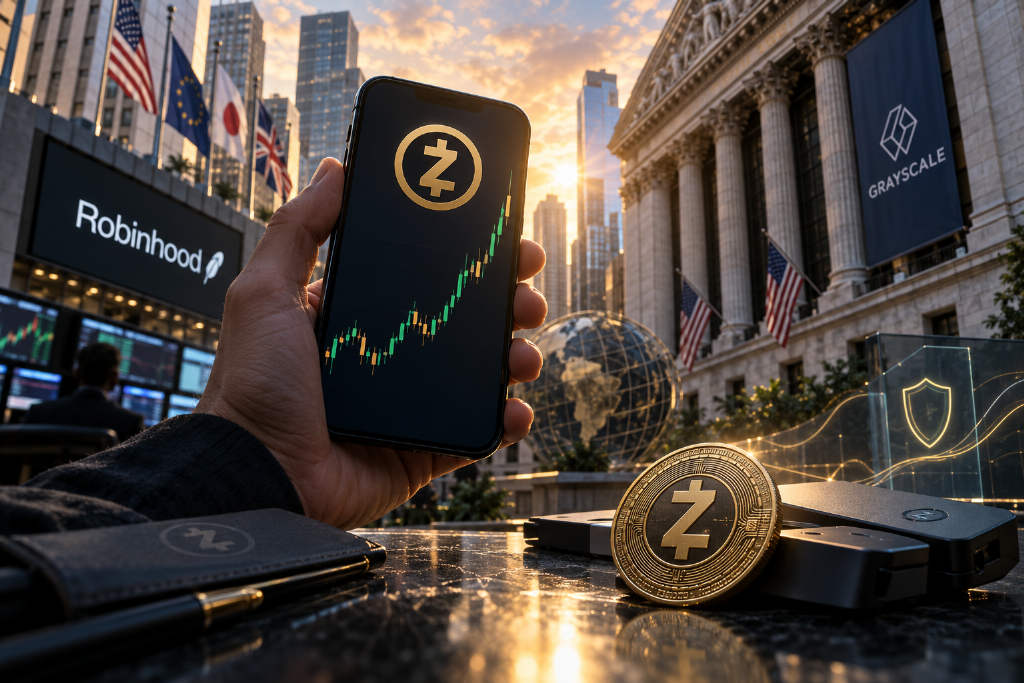
ZEC’s return to elevated levels on Sept. 21 put two distant points on the chart back in view. On a phone screen, the only two stretches above $1,500 sit just a few centimeters apart. In market time, they are separated by nearly a decade.
Zcash, one of crypto’s oldest privacy-focused networks, opened trading with extreme price dislocations. On Bitfinex, it briefly reached 25 BTC per ZEC. On Poloniex, it printed an outlandish 3299.99 BTC per ZEC, a nominal value worth more than $2 million at a time when Bitcoin traded around $700. The frenzy did not last. From the sixth day after launch, Nov. 2, 2016, until before Sept. 14 this year, ZEC did not trade above $1,500 again.
A year before that return, the token was hovering near $40. Earlier still, in July 2024, it had fallen to a record low below $16. The article places that move against a wider crypto backdrop: Bitcoin rose more than 100-fold over the decade, projects such as EOS and Terra came and went, and Zcash spent years looking like one of those technically respected but market-abandoned assets left sitting in exchange listings with little attention.
From DigiCash to Zcash
The story begins in the 1990s, when Zcash co-founder Zooko Wilcox-O'Hearn worked at DigiCash, the company founded by David Chaum. In 1983, Chaum published the paper Blind Signatures for Untraceable Payments, introducing the blind signature concept that would allow a bank to confirm payment without learning what a user bought. Six years later, he launched DigiCash, rolled out eCash, and worked with traditional banks on privacy-preserving payments.
On May 27, 1994, DigiCash processed what the article describes as the first real electronic cash transaction. Mark Twain Bank, Deutsche Bank, and Credit Suisse later adopted the technology in experiments around small anonymous payments. At its peak, the experiment involved thousands of users and hundreds of merchants.
DigiCash was too early for its market and went bankrupt in 1998. Zooko was there when it happened. He later worked on MojoNation, a decentralized network where strangers rented out hard drive space and bandwidth, with a token called Mojo circulating inside the system. That project also failed, but the direction did not change: Zooko kept chasing a form of digital cash that no one could casually inspect.
When Bitcoin launched in 2009, he was among its early supporters. But he also saw what he considered a fatal limitation. Bitcoin’s ledger is fully public, which means anyone can inspect wallet balances and transaction counterparties. The article also revisits the idea later known as the “Zooko Triangle,” his argument that a naming or identity system in a network protocol cannot be memorable, decentralized, and secure all at once.
The Zerocash paper and the six-person ceremony
In 2013, cryptographers at Johns Hopkins University proposed the Zerocoin protocol. A year later, that work evolved into the Zerocash paper. Its core contribution was the use of zk-SNARKs, a construction that would later become a standard reference point across Web3. The practical promise was clear: everyone could verify that a transaction was valid, while no one could see the transaction’s contents.
The article notes that zero-knowledge proofs did not originate with Zerocash, but says Zerocash was the first practical design to combine decentralization with end-to-end encrypted privacy in a deployable system. Zooko later said in multiple interviews that reading the paper left him “extremely excited.” In 2015, he joined the paper’s authors to form Zerocoin Electric Coin Company, later renamed Electric Coin Company, or ECC, the operating company behind Zcash.
Funding came early. Silicon Valley investor Naval Ravikant wrote a $715,000 check near the company’s founding. In later rounds, 17 investors contributed about $3 million in total, including Digital Currency Group’s Barry Silbert and Pantera.
Before mainnet launch, the team staged one of the most elaborate setup procedures in crypto history. zk-SNARKs required a set of public parameters, and generating them created what the article calls “toxic waste.” Anyone who obtained that material could potentially forge zero-knowledge proofs, mint ZEC out of thin air, or double-spend. The article compares it to an initial password for the network.
Six people took part in the ceremony in October 2016, spread across three continents. Three were public: Zooko, Zcash technical adviser Andrew Miller, and Coin Center research director Peter Van Valkenburgh. Three others were anonymous, a choice meant to reduce the risk of targeted attacks.
One participant using the name Moses Spears was later revealed to be NCC Group security engineer Derek Hinch. NCC Group had been quietly hired both to carry out the ceremony honestly and to try to attack it from the inside as a security test. Another participant, using the name Fabrice Renault, was later revealed as Bitcoin Core developer Peter Todd. According to the article, Zooko invited Todd precisely because he was skeptical of the process and believed a critic’s participation would strengthen credibility. The final anonymous participant, John Dobbertin, remained unidentified until 2022.
Each participant used an air-gapped machine to generate a fragment of the parameters, then destroyed both the randomness and the hardware. Some shielded equipment against electromagnetic leakage. Others burned computers outright. If even one of the six participants acted honestly and at least one fragment was destroyed, the ZK system would remain secure.
Launch, thin supply, and founder reward controversy
Zcash mainnet went live on Oct. 28, 2016. Its monetary design closely mirrored Bitcoin: a 21 million coin cap and halvings roughly every four years. Because Zcash targeted a 2.5-minute block time, the block reward was also set at 12.5 ZEC. To reduce early risk, though, the network used a slow-start mechanism that linearly ramped rewards up to 12.5 ZEC over the first 20,000 blocks.
That slow start left very little ZEC in circulation, and prices exploded. As supply increased, the token was cut in half and then cut again within days. By early 2017, it had fallen below $50.
The article says the team also embedded another controversial feature into the economics. During the first four years, 20% of each block reward went directly to founders, employees, advisers, and early shareholders. Over four years, that amounted to 2.1 million ZEC, or 10% of total supply.
When ZEC later climbed back into four-digit territory, F2Pool co-founder Wang Chun posted old chat logs on X showing Zcash members confusing EST and EDT six years earlier. He then criticized the decision to route part of block rewards directly to the early team, adding that even with the price rise, Zcash was nowhere near as hot as Hyperliquid at the same time. The article describes the project’s early tone as unreliable and chaotic.
Snowden’s endorsement and a brief peak
In September 2017, Edward Snowden wrote that Zcash’s privacy technology made it the most interesting Bitcoin alternative. By then, Snowden had already received asylum in Russia. Four years had passed since his 2013 disclosures about mass government surveillance in the United States, but his influence still carried weight in a crypto market that was young and highly narrative-driven.
The article argues that his endorsement gave Zcash a major credibility boost. At the January 2018 bull-market peak, ZEC traded around $800.
At first, many assumed Snowden’s interest came from the use of zero-knowledge proofs in cryptocurrency and their alignment with his views on privacy rights. In 2022, that story changed. A video published by the YouTube account Zcash Media showed Snowden on camera confirming that he had been “John Dobbertin,” the anonymous participant in the launch ceremony.
According to Fortune and Zooko’s own recollection, Zooko became interested in Snowden after hearing a privacy-related talk at Bard College. Through Marcia Hofmann, a senior lawyer at the Electronic Frontier Foundation, he made contact. In the fall of 2016, the two held a heavily encrypted, physically isolated video call. Zooko gave Snowden the alias John Dobbertin, a reference to German cryptographer Hans Dobbertin.
Snowden agreed to participate on one condition: no payment and no equity, only public interest.
Too early to be used
The article says Zcash’s problem was not only market structure or regulation. It was also usability. Early zk-SNARKs took nearly a minute on a high-memory computer to generate a shielded transaction. Most users chose the easier route and sent funds through transparent addresses instead. The result was awkward: one of the most private currencies in crypto had a privacy feature that few people actually used.
At the same time, the underlying technology spread across the industry. Vitalik Buterin repeatedly praised zk-SNARKs. In 2017, Ethereum verified a zk-SNARK proof for the first time through the Metropolis upgrade. From there, zero-knowledge systems moved into the broader market and later became central to the ZK Rollup narrative. In the article’s framing, the project that lit the fire was left standing in the cold.
Eight years of pressure on three fronts
The long decline that followed is described as a three-layer squeeze.
Regulation and delistings
In 2018, after the major Coincheck theft, Japan’s Financial Services Agency pressured exchanges, and Coincheck delisted XMR, Zcash, and DASH. OKEx Korea followed in 2019. ShapeShift did the same in November 2020, and Bittrex followed in January 2021.
The logic was straightforward. Exchanges did not want compliance trouble, and privacy coins became a liability. In February 2024, Binance delisted XMR, putting the whole sector under pressure. ZEC, however, retained a narrow compliance path because it kept transparent addresses and viewing keys. What once looked like a compromise later looked like a lifeline.
In August 2023, the U.S. Securities and Exchange Commission issued a subpoena to the Zcash Foundation. At the time, then-SEC Chair Gary Gensler was pressing many crypto projects to show why they should not be treated as securities, and Zcash was not spared.
Weak price action
After peaking near $800 in 2018, ZEC fell to around $30 in 2019. During the broad 2021 bull market, Bitcoin hit new highs, Ethereum hit new highs, and Dogecoin surged, but ZEC only rebounded to a little above $300. It did not even recover half of its previous peak.
In July 2024, ZEC hit a record low of $15.91 and dropped out of the top 50 by market capitalization. The article says the project was declared dead repeatedly that year. Conference audiences shrank, rankings on market apps kept sliding, and long-time holders joked that they were archaeologists waiting for an artifact to appreciate.
Internal governance strain
The expiration of the founder reward triggered a prolonged governance fight over how development funding should be allocated and to whom. ECC cut staff and tightened spending under financial pressure. In December 2023, Zooko stepped down as CEO and handed the role to Josh Swihart, closing what the article calls Zcash’s first era.
Development kept moving
Even with the token under pressure, engineering work continued. On Oct. 29, 2018, the Sapling upgrade went live and reduced shielded transaction generation time from nearly a minute to a matter of seconds, making mobile wallets practical for the first time.
On May 31, 2022, the NU5 upgrade introduced Halo 2 recursive proofs, replacing the trusted setup model. Zcash no longer needed a ceremony built around destroying computers. Unified addresses also folded three pools of funds into a single address format.
Then came the Zebra node and the Zashi mobile wallet, launched in early 2024. The article says Zashi made privacy the default and reduced the user flow to a few taps. At one point, shielded transactions accounted for nearly 60% of activity.
On-chain figures shifted as well. The amount of ZEC in the shielded pool rose from 5% of supply a few years earlier to more than 4.5 million ZEC in the fourth quarter of 2025, about 28% of total supply. After the second halving on Nov. 23, 2024, the block reward fell to 1.5625 ZEC, leaving daily new issuance at roughly 1,800 coins.
The article’s summary of that phase is blunt: it took eight years to turn a concept race car into something that could actually drive on the highway.
The reversal after late 2025
The turning point, according to the article, came on Oct. 1, 2025. Naval Ravikant, one of the 17 early investors, posted on X: “Bitcoin is insurance against fiat. Zcash is insurance against Bitcoin.”
He followed with another line, saying Bitcoin’s public ledger meant even Satoshi Nakamoto could not comfortably use Bitcoin. The market reacted fast. ZEC rose from $54 to above $156 within a week, then touched $700 a month later.
At first, many saw it as another short-lived move driven by a prominent voice. The article says the next phase proved larger than that. Arthur Hayes’ family office, Maelstrom, began building a position in the third quarter of 2025 and made ZEC its second-largest holding after Bitcoin. Hayes publicly said he wanted to sell Bitcoin to make room for privacy exposure and floated price targets of $1,000 and even $10,000.
Regulatory pressure also eased. The SEC investigation that began in August 2023 ended in January 2026 with no action taken. That same month brought another shock: the entire ECC team split from the parent board, left, and formed ZODL. Within three months, the new entity raised more than $25 million from Paradigm, Andreessen Horowitz, and Coinbase Ventures.
For many projects, that kind of internal rupture would read like an obituary. The article argues that for a rising ZEC market, cutting losses and starting over did not necessarily work as a negative.
Access points widened too. Robinhood listed ZEC in April this year, opening a route for U.S. retail investors. On May 6, ZEC jumped nearly 30% in a single day and liquidated more than $46.7 million in short positions.
Grayscale had launched a Zcash trust back in 2017. On Aug. 25, 2026, that trust converted into a spot ETF and began trading on NYSE Arca under the ticker ZCSH. The article presents that as the first time a privacy coin entered U.S. stock brokerage accounts through this structure.
Cypherpunk Technologies also turned ZEC into a treasury asset. The company had previously been cancer drug developer Leap Therapeutics before changing its name in November 2025 and going all-in on the privacy theme. Backed by capital from the Winklevoss twins, it kept buying. By August 2026, its holdings had exceeded 323,000 ZEC, equal to 1.92% of circulating supply.
How the market prices privacy
The article closes on a single question: what is a correct idea worth when it arrives at the wrong time? At one point, the answer for Zcash was $15.91. What is it worth when timing improves?
Ten years ago, the market broadly understood that privacy mattered, but Web3 was still early and ZK systems were too heavy to be practical. Today, zero-knowledge technology is being used in a wider set of applications. The article points to ZKsync, which at one stage became an early choice for tokenized RWA, and to Brevis, whose ZK Data Coprocessor and Pico ZKVM can compute gas costs and rebate amounts off-chain, then generate proofs for on-chain verification in Uniswap V4 Hook-based incentive and rebate systems.
Zcash itself remains a privacy-transfer currency rather than a platform for those more advanced applications. Even so, the article argues that privacy under a Web3 framework has become a real demand, whether the use case is fully above board or not.
Bitcoin also spent a long stretch of its early life serving as a medium for gray-market transactions, and in the article’s view that has not entirely disappeared. Zcash took 10 years to reach a comparable stage. The piece frames that as a delayed realization of a cypherpunk ambition that dates back to the 1980s: freedom for the strong, privacy for the weak.
After decades of technical evolution and years of doubt, internal conflict, and regulatory pressure, privacy is no longer presented here as a brief late-cycle theme. In this telling, it has become a long-duration thesis that the market is trying to price again.