


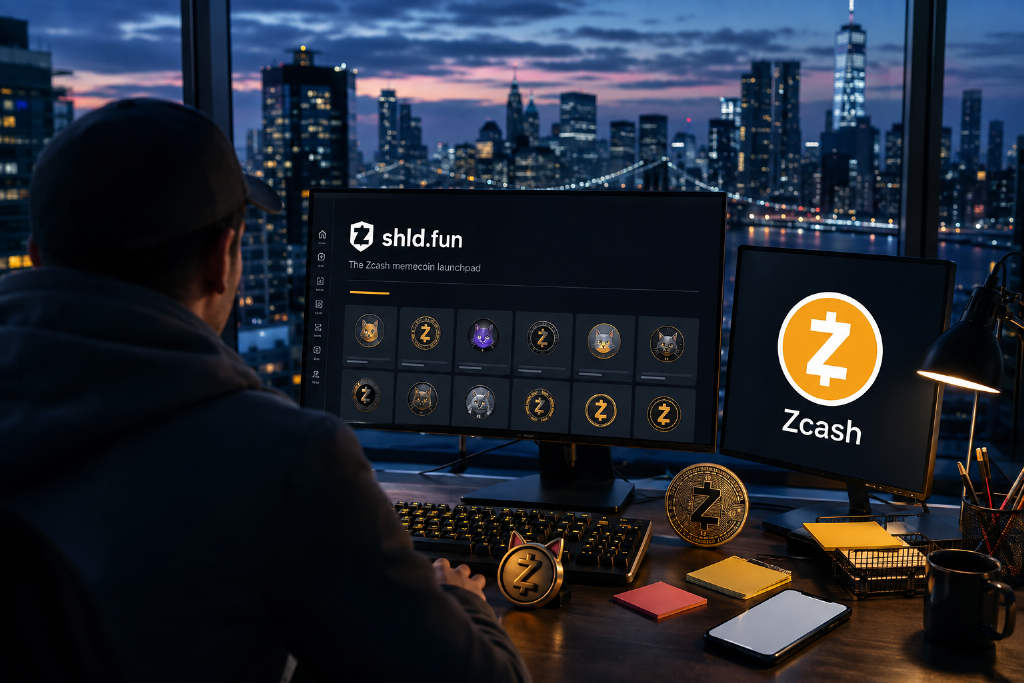
A meme-token launchpad has appeared in the Zcash ecosystem. The source article says shld.fun went live and, within roughly 43 hours, listed 270 token markets. Its strongest gainer, ZECAT, rose 4,844% at peak, equal to 49.4x. Even so, the combined circulating market cap of all tokens on the platform was only 2,502 ZEC, or about $2.55 million. The same article puts ZEC’s own market capitalization at $17.2 billion.
That matters because some traders on crypto social media had linked ZEC’s 16.85% gain the previous day to meme-token activity on shld.fun. Based on the numbers cited in the report, that comparison does not line up.
270 token markets in about 43 hours
The first token launch on shld.fun was ZECAT. Its issuance transaction was recorded at 02:32 UTC on Sept. 3, the article says. By the time of the report, the platform had been running for about 43 hours and showed 270 markets and 5,275 positions. Of those, 16 had already "graduated" into automated market-making pools.
ZECAT led the gains table at 49.4x since launch. It was followed by ZODL at 31x, KET at 29x, and ZBRA at 28x. Claims circulating in the community about multiple 100x tokens had not materialized, according to the article. Only six tokens had risen more than 10x.
The reversal was steep. Over the past 24 hours, ZECAT fell 73.6%, KET dropped 73.7%, and ZEROCOIN slid 83.2%. ZECAT’s circulating market cap stood at $1.64 million, with 2,005 positions, making it the only token on the platform with daily trading volume above $300,000.
Orders use dedicated addresses, not Zcash memo fields
One technical explanation making the rounds was that buyers encoded which token they wanted and how much they wanted to buy inside the 512-byte encrypted memo field of a Zcash shielded transaction, and that the platform’s indexer reconstructed the order from there. The article says a review of the platform’s frontend code showed no memo usage in the buy path.
Instead, shld.fun uses a one-order, one-address design. Once a token is issued, the platform assigns it a dedicated shielded address. Any ZEC sent to that address counts as a buy order, with execution priced at the next block. In the article’s description, the address itself is the order.
Issuance does pass through a shielded transaction. Using ZECAT as an example, the article says the chain shows that the issuance transaction exists, but not its contents. After that, the rest is handled by the platform’s own indexer ledger. Token balances and price progression are tracked there, not on the Zcash chain. The report’s wording is pointed: it is not just that these assets never leave Zcash; they never exist on-chain in Zcash at all.
Shared bonding curve and fee structure
Prices are calculated rather than discovered through an on-chain token ledger. Every token on the platform follows the same public bonding curve, with the article saying the price rises as more is sold. Once a threshold is met, the token "graduates" into a market-making pool. ZECAT started at 0.00042 ZEC on the curve and was quoted at 0.021 ZEC at the time referenced in the story.
The fee schedule is also described as being written into the code. Launching a new token costs 0.01 ZEC. Buying incurs a 3% fee. After graduation, the pool charges a 1.5% platform fee plus a 0.25% liquidity fee. Across those pools, cumulative trading volume had reached 6,999 ZEC, and the platform had collected 105 ZEC, or about $107,000, in less than two days, according to the article.
Platform labels itself experimental
shld.fun presents the project more cautiously than parts of the community, the report says. Its homepage labels the product an experimental technology and tells users to bear their own risk. It also states that it is not affiliated with Electric Coin Company or the Zcash Foundation. The 0.01 ZEC paid to issue a token is a one-time fee, not a deposit, and cannot be recovered.
The article highlights one practical detail for traders: positions in these meme tokens are private data derived in the browser from a seed phrase. In the platform’s words, the "seed" is the only thing worth keeping. If browser data is cleared and the seed phrase was not saved, the position cannot be recovered.
ZSA still tied to NU7, activation height not set
The official Zcash version of private assets, ZSA, remains part of the planned NU7 upgrade. The source article says the project website still lists the activation height as not yet set. In that sense, shld.fun has moved early by building a ZSA-style asset experience with an off-chain ledger.
The article compares the approach with earlier Bitcoin experiments around BRC-20, Taproot, Ordinals, and Runes, framing it as a style of inscription-like experimentation built around a separate indexing layer rather than native on-chain token state.
Key takeaways from the report
- shld.fun is a meme-token launchpad in the Zcash ecosystem. It launched on Sept. 3 and opened 270 token markets within about 43 hours. The platform does not bridge assets across chains. It records token ownership in its own indexer, charges 0.01 ZEC to create a token, and takes a 3% fee on purchases.
- The platform is not using Zcash memo fields for purchases, according to the source article. Frontend code reviewed in the report showed a dedicated shielded address for each order. Issuance uses shielded transactions, but balances and pricing are maintained in the platform’s own ledger.