
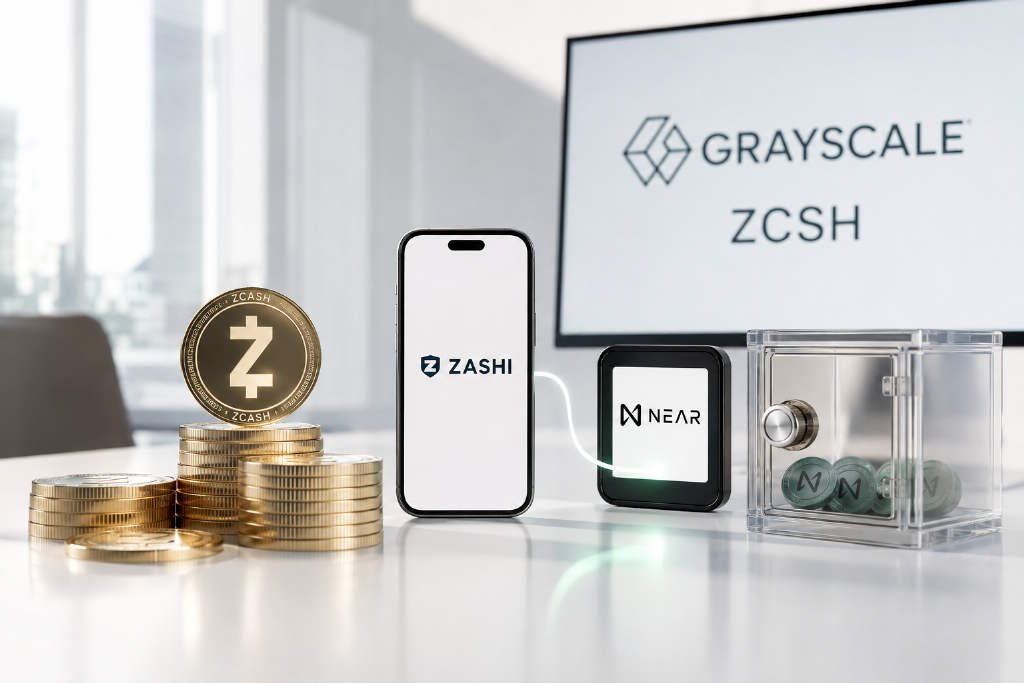
Zcash rose to $1,200 on Sept. 6, taking its three-month gain to 370%. Over the same stretch, Grayscale’s spot ZEC ETF, ZCSH, gathered more than $460 million in assets within two weeks of launch. The conversation around the move has started to shift. Traders are no longer focused only on ZEC itself, but also on the infrastructure processing the traffic around it.
That is where NEAR Intents has entered the discussion. The idea circulating on crypto Twitter is straightforward: instead of chasing the next leg in ZEC after the token cleared the four-digit mark, own the toll road under it.
Zashi and NEAR Intents sit at the center of the flow
The thesis starts with a specific product link rather than a loose narrative.
Zashi, developed by Electric Coin Company, is described in the source material as the most complete self-custody entry point in the ZEC ecosystem from a user-experience perspective. In October 2025, Zashi launched Zashi Swaps, a cross-chain swap feature built on NEAR Intents. It allows users to swap assets including BTC, SOL and USDC directly into shielded ZEC. CrossPay was launched after that, opening the route in reverse by connecting shielded ZEC to payments in assets on any chain.
That makes NEAR Intents both the on-ramp and the off-ramp for ZEC flows coming through Zashi. Every cross-chain swap initiated from the wallet, regardless of direction, is settled through NEAR Intents.
How the Fee Switch ties activity to NEAR buybacks
On Feb. 23, 2026, NEAR Intents activated its Fee Switch. From that date, all protocol-level fees have been collected in NEAR, and 100% of protocol fees have been used to buy back NEAR on the open market.
The transmission chain repeated across social media looks like this: rising demand for ZEC drives more cross-chain swaps in Zashi, those swaps lift volume on NEAR Intents, fee generation rises with that volume, and the protocol then uses its fee income to repurchase NEAR. The end result, in that framing, is structural buying pressure on NEAR.
The topline numbers are large
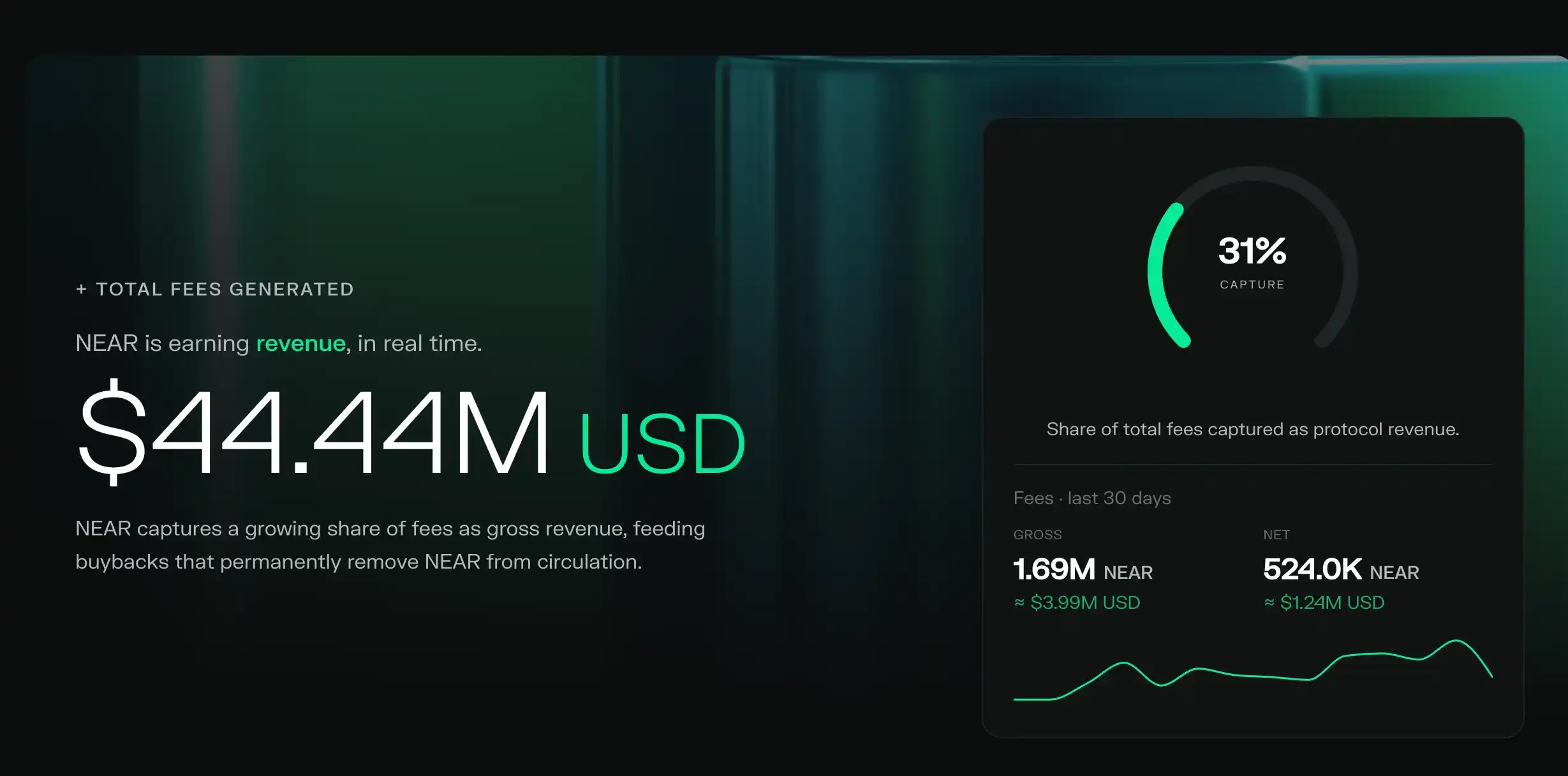
Official dashboard data for NEAR Intents shows cumulative volume of about $27.6 billion as of early September. The protocol covers more than 26 blockchains, has generated about $45 million in cumulative fees, and recorded roughly $3 billion in 30-day volume.
ZEC’s share of that activity has also climbed. Data from late 2025 showed ZEC trading accounting for roughly 10% of average daily volume on NEAR Intents, or about $15 million a day. CoinGecko pair data now points to a much more concentrated picture: USDT/ZEC represents 27.4% of total volume on NEAR Intents, USDC/ZEC adds 7.1%, SOL/ZEC contributes 2.5%, and ETH/ZEC contributes 2.2%. Taken together, ZEC-related pairs account for nearly 40% of total volume.
Gross fees and buyback revenue are not the same thing
The key issue is how much of those fees actually reaches the protocol treasury.
According to DefiLlama data cited in the source, NEAR Intents has produced $45 million in cumulative fees, but only about $5.51 million of that has become protocol revenue that can be used to buy back NEAR. Over the last 30 days, protocol revenue was about $910,000, implying monthly buybacks of roughly $900,000.
That differs from earlier reports that put average monthly buybacks at around $3 million. The gap comes from fee-accounting definitions. Most of the $45 million in total fees did not enter the NEAR buyback pool. Instead, the larger share went to solvers, meaning market makers and settlement parties, as well as distribution channels. SwapKit alone accounted for more than $4.4 million, while Zashi contributed about $760,000. Only the protocol-layer fee portion flows into the treasury for NEAR repurchases.
The “picks-and-shovels” trade works, but it is narrower than the community pitch
The case for NEAR as the picks-and-shovels trade behind ZEC does have a factual basis. The integration between Zashi and NEAR Intents is real, the post-Fee Switch buyback mechanism is verifiable on-chain, and ZEC’s share of volume on NEAR Intents is clearly significant.
Even so, the data suggests the transmission is less efficient than many community posts imply. It also depends heavily on the persistence of momentum in a single asset.
If inflows into the ZEC ETF keep running at the current pace in the coming weeks, the chain may continue to hold. If ZEC enters a period of sharp volatility or a pullback, the volume mix inside NEAR Intents may expose a higher concentration risk than the “multi-chain infrastructure” label suggests.
The metric to watch is concentration, not just total volume
For traders, the more important signal is not simply whether cumulative NEAR Intents volume can clear $30 billion. The more telling metric is the direction of ZEC’s share within that volume.
If that share falls from nearly 40% to below 15% while total volume keeps growing, NEAR would be closer to moving from a trade tied to ZEC’s shadow toward a broader cross-chain settlement infrastructure story.