
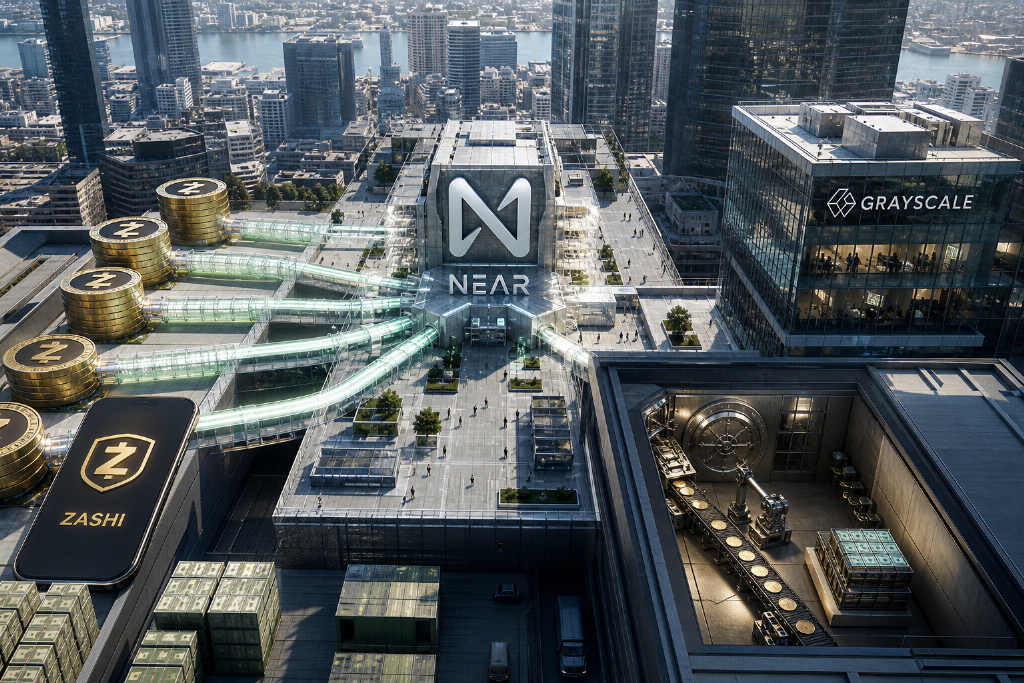
ZEC surged to $1,200 on Sept. 6, bringing its three-month gain to 370%. Over the same stretch, Grayscale’s spot ZEC ETF, ZCSH, gathered more than $460 million in assets within two weeks of launch. The move amounts to the strongest repricing for privacy coins in a decade.
But a large part of the trading discussion has already moved past ZEC itself. The focus has shifted to a different question: if ZEC demand keeps driving volume higher, which protocol sits underneath that flow and collects part of the economics? In that debate, NEAR Intents has become the name to watch.
Zashi and NEAR Intents form the main cross-chain route
In the ZEC ecosystem, Zashi, developed by Electric Coin Company, is one of the most complete self-custody entry points for users. In October 2025, Zashi launched Zashi Swaps, a cross-chain swap feature built on NEAR Intents. It lets users convert assets including BTC, SOL, and USDC directly into shielded ZEC. CrossPay went live afterward and opened the reverse route, connecting shielded ZEC to payments in assets on any chain.
That product structure puts NEAR Intents on both sides of the flow. It serves as the on-ramp into ZEC and the off-ramp out of it. Any cross-chain swap initiated from Zashi, regardless of direction, runs through the NEAR Intents settlement layer.
On Feb. 23, 2026, NEAR Intents activated its Fee Switch. From that date, all protocol-level fees have been collected in NEAR, and 100% of protocol fees have been used to buy back NEAR on the open market. Under that setup, more trading activity means more fees, and more protocol fees mean more buybacks.
The transmission chain circulating on crypto Twitter is simple: rising demand for ZEC leads to more swaps through Zashi; that lifts volume on NEAR Intents; fees are generated at the protocol level; those fees are used to repurchase NEAR; and NEAR then gains a structural source of buying pressure.
Headline volume is large, but the mix matters
NEAR Intents’ official dashboard shows cumulative volume of about $27.6 billion as of early September. The protocol spans more than 26 blockchains, has generated roughly $45 million in fees, and processed about $3 billion in volume over the past 30 days.
ZEC’s share of that activity has changed over time. Data from late 2025 showed that ZEC trading made up about 10% of average daily volume on NEAR Intents, or around $15 million a day. More recent pair-level data points to a much larger footprint.
According to CoinGecko trading-pair data, the USDT/ZEC pair now accounts for 27.4% of total volume on NEAR Intents. USDC/ZEC adds 7.1%, SOL/ZEC contributes 2.5%, and ETH/ZEC represents 2.2%. Taken together, ZEC-related pairs make up nearly 40% of total volume.
That is the core reason the market has tied NEAR Intents so closely to the recent ZEC trade. At current levels, ZEC is not a marginal source of flow on the platform. It is one of the central drivers of activity.
Total fees and protocol revenue are not the same thing
The key question is how much of that flow actually turns into value captured by NEAR.
DefiLlama data shows cumulative fees of about $45 million for NEAR Intents, but only about $5.51 million of that has reached protocol treasury revenue, the portion that can be used to buy back NEAR. Over the past 30 days, protocol revenue has been about $910,000, implying roughly $900,000 in monthly buybacks.
That is well below earlier reports that put average monthly buybacks near $3 million. The gap comes from different accounting definitions. Most of the $45 million in fees did not enter the protocol buyback pool. Instead, the larger share went to solvers, which act as market makers or settlement parties, as well as to distribution channels.
Within those channels, the source material says SwapKit accounted for more than $4.4 million, while Zashi contributed about $760,000. Only the protocol-level portion of fees flowed into the NEAR buyback pool. In other words, higher trading volume does increase gross fees, but it does not translate one-for-one into repurchases of NEAR.
The thesis holds, but it depends heavily on ZEC staying hot
The “pick-and-shovel” case for NEAR in the ZEC trade is grounded in real product links and a verifiable fee design. Zashi is integrated with NEAR Intents. The buyback mechanism has been in place since the Fee Switch was activated. ZEC also represents a meaningful share of current trading activity on the protocol.
Still, the pass-through is weaker than some community narratives suggest. The conversion from gross fees to protocol revenue is limited, and the current volume mix shows a high dependence on one asset. That makes the trade sensitive to whether ZEC’s momentum lasts.
If inflows into the ZEC ETF keep the current pace over the next several weeks, the chain can continue to work. If ZEC instead enters a period of heavy volatility or a pullback, the concentration risk inside NEAR Intents may become more visible than the broader “multi-chain infrastructure” label implies.
For traders, the metric to watch is not only whether cumulative NEAR Intents volume clears $30 billion. The more important signal may be how ZEC’s share of that volume changes. If ZEC-related trading falls from nearly 40% to below 15% while total volume still grows, that would mark a stronger shift for NEAR Intents from being closely tied to one asset narrative to operating more clearly as cross-chain settlement infrastructure.
