
ZEC climbed 18% in the past 24 hours to around $1,479. A month ago, it was trading near $485, and a year ago it was at $51. That move takes the token from $51 to $1,479 in a year, a 25x increase. Its market capitalization has reached $25 billion, lifting it to ninth place across the crypto market.
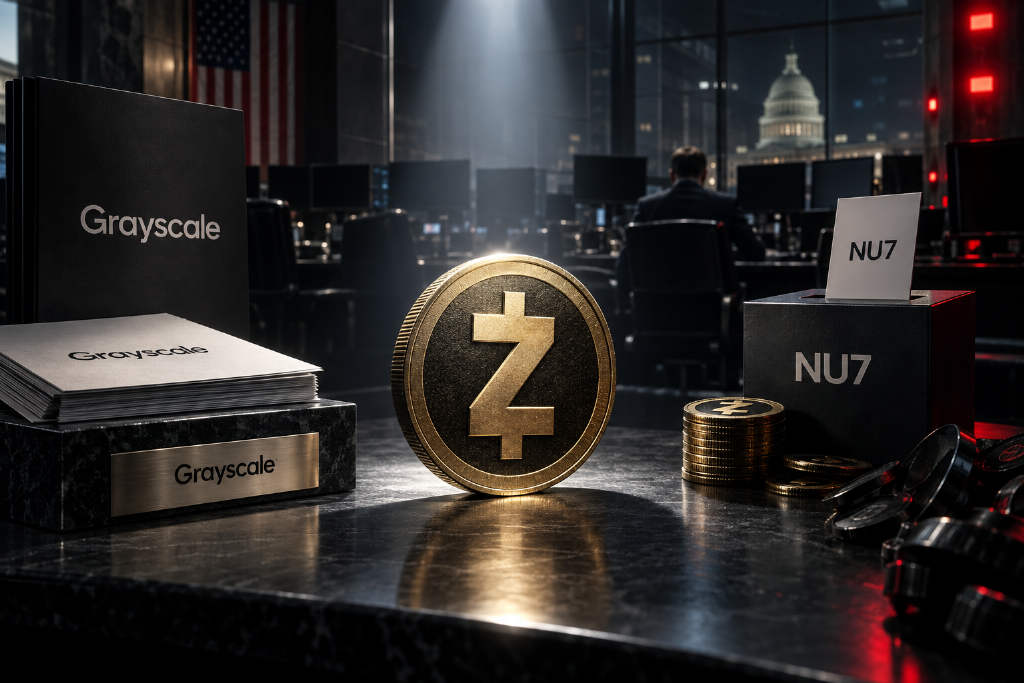
The rally has unfolded in a privacy coin with a 10-year history, a hard cap of 21 million coins, and a past drawdown from $5,941 to $16. MarsBit said at least three forces are acting at the same time in this cycle: Grayscale’s spot ETF, the NU7 governance vote, and a large leverage-driven squeeze in derivatives.
Grayscale’s spot ETF widened access to ZEC
On Aug. 25, Grayscale’s spot Zcash ETF, ticker ZCSH, began trading in the U.S. It is the first regulated spot investment product tied to ZEC. Within two weeks, assets under management topped $400 million.
MarsBit argued that the product’s importance is not mainly about the size of fresh capital. Against a $25 billion market cap, $400 million is not a large share. The bigger change is in investor composition. Before the ETF launch, ZEC buyers were largely crypto-native investors and miners. After the listing, traditional investors could add ZEC through brokerage accounts without managing private keys or using crypto exchanges directly.
That shift is structural and long term, according to the report. Once an asset moves from being accessible to one class of investors to several, the demand curve is lifted on a more permanent basis. In that framework, the ETF sets a higher floor for long-term demand, but it does not explain violent short-term price swings on its own.
NU7 vote results strengthened the “Bitcoin-like scarcity” case
Results from the NU7 upgrade vote were released on Sept. 14. The process combined ZCAP and token-holder voting, with about 2.4 million ZEC taking part.
Several outcomes stood out:
- The halving mechanism stays. A total of 96.5% of voters rejected a “smooth issuance curve” and chose to keep Bitcoin-style halvings. That means ZEC will continue to halve issuance every four years, preserving a hard-coded supply shock.
- NSM reissuance was delayed until February 2031. Some 96.6% supported postponing the reissuance of ZEC collected through the Network Sustainability Mechanism, or NSM, until February 2031. For more than the next four years, the deflationary effect from fee burning will not be offset by new supply from that source.
- Fee burning will be written into the protocol. A total of 78% supported burning part of transaction fees through NSM, giving ZEC a deflationary mechanism that MarsBit compared with Ethereum’s EIP-1559.
- Faster block production under Project Tachyon received near-unanimous backing. A total of 99.3% chose to ship as soon as possible and cut unfinished features, prioritizing speed over completeness.
Those results push ZEC’s economic design further toward a model built on a hard cap, halvings, fee burning, and delayed reissuance. MarsBit said the asset is increasingly being framed as “Bitcoin with privacy” rather than “a privacy tool with blockchain features.” The report described that narrative shift as one of the more easily underestimated catalysts in the current run.
$3.55 billion in open interest points to leverage as the short-term driver
Derivatives data paints a different picture for the near term. As of Sept. 17, CoinGlass data showed ZEC futures open interest at $3.55 billion, a record high. Twenty-four-hour futures volume reached $14.45 billion, while 24-hour spot volume stood at $1.61 billion. Liquidations over the same period were about $67.36 million.
Broken down, those figures suggest that current price discovery is being led more by leveraged traders than by spot buyers.
Derivatives-to-spot volume is about 9:1
Derivatives turnover is roughly nine times spot volume. MarsBit said that points to a market where leverage is setting the pace. A high ratio between futures and spot is also a sign of short-term fragility. If funding turns positive or longs start taking profit, leverage can amplify the move in the other direction.
Open interest is about 14.2% of market cap
With $3.55 billion in open interest against a $25 billion market cap, the ratio comes to about 14.2%. MarsBit said that is elevated for a major token. For comparison, BTC’s open-interest-to-market-cap ratio is usually around 2% to 4%, while ETH is around 3% to 5%. ZEC at 14% points to unusually heavy leverage participation.
Liquidations have been skewed toward shorts
In several recent price spikes, short liquidations were the dominant force. On Sept. 6, when ZEC broke above $1,000, single-day short liquidations reached $46 million. On Sept. 11, a 5.6% hourly jump came with $28.9 million in liquidations, again led by shorts.
That pattern suggests the final leg of the move has been driven to a large extent by forced short covering rather than broad, aggressive buying from new entrants.
Chun Wang says the move is narrative-driven
F2Pool co-founder Chun Wang said, 「ZEC’s rise is narrative-driven, and the fundamentals do not match its current market ranking.」
He also pointed to long-running disputes around token distribution, governance, and security, citing the Orchard privacy protocol vulnerability in June as one example.
The three forces matter on different time frames
MarsBit did not treat the three drivers as equal.
In its view, the ETF is the structural lift at the bottom. It changes accessibility and helps establish a floor for long-term demand. But with $400 million in AUM spread across daily buying, its marginal effect is limited and does not account for sharp short-term swings.
The NU7 vote is a medium-term narrative booster. Keeping halvings, burning fees, and delaying reissuance lock in ZEC’s “Bitcoin-like scarcity” story for at least four years. That can support multiple expansion, but MarsBit said it still does not explain the 176% gain over the past month.
The main short-term force is the leverage squeeze. Record open interest, a 9:1 derivatives-to-spot ratio, and price action led by short liquidations all point to a leverage-driven market. Once shorts are largely cleared out, or if longs begin to unwind profits, that force can reverse within hours.
The report used a simple comparison: the ETF is the reservoir, the NU7 vote sets the direction of the flow, and the leverage squeeze is the tide that can push water levels sharply higher or lower in the short run. The reservoir is filling and the direction is clear, but how much of today’s level comes from the tide will only be known after it recedes.
Current risks: overbought conditions and little historical support
ZEC’s daily RSI is near 70, placing it in overbought territory. Its 200-day moving average is $586, leaving the current price more than 150% above that level. At a nine-year high, there is no overhead supply from prior trapped holders to offer a clear resistance reference, but there are also no historically tested support levels nearby.
MarsBit said a more specific risk would emerge if the Grayscale ETF posts net outflows in the coming weeks while leveraged longs start closing positions. If open interest contracts quickly from $3.55 billion under those conditions, the token could see a pullback as violent as the rise.
The report’s framework is straightforward: watch leverage in the short term, narrative in the medium term, and ETF inflows plus on-chain privacy usage over the long term.
Disclaimer: This article does not constitute investment advice. ZEC is highly volatile, and leverage participation is at a historical high. Investors should assess risks independently.