


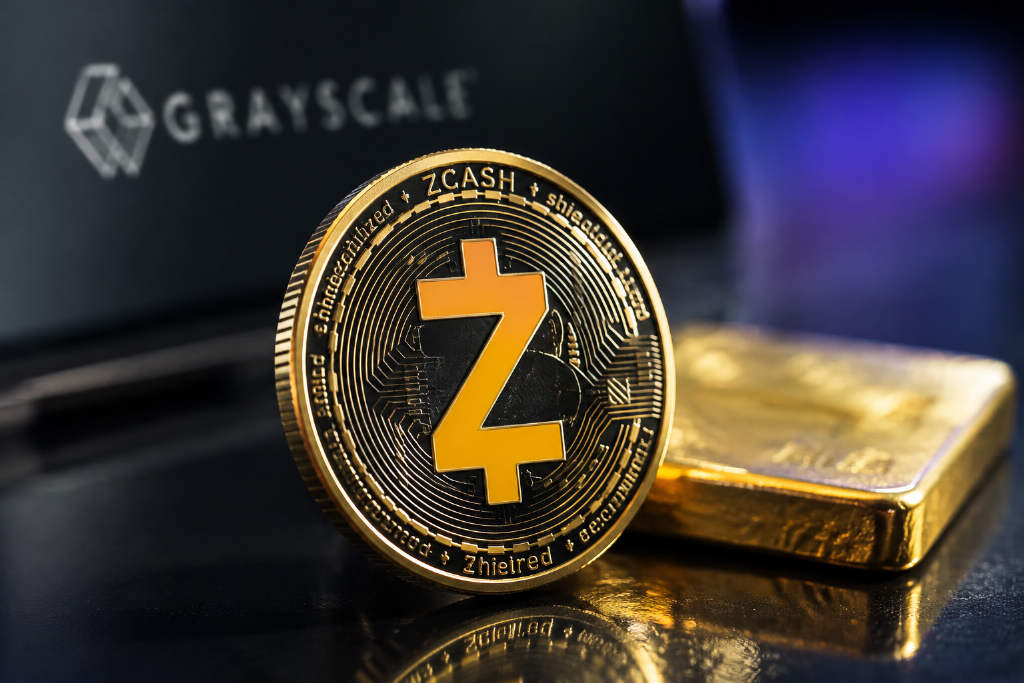
Taiki Maeda’s ZEC thesis starts with a simple claim: the move in Zcash is not just a return of the privacy narrative. In his video, ZEC: Once in a Lifetime Trade, he breaks the position into a deeper set of questions — whether Zcash can be re-rated from a privacy coin into a store-of-value asset outside Bitcoin, whether price gains can improve the product itself, and how an investor should size up when the market begins validating a view that was not consensus to begin with.

The piece, compiled from Maeda’s video and translated by Peggy for BlockBeats, says Zcash has moved back into focus after years on the sidelines. ZEC, after nearly nine years of relative weakness, has rallied sharply and recently moved above $1,000. At the same time, a Grayscale Zcash ETF has started trading on NYSE Arca, giving traditional investors another route to gain exposure.
From privacy coin to privacy-focused store of value
Maeda’s first argument is about positioning. In his view, the market may be starting to understand Zcash in a different way.
Zcash launched in October 2016 as a decentralized blockchain built around financial privacy. Its monetary design shares several features with Bitcoin: a capped supply of 21 million coins, proof-of-work security, and a halving cycle that takes place about every four years.
The main difference is privacy. Bitcoin’s ledger is public by default, with balances and flows visible on-chain. Zcash supports both transparent addresses and shielded addresses, which means users can make public transfers or move ZEC into a shielded pool that hides the sender, receiver and amount. That capability relies on zero-knowledge proofs. The article describes Zcash as one of the earliest blockchain projects to put zero-knowledge proofs into practical use.
For years, the market mostly treated Zcash as an anonymous transaction tool. Maeda argues that this framing held back valuation and left the asset under persistent regulatory and compliance pressure. His revised framework does not cast ZEC as a replacement for Bitcoin. It treats Zcash as a complement to Bitcoin’s store-of-value role: Bitcoin offers scarcity, decentralization and auditable supply, while Zcash attempts to add optional privacy on top of similar monetary properties.
That does not mean Zcash can displace Bitcoin. The more plausible outcome, as he sees it, is coexistence. The two assets may satisfy different needs while sitting side by side, much as gold and silver can both carry store-of-value characteristics. The article is explicit on one point, though: this remains an unproven market judgment. A technical distinction does not automatically become durable monetary consensus.
Why Maeda thinks the crypto market is still in the early stage of a bull cycle
Before getting to ZEC itself, Maeda lays out his view of the broader market. He says crypto may be entering the early phase of a new bull market, and he gives two main reasons.
First, the debasement trade is back in focus. As investors pay renewed attention to fiscal expansion, long-term rates and the purchasing power of fiat currencies, both gold and Bitcoin have rebounded from lower levels. Maeda says the more meaningful shift is in how Bitcoin is being interpreted. Five years ago, a large share of capital still saw BTC as a high-beta Nasdaq proxy or a pure speculative instrument. Now, more traditional money is placing it inside a debasement and store-of-value framework.
That matters because the demand may come from outside crypto. If external allocators keep adding exposure, he argues, Bitcoin can find support even without a rapid near-term move higher.
Second, he believes crypto-native investors may have become too pessimistic. Market sentiment often reaches extremes at both tops and bottoms. In the fourth quarter of last year, many traders treated upside as almost certain, positioned early, and left the market short of incremental buyers. Once a downside catalyst appeared, those same fully loaded participants turned into sellers.
He sees the present setup as close to the opposite. Many investors are holding significant cash and waiting for another leg down. Bullish calls are often treated as dangerous signs of a top. In Maeda’s reading, that means positioning may already be defensive. If price action improves and sidelined money returns, the bearish consensus can break.
He is not arguing for a rising tide across all tokens. The article says crypto is showing a K-shaped split: one side includes store-of-value assets such as Bitcoin and ZEC, as well as projects that generate revenue and return value to tokenholders through buybacks; the other side includes assets with weak real demand and ongoing pressure from unlocks and selling.
Over the past few months, Bitcoin has not moved dramatically, but HYPE, LIT and ZEC have outperformed. Maeda reads that as internal capital rotation. Investors are selling tokens that disappointed in the last cycle and reallocating to assets with a store-of-value angle, cash flow, or a narrative the market can still underwrite.
The reflexive case for ZEC
One of the article’s central ideas is that Zcash may have stronger price reflexivity than many other crypto assets. That is a large part of why Maeda is bullish.
Zcash has been live for nearly a decade and spent most of that time underperforming. It lagged Bitcoin and other major crypto assets for years. Now the price has broken out of a long range, market attention has returned, and momentum has improved. Maeda says this should not be dismissed as a short-lived trade.
He points to the amount of ZEC held in the shielded pool as a key fundamental indicator. The shielded pool is the capital set that underpins private transfers on Zcash. The more users and assets are inside it, the smaller any single transaction tends to appear relative to the whole, which can make it harder to identify. According to the article, the amount of ZEC entering the shielded pool has been recovering over the past two years, at minimum showing that more assets are making use of Zcash’s privacy functionality.
That does not prove real user growth by itself. Because the activity is private, outside observers cannot determine how many users those assets represent or what the precise use cases are. Even so, compared with the near-stagnation of prior years, the change is meaningful enough for Maeda to track closely.
He puts equal emphasis on the dollar value of assets inside the shielded pool. That is where the reflexive argument becomes more specific.
If the shielded pool is worth only $1 million, a user trying to move $10 million would stand out, making effective privacy difficult. If the pool holds $10 billion instead, the same-sized transfer becomes a much smaller share of the total set, which expands the privacy set materially. In other words, a higher ZEC price can increase the dollar depth of the privacy pool, which may improve the product for larger users.
From there, Maeda describes a reflexive loop: a higher ZEC price raises the dollar value sitting in the shielded pool; a larger pool improves the network’s usefulness for larger private transfers; stronger usage can reinforce network effects and the store-of-value story; and that can attract more capital. In this framing, price is not only an outcome of fundamentals. It can help shape them.
The same mechanism can work in reverse. If adoption stalls or confidence breaks, the reflexive tailwind can become a downside amplifier very quickly.
He contrasts ZEC with exchange-related tokens. Assets such as HYPE or LIT can be discussed in terms of revenue, buybacks and valuation multiples, which means their attractiveness may fade once price moves too far ahead of cash generation. ZEC does not produce cash flow. Its value depends more on consensus, network effects and how much wealth investors are willing to allocate to store-of-value assets. That raises the theoretical ceiling, but it also leaves much more uncertainty.
At the time the video was recorded, ZEC was around $850 and its market capitalization was roughly 1% of Bitcoin’s. Maeda’s bullish scenario is that if Zcash gradually becomes viewed as a second crypto store-of-value asset outside Bitcoin, its market cap could eventually reach 5% to 15% of BTC’s. The article stresses that this is a scenario analysis, not a firm price forecast.
His point is that if Bitcoin itself were to double and ZEC’s discount to BTC narrowed at the same time, ZEC’s dollar price could benefit from both BTC appreciation and a relative re-rating. That, for him, is the source of the asymmetry.
The ETF opens a door, but not the demand question
The third major part of the thesis is access. On Aug. 25, Grayscale’s Zcash ETF began trading on NYSE Arca under the ticker ZCSH, creating a new route for traditional investors to gain spot-price exposure to ZEC.
Before that, investors mostly needed to use crypto trading venues to build a ZEC position, and that came with friction around custody, capital access and compliance. The ETF reduces some of that friction and gives Maeda’s “second crypto store of value” idea a more standardized financial wrapper than it had before.
The article adds an important qualification: the product is not a traditional fund registered under the U.S. Investment Company Act of 1940, so its regulatory protections and risk structure differ from those of a standard ETF.
Maeda’s view is that the listing matters because it lowers the barrier to allocation. It does not, by itself, prove that institutional demand has arrived. The real signals to watch are net creations, growth in holdings and trading activity after launch. If traditional money keeps coming in while shielded pool assets continue to rise, the reflexive case for Zcash becomes stronger. Without that follow-through, the ETF is just a vehicle.
Why he sold after the Orchard scare and bought back higher
Maeda’s conviction was not built in a clean market. It was tested by a trust shock.
He says he began buying ZEC below $400 between April and May this year and added as the price climbed. At the time, he believed ZEC could break out of its long range in the second quarter.
Then researchers disclosed a potential integrity vulnerability in the Orchard shielded pool. Under certain conditions, an attacker could theoretically forge shielded assets, raising doubts about the credibility of ZEC supply. Public information did not show the vulnerability had actually been exploited, but for an asset whose value depends on scarcity and trust, the mere possibility of hidden inflation was enough to damage confidence.
After the news, ZEC fell by more than 60% at one point. Maeda says he feared the event could permanently impair Zcash as a store-of-value asset, so he exited his spot position. Some of that ZEC was sold below $300.
He describes the trade as a painful loss. A few years earlier, he says, he likely would have crossed Zcash off the list and never looked back. This time he set a condition instead: if ZEC could reclaim its pre-event price range, he would reassess the trade and consider buying back.
That is what happened. ZEC recovered the decline, and he rebuilt the position at a higher price than where he had sold.
On the surface, it looks like a classic sell-low, buy-high sequence. In Maeda’s framework, the recovery meant the market had not fully abandoned Zcash. If the vulnerability and panic could have destroyed the store-of-value narrative but the asset still recovered after the fix, then Zcash had shown a degree of anti-fragility.
He compares that pattern to Bitcoin’s early years, when repeated crises — exchange failures, hacks and regulatory actions — did not kill the network. The longer a system survives and the more stress it absorbs, the more confidence the market may place in its ability to persist.
The article does not overstate that point. Price recovery does not prove that all technical risk is gone. It shows only that market participants are willing to take risk again. It does not prove there are no unknown vulnerabilities left in the protocol. What still needs to be tested is whether the remediation can hold up over time and whether users continue to trust the integrity of supply.
Adding to winners, not defending cost basis
The most revealing part of the review may be how Maeda thinks about position management.
He argues that many investors average down after price falls because they do not want to admit their thesis may be wrong. Then, when price rises, they rush to take profit. The result is a portfolio where winners get sold too early and losing positions become larger.
His method runs the other way. He starts with an investment thesis and an initial position. When price action, fundamentals and market momentum begin to validate that thesis, he adds exposure. If the original logic breaks, he accepts the loss and exits.
In the video, he uses a simple Bitcoin example. If an investor bought a small position at $1,000 because they believed Bitcoin could reach $10,000, then a move to $2,000 does not necessarily just make the asset more expensive. If the original thesis remains intact, the move may also increase the probability that the market is validating the idea. That is the lens he applies to ZEC.
Maeda says this is why he kept adding after buying ZEC back. He holds spot, uses some leverage, and has stop-loss levels on the position. At this point, the trade accounts for most of his net worth because he sees ZEC as his highest-conviction opportunity.
He is not presenting that as a template for everyone else. Concentration and leverage can magnify errors quickly, and high conviction does not mean high win rate. If “market validation” means nothing more than price going up, with no support from adoption, fund flows or protocol progress, then it can easily become a justification for chasing.
For his thesis to remain intact, Maeda says several conditions need to hold:
- the amount of ZEC in the shielded pool keeps rising;
- the ETF brings in stable new capital;
- ZEC remains strong relative to BTC;
- protocol upgrades preserve market confidence in supply integrity;
- privacy and quantum security gain wider investor attention.
If privacy adoption stalls, ETF money does not keep coming, technical risk damages trust again, or ZEC falls back into its old range after the breakout, then the thesis needs to be revisited.
The bet is on a self-reinforcing loop
Maeda says he sees ZEC as a rare setup not because of price momentum alone, but because it has gone through nearly a decade of issuance, disappointment and neglect, and is now seeing changes in price, adoption, access channels and privacy narrative at the same time. In his telling, that path is hard to replicate in a newly issued VC token or a meme coin.
His final bet is not merely that ZEC keeps climbing. It is that price, privacy adoption, institutional access and store-of-value consensus can form a self-reinforcing loop. If that loop holds, a higher price can improve the network’s real-world utility and bring in more capital. If any leg breaks, the same reflexivity can reverse just as fast.
That leaves the larger question raised by the article: how does a crypto asset with no cash flow build value across technology, narrative and capital movement? Maeda is making that bet through ZEC. Whether the market confirms it will depend on the data that comes next.