
ZEC has rallied 25x over the past year, and that move has revived a question that usually sits at the edge of crypto debate: could Zcash ever surpass Bitcoin, and should it?
In a Blockworks analysis, Jake Koch-Gallup says the idea makes him uneasy because BTC makes up a large share of his portfolio and he owns no ZEC. Even so, he argues that the case is not as far-fetched as it sounds.
Zcash as a privacy-upgraded Bitcoin
Koch-Gallup frames Zcash as Bitcoin with a privacy layer built in. He notes that this description alone does not make every Bitcoin fork valuable. BCH, BSV and XEC are also Bitcoin forks, yet none of them has come close to a $1.7 trillion market capitalization.
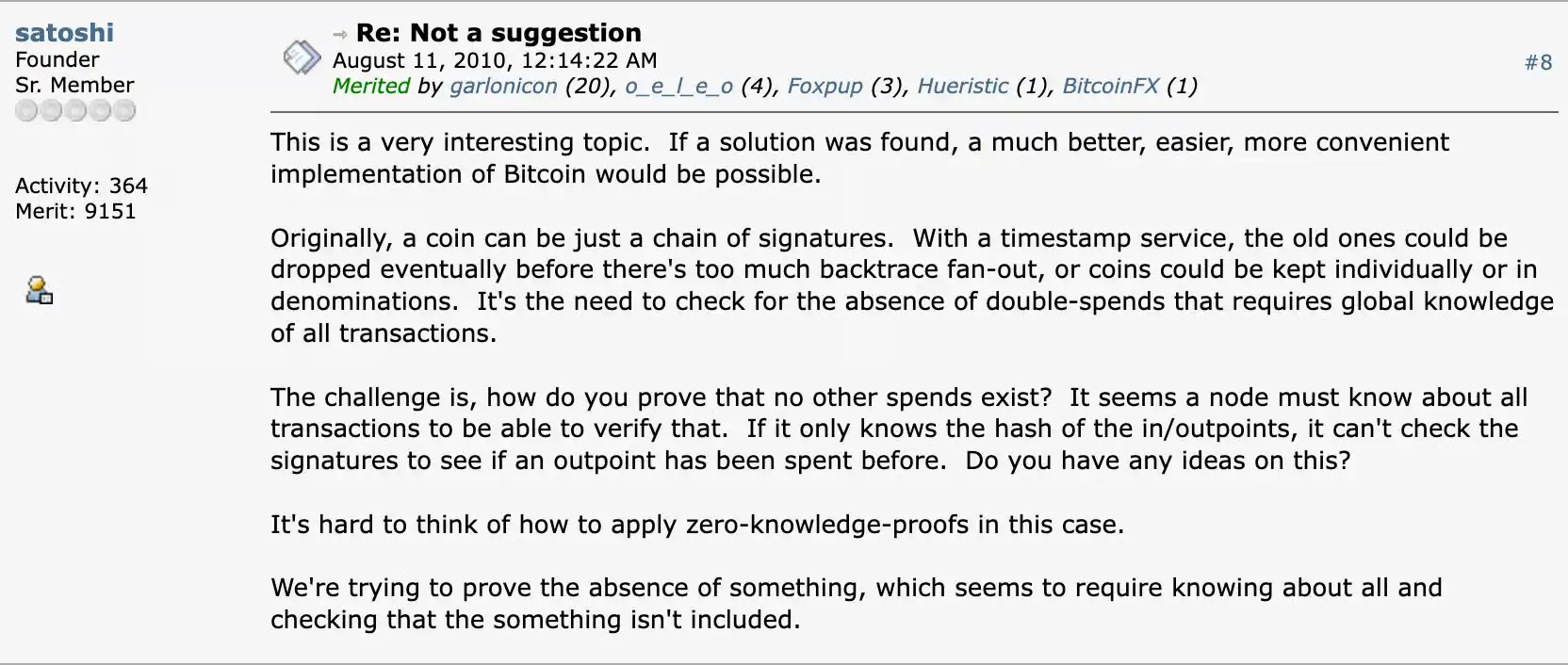
What Zcash has, in his view, is protocol-level privacy that those other forks do not. He says privacy matters, and points to Satoshi Nakamoto’s own comments from a 2010 forum discussion. Nakamoto wrote, 「If a solution was found for privacy, a much better, easier, more convenient version of Bitcoin would be made.」
The obstacle was double spending. To make sure the same coin is not spent twice, every node needs to see every transaction. Nakamoto did not solve how to prove a coin had not already been spent without exposing the coin itself. Koch-Gallup says Nakamoto acknowledged that it was hard to see how zero-knowledge proofs could solve the problem and asked the forum if anyone had ideas.
His conclusion is simple: Zcash is that solution.
Why technical merit does not equal market value
The analysis then asks whether solving privacy on top of Bitcoin’s design means Zcash deserves a higher valuation. Koch-Gallup says the answer depends on why BTC is worth what it is today.
He lists Bitcoin’s first-mover advantage, the deepest liquidity in crypto, the most secure network, acceptance by banks and governments, and its role as digital gold. Zcash, he writes, has almost none of those strengths.
That leads him to a split verdict. On pure technology, he says, ZEC should of course be worth more. On real-world valuation, it will never overtake BTC. Still, he adds, that does not mean it cannot get closer.
ZEC is already repricing against BTC
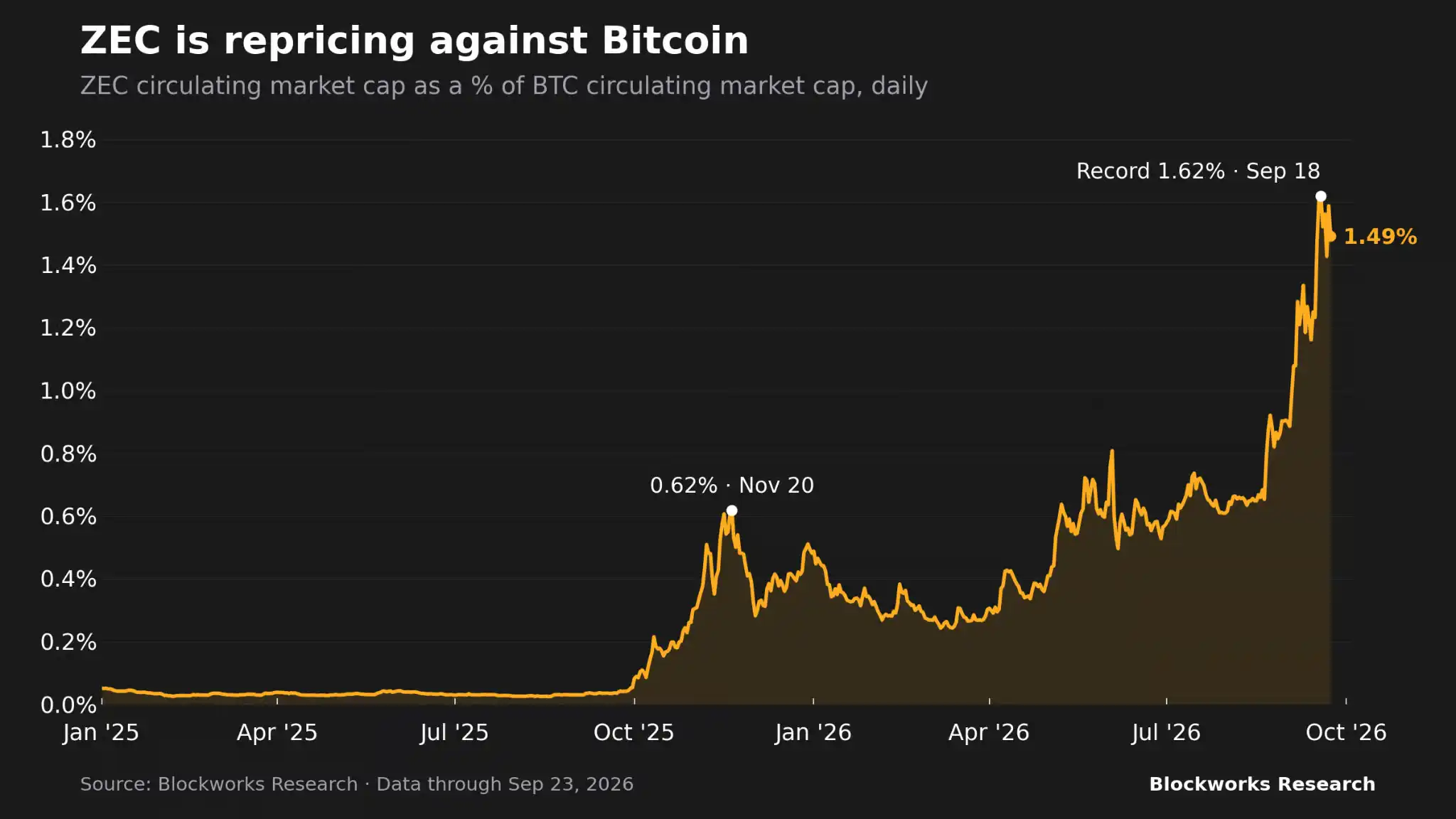
Koch-Gallup cites ZEC’s market cap at $25.3 billion, equal to 1.49% of Bitcoin’s $1.70 trillion market value. At the start of 2025, that ratio was only 0.05%.
A chart in the article shows ZEC’s circulating market cap as a share of BTC’s circulating market cap on a daily basis. The record was 1.62% on Sept. 18, while the reading for Nov. 20 was 0.62%. The source is Blockworks Research, with data through Sept. 23, 2026.
In Koch-Gallup’s view, 1.49% is still low. He compares that level with ETH at 19.4%, BNB at 6.1% and XRP at 5.7% of Bitcoin’s value. He says ZEC could reprice toward the levels seen in BNB and XRP.
Why might that imply another 4x move from current levels? His answer is that privacy is how money is supposed to work. Cash is private by default, while crypto reversed that norm. Even after this rally, he says, ZEC and XMR together still account for only about 1.2% of the crypto market, which suggests the market continues to price privacy as an optional extra. If privacy shifts into the category of a requirement, that gap could close quickly.
Shielded pool growth is being read as real usage
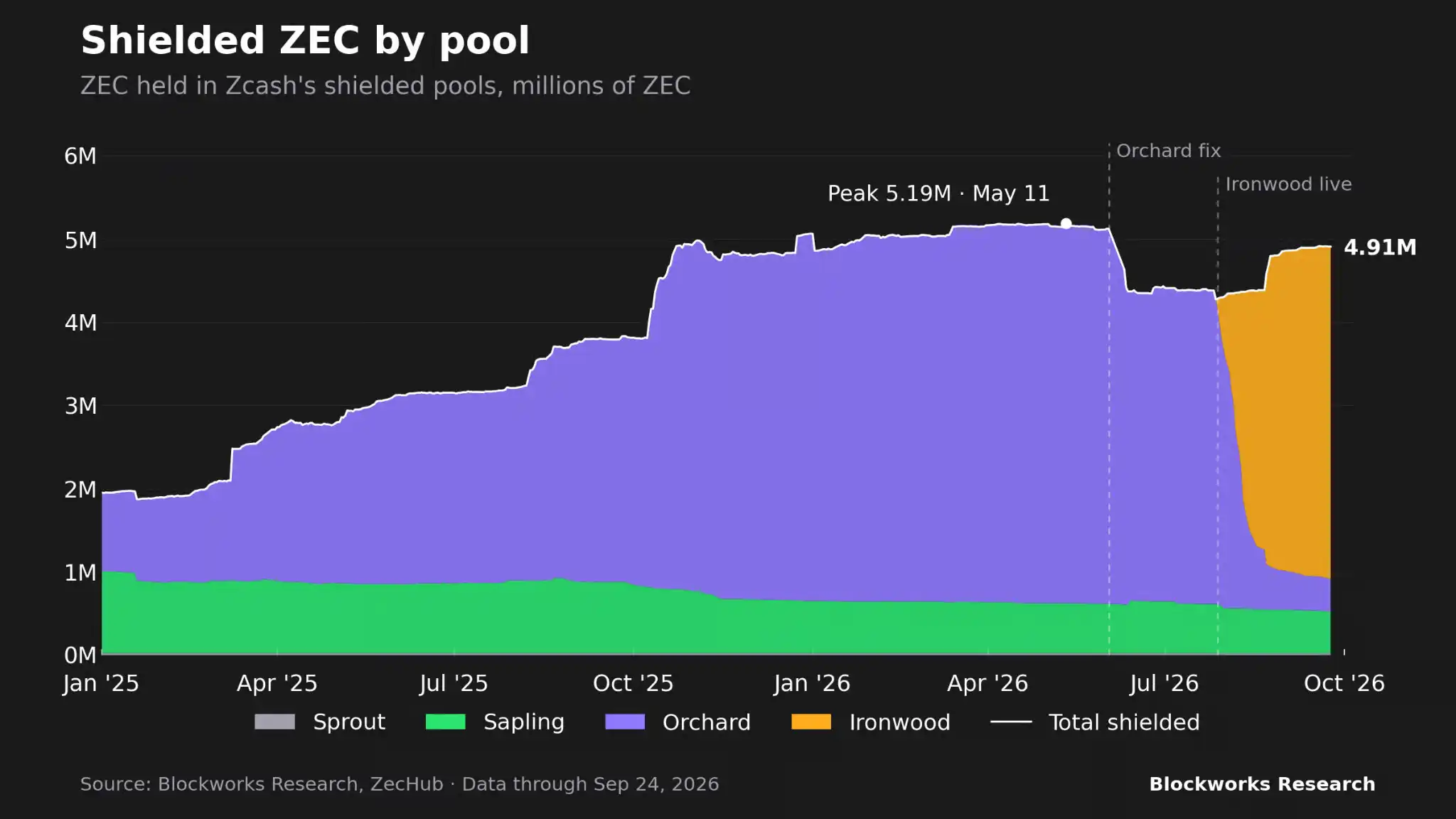
The article also points to growth in shielded ZEC. The amount reached a peak of 5.2 million in May, which Koch-Gallup says shows people are not just buying ZEC but using its privacy feature.
Each coin entering the shielded pool makes the other transactions inside it harder to trace, so privacy becomes stronger as usage rises. Combined with the same 21 million supply cap and halving structure as Bitcoin, he argues that ZEC has moved very close to the upgraded Bitcoin Nakamoto once described.
Another chart tracks the amount of ZEC held in Zcash shielded pools, measured in millions of ZEC. It shows a peak of 5.19 million on May 11 and marks the Orchard fix and the Ironwood launch. The source is Blockworks Research and Zechub, with data through Sept. 24, 2026.
Bitcoin-native privacy may become a challenger
Koch-Gallup does not ignore competition. He says one of Zcash’s newest challengers is coming from Bitcoin itself.
Alloc Init recently published a paper on Shielded Bitcoin, a design that would bring private transfers to Bitcoin without a soft fork. He sees more privacy on Bitcoin as a positive development, but says it is unlikely to compete with Zcash in the near term. For now, it is still a paper, while Zcash has been in production for roughly 10 years.
He also notes that Zcash’s record is not spotless. In late May, a researcher found a counterfeiting vulnerability that had existed for four years in Zcash’s main shielded pool. ZEC fell more than 50% after the disclosure. The bug was fixed within days, and there is no evidence it was ever exploited.
Shielded Bitcoin, he adds, still requires a trusted setup, something Zcash spent years engineering away.
There is also the matter of crowd size. Privacy needs users to hide among. When usage is low, on-chain investigators can link deposits and withdrawals. Zcash’s shielded pool already holds millions of ZEC. Koch-Gallup notes that even Robin Linus, the creator of BitVM, warned that the cryptography involved is highly experimental and may take years to earn trust. In his reading, Zcash still has a large first-mover advantage.
The risks are clear as well
The article does not end on a one-sided bullish note. Koch-Gallup says investing in ZEC still carries material risks.
- Only about 29% of ZEC is actually shielded, so most ZEC transfers remain transparent in much the same way as Bitcoin.
- About 81% of ZEC supply has been issued, compared with 95% for BTC.
- Annual inflation is still around 4%.
- Twenty percent of block rewards go to a development fund rather than miners.
- If privacy features keep arriving on larger chains, including Ethereum-based efforts such as RAILGUN and Zama, users may not need a standalone privacy coin at all.
Koch-Gallup says those risks do not invalidate the broader logic, but they are enough to keep him on the sidelines for now. If ZEC can take monetary premium away from ETH, BNB and XRP, while continuing to improve its technology — he mentions possible quantum resistance as one example — then he says he might, just might, become a buyer.