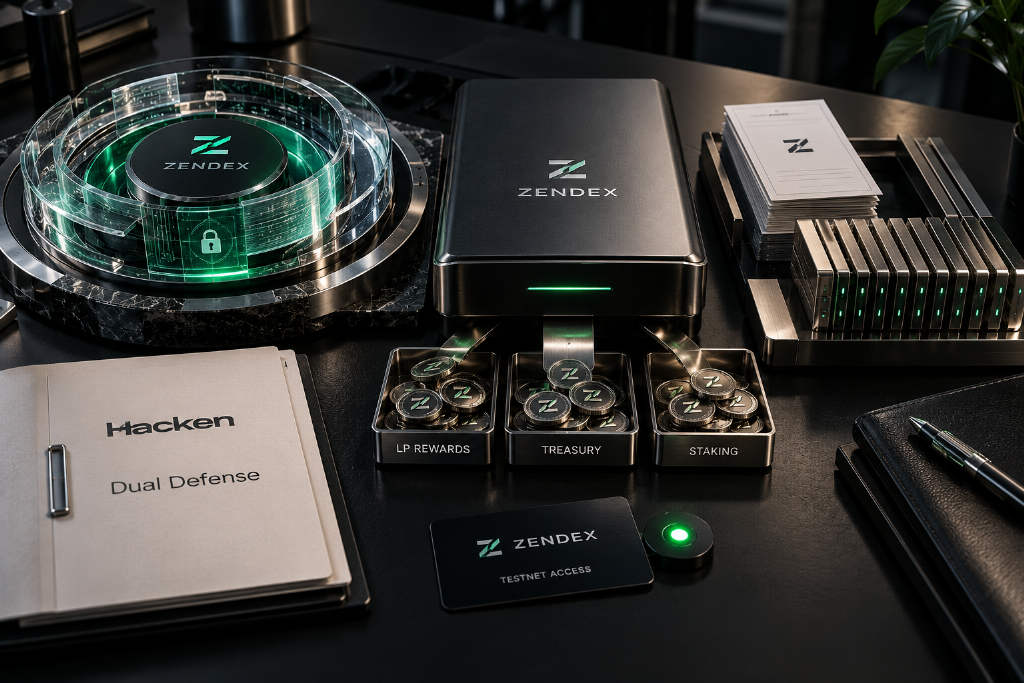
ZENDEX, a decentralized exchange focused on professional capital and privacy-preserving execution, has launched its testnet and opened trading, according to a Techub News brief citing CryptoPotato. The project said the testnet rollout follows full security audits by Hacken and Dual Defense. It will be introduced in phases and include a points-based incentive program, with seed liquidity and a privacy DEX mainnet venue planned for later stages.
The protocol uses a dual-engine execution design that combines a shielded ZK-AMM with a private limit order book inside a zero-knowledge framework. ZENDEX said the setup is intended to conceal trade size, execution intent, and other sensitive trading activity, aiming to reduce extractive MEV risks such as front-running and sandwich attacks while preserving deterministic settlement.
ZENDEX also said it uses a perpetual fee converter denominated in ZEN. Under that model, all collected fees are converted into ZEN, the utility asset of the Horizen ecosystem, and distributed transparently to liquidity providers, treasury operations, and existing ZEN staking contracts. The team said the mainnet and later V2 and V3 releases are planned to add privacy EVM liquidity aggregation and more advanced on-chain ZK-DeFi execution features.
ZENDEX, a decentralized exchange focused on professional capital and privacy-preserving execution, said its testnet is now live and trading has opened, according to a Techub News brief that cited CryptoPotato. The project added that the testnet had already completed full security audits by Hacken and Dual Defense.
The rollout will happen in phases and includes a points incentive program. Later stages are set to introduce seed liquidity and launch a privacy DEX mainnet trading venue.
Dual-engine design combines ZK-AMM and a private order book
ZENDEX uses a dual-engine execution architecture that brings together a shielded ZK-AMM and a private limit order book within a zero-knowledge framework. The design is intended to hide trade size, execution intent, and sensitive trading activity, reducing exposure to extractive MEV risks including front-running and sandwich attacks while keeping settlement deterministic.
Fees are converted into ZEN and distributed on-chain
The protocol uses a perpetual fee converter denominated in ZEN. Under this model, all fees collected by the protocol are converted into ZEN, the utility asset in the Horizen ecosystem, and distributed transparently to liquidity providers, treasury operations, and existing ZEN staking contracts.
ZENDEX said its mainnet release, along with later V2 and V3 versions, is planned to deliver privacy EVM liquidity aggregation and more advanced on-chain ZK-DeFi execution features.
This article was originally published by Bit.Fan. For more cryptocurrency news and market insights, visit www.bit.fan. Disclaimer:
The market information, project data, and third-party content displayed on this platform are for industry information sharing only and do not constitute any form of investment advice or return commitment.
Cryptocurrency trading carries high risks. Users should fully assess their risk tolerance and make independent decisions. All profits, losses, and legal responsibilities are borne by the users themselves.