
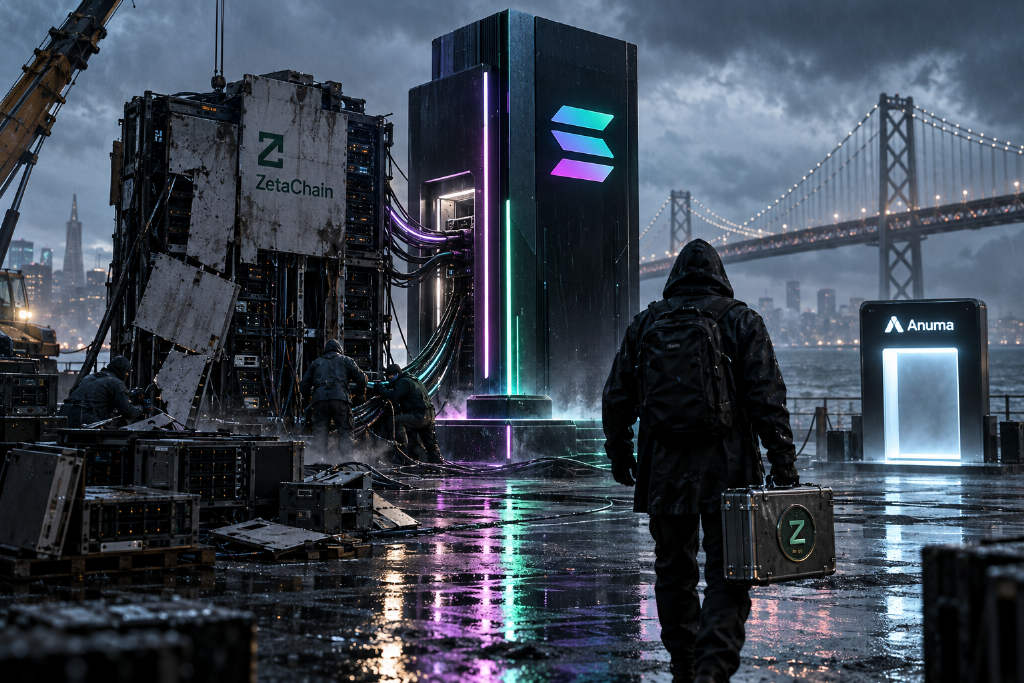
ZetaChain has passed Governance Proposal 68, with 99.4% voting in favor on Sept. 20. Turnout reached 58%, well above the 40% quorum threshold, while opposition and abstentions each accounted for 0.3%.
The proposal does one thing in plain terms: shut down ZetaChain’s own chain and move to Solana.
That makes this an unusual case in crypto. A Cosmos-based Layer 1 blockchain that raised $27 million and operated for three years is now set, by community vote, to give up its own blockspace, validator set, and gas economy. Its native token will be converted 1:1 into a Solana SPL asset, and the token’s purpose will be rebuilt around an AI application called Anuma.
ZETA is currently trading at about $0.03, down 99% from its all-time high of $2.85 in February 2024. Its market capitalization is about $50 million, and its fully diluted valuation stands near $65 million.
From cross-chain infrastructure to an AI application
ZetaChain was originally positioned as an “omnichain interoperability” network, a Layer 1 designed to let smart contracts read and write data across multiple chains. When it raised $27 million in 2023, the cross-chain trade was still crowded and active, with LayerZero, Wormhole, and Axelar all competing for the same market.
According to the article, ZetaChain did not win that contest. Competition among bridges and interoperability protocols was intense, and network effects favored a small number of leaders. ZetaChain’s Layer 1 never attracted enough developers or deployed applications to prove that it needed to exist as an independent chain.
In February 2026, the team launched Anuma, described as a “private AI” application. Its core feature is a Private Memory Layer, where users keep ownership of their memory layer. Conversation history and preference data are stored in encrypted form, and users can move their context across different AI models without handing that data to a single AI company.
Based on official figures cited in the piece, Anuma has more than 300,000 users and has processed more than 1 million AI requests.
The team’s view is that the cost and complexity of operating a standalone Layer 1 now exceed what Anuma actually needs from infrastructure. Solana’s high-performance execution environment and more mature developer tooling, in that framing, are a better fit for the application.
The article quotes the team as saying: “What Solana’s AI infrastructure stack lacks is the application layer — an app people use every day, carrying their own memory that can move across models and across applications.”
ZETA’s role changes completely after the migration
The migration changes how ZETA is supposed to capture value.
Before the move: native token of an L1
- ZETA was used to pay transaction fees on ZetaChain.
- Validators and delegators staked ZETA to secure the network and earn staking rewards.
- ZETA also functioned as the native asset for cross-chain message transfer.
After the move: an SPL asset on Solana
- Locking 100,000 ZETA unlocks access to Anuma Pro.
- The amount locked determines the level of AI service usage available.
- Gas fees are no longer paid in ZETA and instead use SOL.
- Network security is provided by Solana validators.
In short, ZETA moves from being the fuel that keeps a chain running to being the ticket required to use an AI application.
The central issue is whether that new model is stronger than the old one.
A gas-and-staking model has one clear advantage: demand is structural as long as the chain remains active, because every transaction requires the token. But the article argues that ZetaChain’s on-chain activity never reached a level where that model generated meaningful revenue.
The lockup model tied to an AI application offers a different path. If Anuma becomes a widely used AI product, demand to lock ZETA could rise with user growth and remove a meaningful amount of supply from circulation. That only works, though, if Anuma can convert enough of its 300,000 free users into paying users.
How to read the 300,000-user and 1 million-request figures
The article says those numbers sound encouraging, but they need to be broken down.
First, usage is not the same as willingness to pay. Anuma’s current growth has mainly come from its free tier. Unlocking the Pro version requires users to lock 100,000 ZETA, worth about $3,000 at current prices. That is not especially high at today’s token price, but for an AI assistant product, the decision to lock assets depends on whether Anuma offers enough differentiation against products such as ChatGPT and Claude. The article says the “private memory layer” is a compelling concept, but there is no evidence yet that consumers are willing to pay a premium for AI privacy.
Second, the quality of the 1 million requests is unclear. The available figures do not show how many came from paying users, or how many came from free users. If most of that activity came from the free tier, the contribution to ZETA lockup demand would be limited.
Third, 300,000 users are a starting point, not a moat. The article describes that figure as seed-scale in the AI application market. By comparison, ChatGPT has hundreds of millions of users, while Perplexity has tens of millions. For Anuma to hold its ground, the article argues, it needs users who cannot do without it, not just users who have tried it.
Who stands to gain and who takes the hit
The first beneficiary, in the article’s view, is Solana.
Each project that moves from another ecosystem into Solana adds to Solana’s user base, on-chain activity, and narrative weight. If ZetaChain’s 300,000 Anuma users migrate successfully, that would directly add to Solana’s daily active users.
ZETA holders could also benefit if Anuma succeeds. If the application achieves real user growth and paid conversion on Solana, demand to lock tokens could support the price of ZETA. The 1:1 conversion means holders are not diluted during the migration.
The group that loses most clearly is ZetaChain’s validator set. The article notes that validators committed hardware and staked capital to run nodes, and those investments become sunk costs once the chain is shut down. Validators can continue staking until Proposal 2 is passed, but the outcome is already set.
Projects that relied on ZetaChain’s cross-chain functionality also face disruption. Any application that deployed cross-chain logic on ZetaChain will need to find an alternative or stop operating.
A broader signal for the L1 market
The article argues that ZetaChain is not an isolated case. It places the project alongside other L1 and L2 shutdowns in 2026: Linera, backed by a16z, shut down in September after its token sale raised only $848,000; Entropy shut down in January; Legend shut down in July.
The trend, as framed in the piece, is that the market is no longer willing to pay a premium simply because a project has its own chain.
During the 2021-2022 funding cycle, “we are building an L1/L2” was one of the most common startup narratives in crypto. Many teams believed they needed a dedicated chain to carry their vision. Three years later, the article says, most chains never attracted enough developers and users to justify operating independently. At the same time, the cost of maintaining a chain — validator incentives, security audits, and infrastructure operations — remained a real cash expense, while chains without transaction volume failed to produce meaningful cash income.
The article says ZetaChain’s approach is at least more constructive than simply shutting down. Unlike Linera, which exited after running out of funds, ZetaChain is choosing to pivot while it still has 300,000 users and an AI product that is still growing. The 99.4% approval rate suggests the community accepts that judgment.
Still, the move raises a sharper question. If a chain that raised $27 million ultimately concludes that running its own chain is not worth it, how many other chains are still burning capital to maintain blockspace that nobody truly needs?
The article’s answer is blunt: not every chain deserves to survive. What matters is what runs on the chain, not the chain itself.