
ZetaChain is less than a month away from shutting down its native Layer 1. Once the network reaches block height 20,755,000, expected on Dec. 9, 2026, the chain will stop operating and ZETA will migrate to Solana at a 1:1 ratio. The project will also cancel its planned inflation mechanism and burn roughly 55 million ZETA that had been reserved for validator incentives but never distributed.
The move is also a business transition. ZetaChain’s independent-chain phase will end as the project shifts its focus toward ZetaLabs, a financial AI platform for crypto users. A second governance proposal approved on Nov. 7 reorganized the token supply and set out the product roadmap for Anuma’s upgrade into ZetaLabs.
ZETA’s validator allocation will be burned
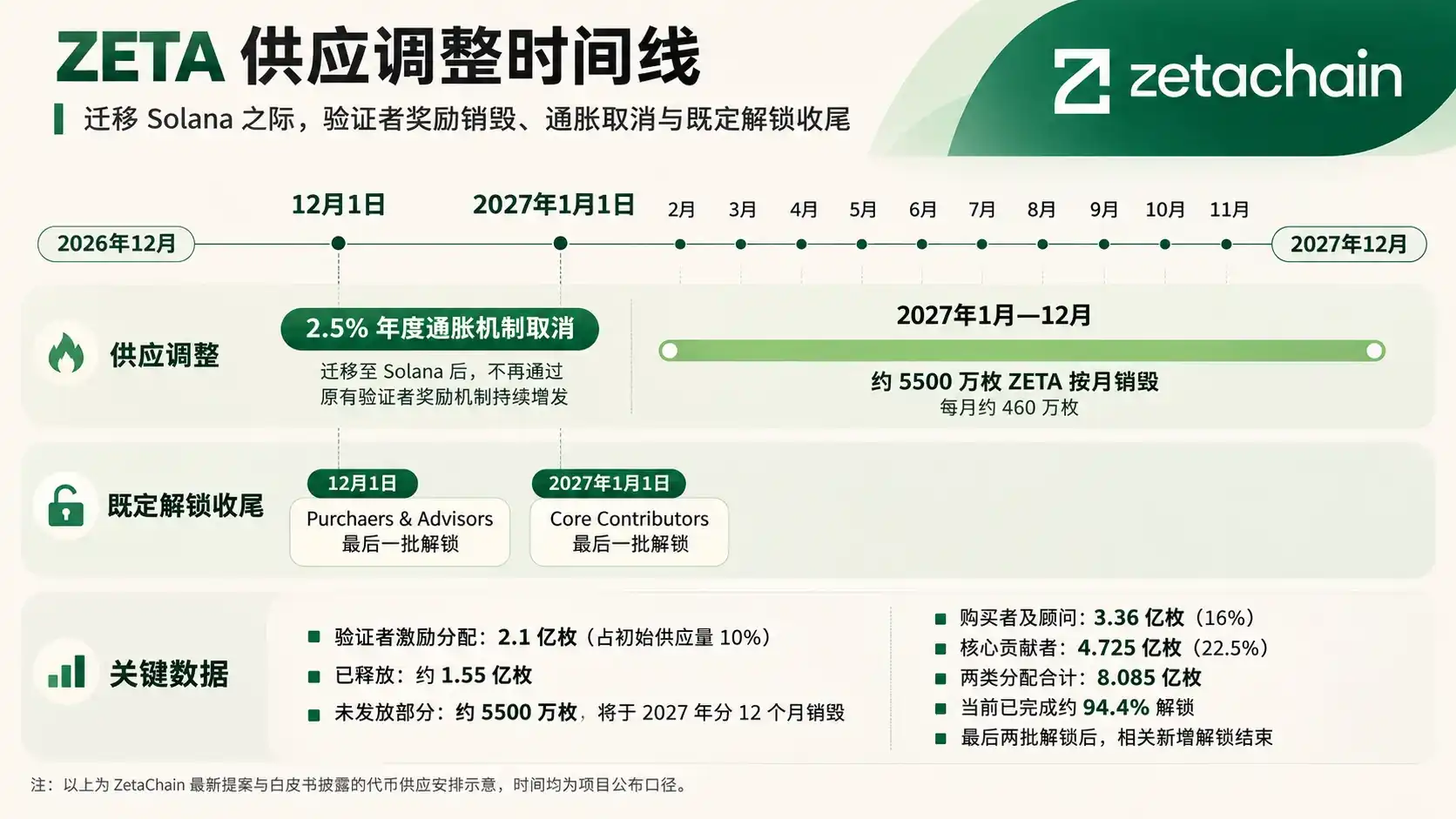
ZETA has an original maximum supply of 2.1 billion tokens. Of that amount, 210 million ZETA, or 10% of the initial supply, was reserved for validator incentives. About 155 million tokens had been released through block rewards by the migration snapshot, leaving approximately 55 million undistributed.
That reward system will end with the native Layer 1. ZetaChain will not put the remaining allocation into circulation. Instead, it plans to burn the tokens according to the original release schedule, from January through December 2027, at roughly 4.6 million ZETA per month.
The 2.5% annual inflation mechanism that was scheduled to begin in the chain’s fourth year will also be dropped. Once ZETA moves to Solana, it will no longer be issued through the former validator-reward system.
Tokens allocated to investors and core contributors will follow the existing unlock plan through its final stages. Purchasers and advisors received 336 million ZETA, equal to 16% of total supply. Core contributors received 472.5 million, or 22.5%. The two allocations total 808.5 million ZETA.
About 94.4% of both allocations has already unlocked. The remaining portions are scheduled for release on Dec. 1 and Jan. 1, 2027. Once those final releases are completed, the established unlock schedules will end and no additional unlocks will be added under those allocations.
The foundation’s other allocations will follow a separate arrangement. ZetaChain Foundation has committed not to sell newly released tokens in 2027 from the User Growth Pool, Ecosystem Growth Fund, Protocol Treasury or Liquidity Incentives allocations.
The supply changes therefore cover three areas: burning undistributed validator rewards, completing the scheduled investor and core-contributor unlocks, and restricting foundation sales of newly released tokens during 2027. The native chain’s closure will remove the former issuance and unlock structure from the operating model.
The migration will be based on a block-height snapshot
The second governance proposal also establishes how ZETA will move from ZetaChain’s native network to Solana. The project expects the chain to reach block height 20,755,000 on Dec. 9, 2026, when it will take the asset snapshot. After the snapshot, the native Layer 1 will stop operating, validator nodes will shut down and the network will not restart.
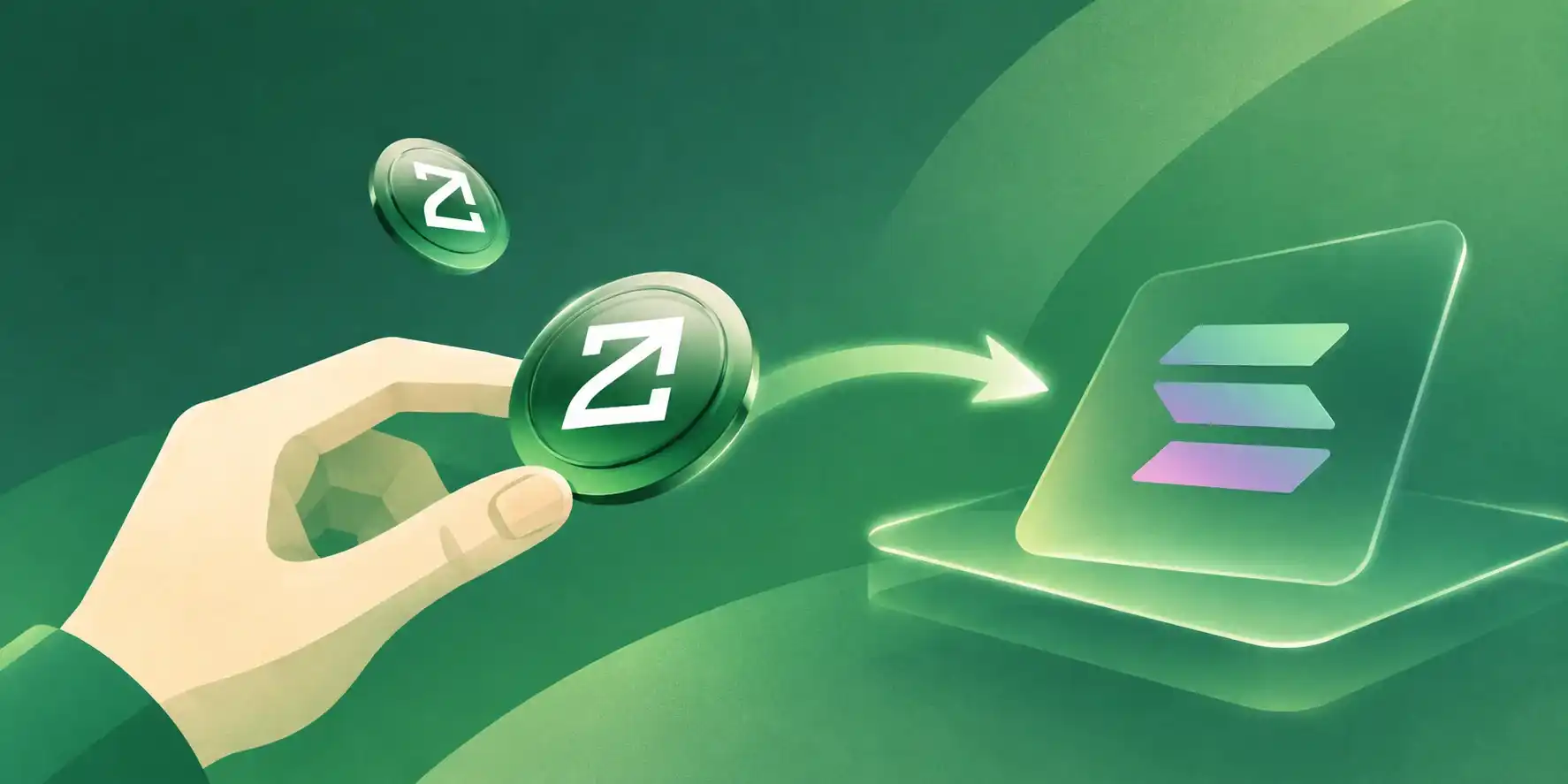
ZetaChain will then issue a native SPL version of ZETA on Solana. The exchange ratio will be 1:1, and the token name and ticker will remain unchanged. The total amount issued will match the native ZETA balances recorded in the snapshot. After issuance, the mint authority will be revoked so that Solana-based ZETA cannot be minted again.
Users will not need a third-party bridge
Regular holders will not need to use a third-party bridge. After the migration portal opens on Dec. 9, users can connect the wallet holding their native ZETA through the official migration program and the ZetaHub page. They will then sign a message containing a Solana receiving address to claim the corresponding amount of SPL ZETA.
The claim process will not require a fee, and users will not need to hold SOL in advance. Each address must have at least 10 ZETA to claim.
Staked assets do not need to be unstaked before the snapshot. The snapshot will record ordinary balances, delegated staking balances, balances in the unstaking process and unclaimed rewards, with the corresponding amounts included in the migration balance. Staking rewards will stop accruing at the snapshot block height.
Users holding ZETA on centralized exchanges will not need to claim the new tokens themselves. Each exchange will handle the conversion, with timing and procedures subject to its own announcement.
ZRC-20 assets can be returned to their original networks
Other cross-chain assets held on ZetaChain will have a separate process. Assets that still exist as ZRC-20 tokens at the time of the snapshot can be returned to their original blockchains through ZetaHub starting Dec. 9. The process covers nine original networks, and the minimum claim amount is $5 for each asset.
Wrapped ZETA and liquidity-pool positions require action before the snapshot. Because those assets are held in smart contracts or liquidity pools, a standard wallet address cannot sign a direct claim for them. Holders must unwrap the assets or withdraw from the pool and return the corresponding assets to a personal wallet before the snapshot.
Migration tools are undergoing an independent audit
ZetaChain said the Solana token-distribution program and the migration-claim service are undergoing an independent security audit by Hacken. The report is scheduled to be published before the migration page opens.
The project also plans to publish the snapshot data and verification files, token-mint records and program-verification information. Those materials will allow outside parties to compare asset amounts before and after the migration.
The existing ZetaScan explorer will continue to provide access to historical transaction data. ZetaChain plans to keep read-only archive nodes available at least until Oct. 31, 2027, so users can review past records.
The migration applies only to ZETA on ZetaChain’s native network. The ERC-20 version previously issued on Ethereum is not affected and will remain in its existing form.
Anuma is becoming a crypto-focused financial AI product
As the native chain winds down, ZetaChain’s next business focus will be ZetaLabs. Anuma was built mainly around general AI interaction. ZetaLabs narrows the product’s focus to crypto markets and is designed to bring live market information, a user’s own on-chain activity and AI models into one workflow.
ZetaChain launched Anuma Chat in February 2026. The product used multi-model aggregation and a private memory layer, allowing users to switch between AI models while retaining personal preferences and historical context.
ZetaLabs will build on that technology with features aimed at crypto research. The official roadmap calls for Chat, Radar, Bloom and the ZETA Dashboard to launch on Dec. 9.
Radar tracks markets while Bloom reads on-chain activity
Radar and Bloom are two of the product’s main differences from a general-purpose AI chatbot. Radar tracks markets, while Bloom gives the AI context about a user’s own on-chain activity.
Radar will provide a real-time, personalized information feed covering cryptocurrencies, perpetual futures, prediction markets, stocks and commodities. Users can follow the markets they care about and ask Chat follow-up questions. The design removes the need to repeatedly explain the research subject and its background to a general AI system.
Bloom extends analysis from public market information to the user’s own activity on-chain. After a user connects a Solana wallet, Bloom can build private memory around that wallet’s transactions. The user can then ask natural-language questions about personal trading activity.
The AI is intended to understand more than a token’s price history. It can also use the user’s on-chain activity as context. Someone reviewing recent Solana transactions could ask about the wallet directly instead of opening a block explorer for every transaction, locating transaction hashes and organizing the records manually.
The same design is intended to support more detailed transaction analysis. ZetaChain’s roadmap for the first quarter of 2027 includes Lens. By entering an on-chain transaction, a user will be able to see what happened, which operations were involved and how much the transaction cost.
Radar addresses fragmented market information. Bloom and Lens focus on the difficulty of understanding on-chain transactions and organizing an individual trading history.
Private Memory Layer keeps control of the keys with users
Privacy is another central element of the ZetaLabs design. Crypto investors using AI research may provide wallet addresses, transaction records and holdings. Combined with chat histories, those details can create a detailed financial profile.
With ordinary AI chat tools, users generally submit prompts and related context to the model provider. ZetaChain wants its Private Memory Layer to offer a different structure.
The infrastructure is designed to encrypt users’ chats, research and memories while leaving the keys under user control. ZetaChain itself would not be able to read that content. AI models would receive only the information required to answer the current question, rather than direct access to the user’s full history.
ZetaChain also plans to release Zeta Intelligence and Zeta MCP in the first quarter of 2027. Zeta Intelligence will use private memory to support deeper financial research and decision assistance. Zeta MCP will allow third-party applications to call ZetaLabs tools, with access to relevant memories available only after user authorization.
Under the project’s design, AI agents handling market research, transaction analysis and other financial tasks need more than model capability. They also need user-authorized data, persistent personal context and a payment mechanism. ZetaChain aims to combine those functions through private memory, open interfaces and payment standards such as x402.
ZETA will rely on application use after the move
ZETA’s role in the new business is another major change. On the native ZetaChain Layer 1, the token was used for network gas, validator staking and rewards. Once that chain stops operating, the model will leave with it. On Solana, transaction fees will be paid in SOL, so ZETA will need application-level demand.
The revised white paper identifies three main uses for ZETA.
- AI-service payments: Users can pay for AI services inside ZetaLabs with ZETA, receive a discount and unlock additional reports and product features.
- Premium membership: From the first quarter of 2027, users will be able to lock ZETA to obtain ZetaLabs Premium access, including deeper market research reports and higher service limits. The locked tokens will remain the user’s property and can be withdrawn only by the user’s wallet.
- Product governance: Users can use ZETA to vote on product direction, including which markets, data sources and AI models ZetaLabs should support.
Compared with the previously discussed ZETA Access model, which involved locking tokens for AI-call credits, the revised white paper defines the token’s role through service discounts, Premium access and product-direction voting.
According to the project, every user will receive a daily free usage allowance. Additional AI calls and research services can be paid for with ZETA, USDC or a credit card. ZETA is therefore not required to use the product. It is one payment and access option that offers discounts and specific benefits.
Users can try the service with USDC or a credit card, while ZETA offers additional product rights as usage expands. With Radar, Lens, Zeta Intelligence and MCP on the roadmap, ZetaLabs is being built around financial data, market research and tools for third-party AI agents.
The Solana migration will close ZetaChain’s period as an independently operated public chain. ZetaLabs will carry the project’s next product phase, with its stated focus on turning existing AI technology into continuing product demand and expanding ZETA’s use across the ecosystem.



