
「Humanity is on the eve of AGI. Join DeepSeek and witness the development of AGI from the front row of history, as a new era is born.」
That line appeared in a DeepSeek hiring post. As the company opens its second financing round, the same pitch has also resonated with investors looking for a seat at the table.
DeepSeek completed its first funding round in June. According to the report, the investor list included state-backed funds, market-oriented institutions, internet companies, and a RMB 5 billion commitment from Contemporary Amperex Technology Co. Ltd. (CATL). A deeper look at the cap table also points to industrial capital from Andon Health, By-Health, and Septwolves.
One name that had drawn less attention, the report said, was Zhong Shanshan. Publicly available ownership records indicate that Zhong indirectly invested in DeepSeek through a private equity vehicle under his control, with the amount estimated at about RMB 354 million.
Zhong’s DeepSeek investment ran through a layered equity structure
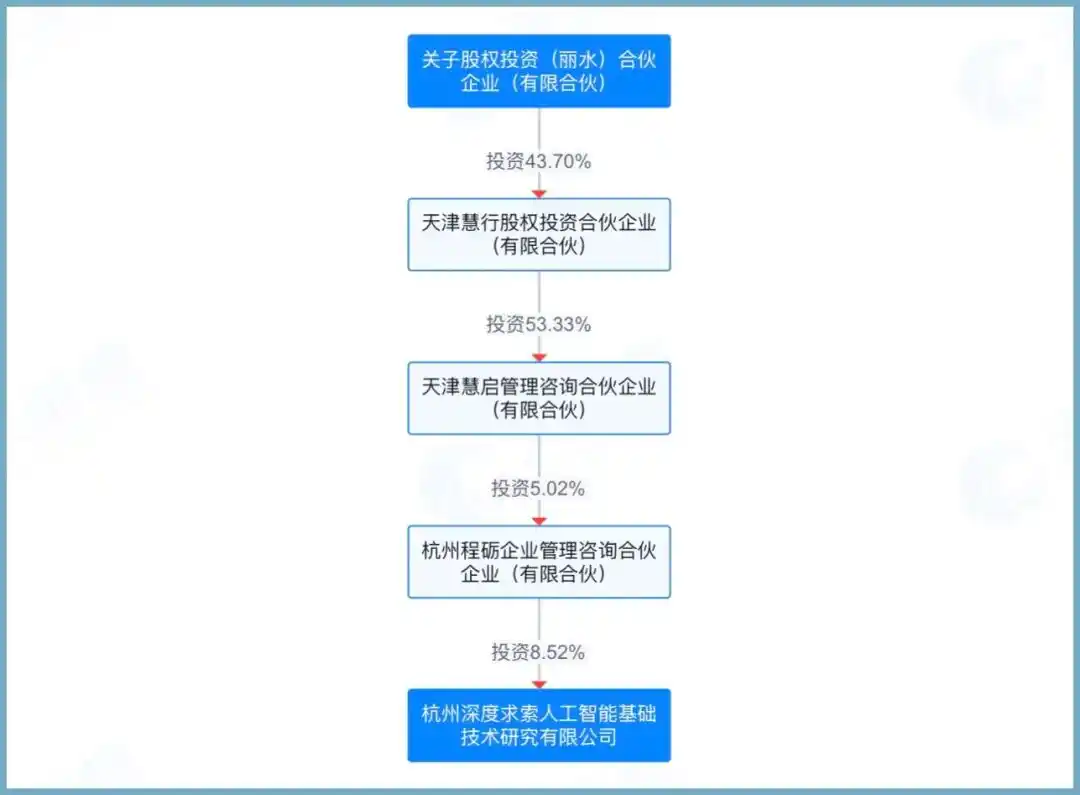
In DeepSeek’s first round, investors other than the National AI Fund entered through an entity called Hangzhou Chengli, according to the article. Those investors included Tencent, CATL, NetEase, JD.com, IDG Capital, Loyal Valley Capital, Monolith Capital, and Shixiang Technology.
Zhong’s path into the deal followed the same structure. Tianjin Huiqi held about 5% of Hangzhou Chengli, while Tianjin Huixing held more than 50% of Tianjin Huiqi.
Further up the chain, the largest shareholder of Tianjin Huixing, with a 43.7% stake, was Guanzi Equity Investment (Lishui) Partnership (Limited Partnership). That entity belongs to Guanzi Private Equity Fund Management (Hangzhou) Co., Ltd., or Guanzi Venture Capital, which the article identifies as an investment platform controlled by Zhong.
Citing Tianyancha data, the report estimates Guanzi Venture Capital’s investment at roughly RMB 354 million, based on Tianjin Huixing’s registered capital of RMB 804 million. Tianjin Huiqi and Tianjin Huixing were both established in May and June this year, and the article argues that the structure was set up specifically for the DeepSeek financing.
Zhong and DeepSeek founder Liang Wenfeng both built their careers in Hangzhou. The report notes that both men have kept a low profile for years, making this intersection unusual.
From Nongfu Spring and Wantai Bio to Guanzi Venture Capital
Zhong built his fortune in industry and controls Nongfu Spring and Wantai Bio. Nongfu Spring is described in the article as a 30-year-old leader in bottled water and beverages. Wantai Bio, by contrast, traces back to an earlier investment: in 2001, Zhong acquired 95% of the company for RMB 17.1 million. In 2020, Wantai Bio listed on the Shanghai Stock Exchange, and its market value at one point exceeded RMB 100 billion.
That same year, Nongfu Spring completed its Hong Kong IPO. With two listed companies under his umbrella, Zhong rose to become China’s richest man. In the following year, Guanzi Venture Capital was established in Hangzhou with registered scale of more than RMB 2 billion, wholly owned by Yangshengtang Co., Ltd., which is ultimately controlled by Zhong.
Since then, Guanzi Venture Capital has made repeated moves in the primary market, backing companies including Saimoluo Bio, Jiayue Pharma, Life Bio, Ruijian Pharma, Jiake New Materials, and Zhuochen New Materials. Most of those bets have been concentrated in pharmaceuticals and new materials.
Still, AI was not entirely new territory. According to Lightelligence’s Hong Kong IPO filing, Guanzi Venture Capital had previously been a pre-IPO shareholder in the company, which the article calls the first AI optical chip stock. This indirect DeepSeek investment, however, is described as Zhong’s first move into the hot AI large-model track.
Three investment arms under the Yangshengtang system
The report says that, beyond Guanzi Venture Capital, two other investment entities under Zhong’s Yangshengtang system have also been active: Qiantang New Materials Laboratory and the Kunshan Gewu Zhizhi fund.
Qiantang New Materials Laboratory was established in 2024, with a first-phase investment plan of RMB 1 billion. Its stated role is to connect lab technology with industrial application, and it favors startups founded by scientists and industry veterans. Since launch, it has quietly invested in more than 10 companies, nearly all in hard tech, with a strong focus on new materials. The names listed in the article include Kunhepang Technology, Jingyuanhong Technology, Yishengxin Technology, Yanyuan Natan, Chaocai Materials, and Qianyu New Materials Technology.
After 2025, the pace of those deals increased. In August 2025, the lab invested in photonic chip company Qiming Photonics. In June this year, it backed superconducting thin-film equipment company Shanghai Superconductor. In July, it made its first investment in embodied intelligence company Oak Fruit Robotics.
The report adds that Qiantang New Materials Laboratory often acquires sizable stakes and becomes a core shareholder. In a number of cases, portfolio companies later moved their registered addresses to Yunpu Street, Shuangpu Town, Xihu District, Hangzhou, which is also the location of Yangshengtang Co., Ltd.
The Kunshan Gewu Zhizhi fund has also invested in a range of early-stage technology projects. One recent deal highlighted in the article involved Zhibang Lithium Battery New Materials, a solid-state battery company from Quzhou, Zhejiang. In the company’s Series A round, Kunshan Gezhi Phase I Venture Capital Partnership took a 10% stake for RMB 500 million.
Earlier investments by the same fund included Zhongke Tiansuan, which works on space computing power, as well as Zhongke Jingyi, Saicun Bio, Huake Lengxin, Hongrun Qingyuan, and Tongya Electronics.
Taken together, Guanzi Venture Capital, Qiantang New Materials Laboratory, and the Kunshan Gewu Zhizhi fund form a distinct technology investment map under the Yangshengtang system.
DeepSeek’s first round also drew in established industrial capital
The article places Zhong and similar investors in the category of old money. Over the past two decades, sectors including consumer goods, real estate, internet services, new energy, and innovative drugs produced successive waves of wealth creation for both founders and investors.
That capital is now appearing in AI and hard tech. In DeepSeek’s first round alone, the report says CATL’s system contributed RMB 5 billion, while Andon Health, By-Health, and Septwolves also surfaced in the ownership structure.
- Andon Health’s unit Jiuan Hong Kong invested RMB 750 million and indirectly took part in DeepSeek through the Tianjin Shixiang Industry Fund. The article says Andon Health has also invested in Moonshot AI, Muxi, StepStar, and AgiBot.
- By-Health committed RMB 130 million to Monolith Capital’s Lisi Xingling Venture Fund and indirectly holds 0.04% of DeepSeek. The article adds that By-Health has also invested in Moonshot AI and StepStar.
- Septwolves chairman Zhou Shaoxiong, through an entity he controls called Ningbo Yishang, invested about RMB 150 million into Tianjin Huixing, thereby indirectly backing DeepSeek. At the group level, Septwolves has also invested in Moore Threads and Unitree Robotics, according to the article.
The piece closes by citing a line from the founder of Haier Group: 「There are no successful companies, only companies of their times.」 In the article’s framing, as the names of established industrial capital grow denser around AI and hard-tech deals, wealth and resources accumulated in earlier cycles are being redeployed in search of a new era’s coordinates.
The article was originally published by the WeChat account Touzijie (ID: pedaily2012) and written by Feng Yuchen.