
Crypto privacy moves beyond the chain
Zero-knowledge systems and other privacy tools can hide what a user does on-chain without hiding who the user is. Mobile wallets are usually light clients. They do not keep a complete copy of the blockchain locally, so they rely on remote servers to retrieve balances and other chain data and to broadcast transactions. Those servers can see a user’s IP address, the content of a query, and the time at which the request was made. The combination can become an identity link outside the chain.
The Zcash wallet team behind Zodl, formerly known as Zashi, has started moving users to a new wallet-server architecture. The design is intended to ensure that a user’s IP address and wallet request data do not reach the same operator. It shipped with Zodl 3.20.0 and is enabled by default, with no manual setup required.
The change is a departure from the wallet’s earlier configuration. When the author tested Zashi’s shielded swap feature a year ago, its built-in Tor client was an option users had to select. Zodl now treats network-layer protection as the default starting point. The team said the upgrade would be rolled out to all users in stages over the following days.
Why an IP address can identify a wallet user
Within the Zcash ecosystem, lightwalletd servers handle data queries and transaction broadcasts for light wallets. Even if a user’s ZEC is fully shielded on-chain, repeated connections can expose the user’s IP address, request timing, and access patterns. A party with a broad monitoring view may use those signals to connect wallet activity with a real-world identity.
This is not only a theoretical concern. Developer b10c publicly documented an entity called LinkingLion in 2023. The entity tracks which Bitcoin nodes are first to broadcast newly created transactions. That vantage point can connect a fresh BTC transaction with the real IP address behind its first broadcast. LinkingLion’s activity can be traced back as far as 2018, suggesting that it may have accumulated years of connection intelligence.
Similar metadata monitoring reaches other crypto networks and privacy coins. b10c previously observed that the same group of IP ranges associated with LinkingLion also connected to Monero nodes. For wallets, the question is not simply whether a transaction is hidden on-chain. It is also which network entry point handled the query or the first broadcast.
OHTTP separates identity from request content
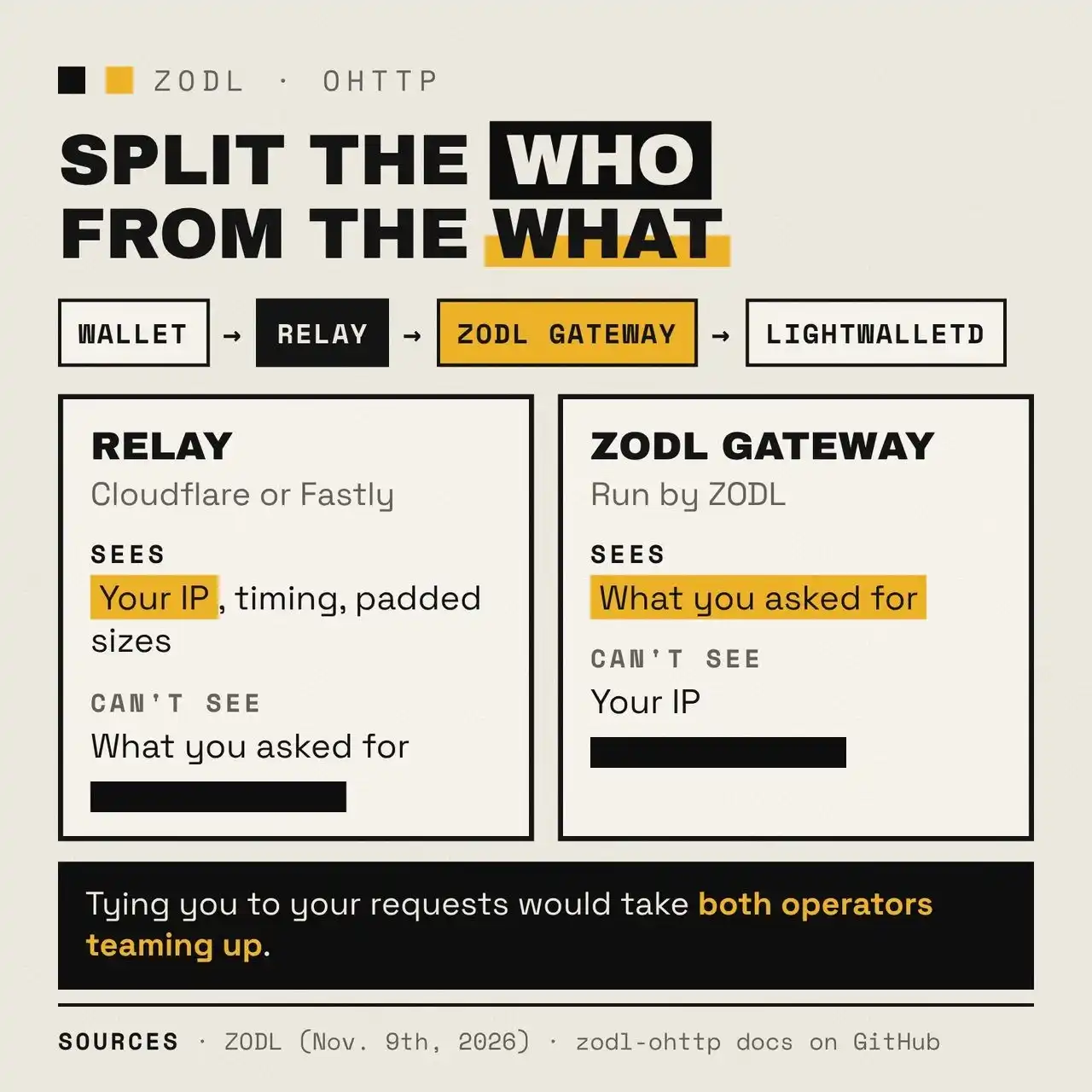
Before the new architecture, Zodl users who wanted to conceal network metadata had two main choices: use a slower Tor proxy or trust the server operator not to misuse the information it could see. Zodl 3.20.0 introduces Oblivious HTTP, or OHTTP. The protocol is an IETF Internet standard. Its central design splits one communication flow between two independent parties.
- The wallet encrypts each request locally with a key that only the ZODL gateway can decrypt.
- The encrypted packet travels to a relay operated by Cloudflare or Fastly. The relay removes the network headers that contain identifying information and forwards the packet. It knows the source IP, but it cannot read the request.
- The ZODL gateway is the only node in the path that can decrypt the request. It can see what the user wants to retrieve, but the visitor address it sees belongs to the relay. The gateway then forwards the request to lightwalletd.
Cloudflare or Fastly knows who is asking. ZODL knows what is being asked. Neither side, acting alone, has both pieces of information.
The publicly available open-source code includes two additional defenses: traffic-size padding and unlinkable logging. Outgoing requests are padded into fixed size bands, with steps of roughly 4 KB. Transaction broadcasts are padded upward to 16 KB or more. Sensitive responses use the same approach. The goal is to make it harder for an observer to infer whether a user is checking a balance or broadcasting a transaction from the size of a packet.
The logging system addresses the risk that relay and gateway records could be matched after the fact. Request IDs generated at the relay are not written to ZODL logs in plaintext. Instead, the gateway uses a rotating key that exists only in memory to calculate an HMAC fingerprint, which is then logged. When the gateway restarts, the key is destroyed. That prevents later alignment of ZODL logs with relay logs.
The limits of an OHTTP privacy shield
OHTTP depends on a central assumption: the relay operator and ZODL do not collude. The relay can still observe when a user connects and estimate the amount of traffic being sent. It simply cannot see the plaintext payload.
Critics on the Zcash community forum have pointed out that Cloudflare and Fastly are US companies and must comply with legally valid requests for information. Presenting OHTTP without its limits could give some users a false sense of security.
y4ss, a core ZODL contributor, acknowledged the limitation. He described OHTTP as a better default starting point, but said it does not replace Tor or Nym against nation-state-level adversaries. He had also suggested that users whose threat model includes legal pressure on cloud infrastructure could layer Zodl’s Tor option on top of OHTTP. In that configuration, the Cloudflare relay would see the IP address of a Tor exit node rather than the user’s real address.
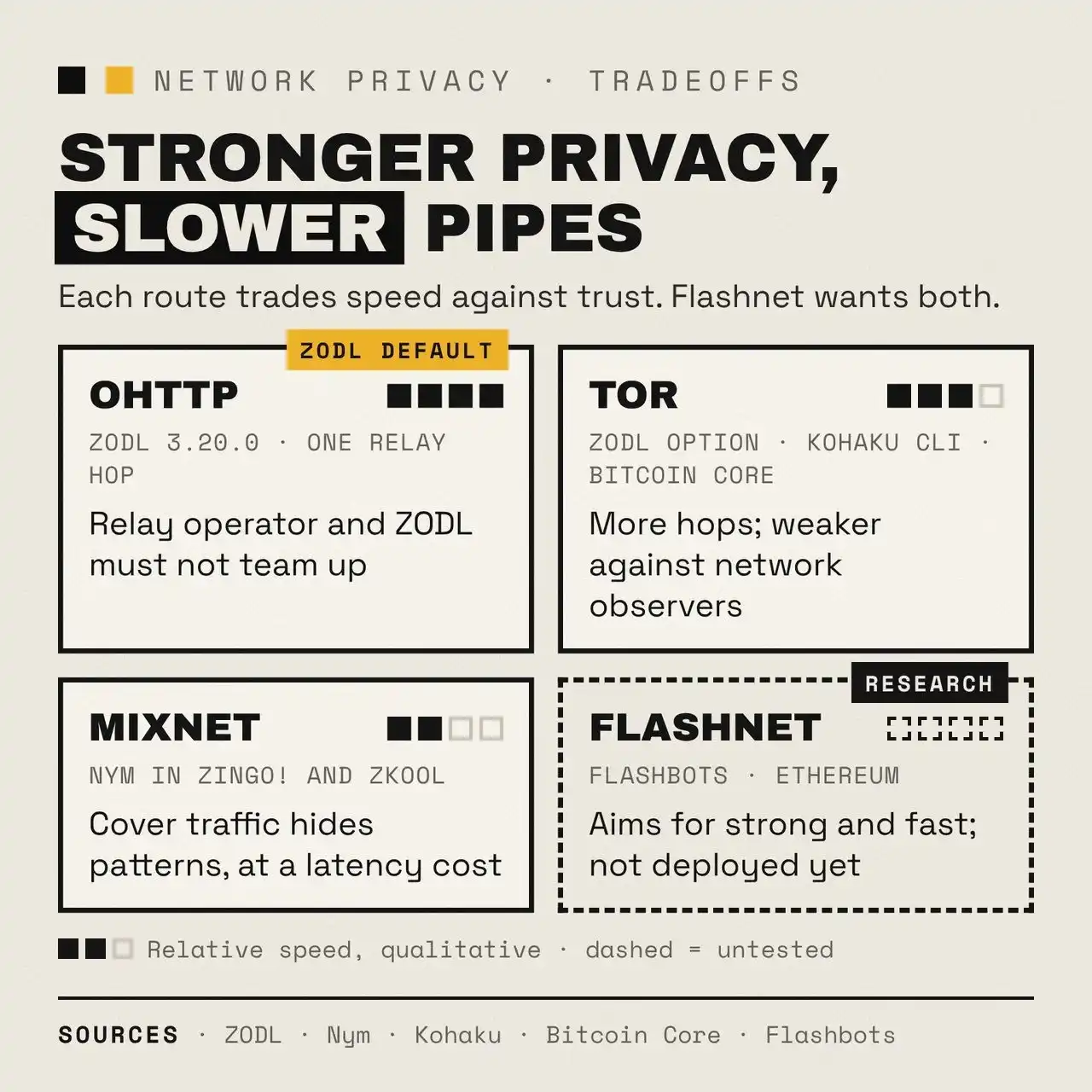
OHTTP adds only one lightweight relay hop, so its performance cost is low enough for a default setting aimed at all users. It does not eliminate every trust assumption. It changes the default from exposed network metadata to basic network privacy.
Nym’s mixnet trades speed for stronger concealment
Zodl is one part of a wider effort to defend the network layer. Mixnets offer a stronger and heavier approach. They split communication across multiple relay hops, pad packets to the same byte size, and inject large volumes of decoy traffic. This makes it difficult for a monitor to match traffic entering the network with traffic leaving it.
Nym said in September that two Zcash wallets had integrated its mixnet. Zingo offers a one-click switch, while Zkool lets users route a node connection directly through the mixnet. Nym is also in discussions with Zodl about a possible partnership. At Devcon 8 last week, Nym released a new software development kit intended to help more wallets and decentralized applications connect to the mixnet. The clear cost is speed: multiple layers of obfuscation add latency.
Ethereum, Flashnet and Bitcoin take different paths
The Ethereum Foundation’s Kohaku privacy wallet project has treated IP and RPC leakage as core goals since its launch. The newly released Kohaku command-line tool sends all traffic except calls to a user’s own local RPC through Tor by default.
An anon-rpc proposal introduced by the Ethereum Foundation in June seeks to provide wallets with a general interface for connecting to any anonymity network when needed. Versions supporting Tor and Nym are now running on mainnet, and the web interface for Privacy Pools v2 has adopted the system. Once a user activates the Connect with Tor option, RPC requests can automatically use the anon-rpc channel.
Flashbots is exploring another route. Flashnet, introduced in February, is a research project for anonymous Ethereum transaction submission. Users place transactions into random slots in a shared batch and secret-share them. The shares are reconstructed across a group of servers, separating an individual transaction from its sender.
Flashnet is designed to avoid two weaknesses at once: the limited protection of Tor against certain monitoring models and the high latency of mixnets. It has not yet received a formal mainnet deployment, and no benchmark stress-test data has been released.
Bitcoin developers have spent years working on the first hop of transaction broadcasts. Bitcoin Core 31.0, released in April, added an optional private-broadcast feature that sends transactions outward only through Tor or the I2P anonymity network. Each transaction also gets its own separate connection, making it harder for an outside observer to tie multiple transactions to one network session.
The mechanism directly addresses the kind of monitoring associated with LinkingLion. It was not complete at launch. In June, developers disclosed a bug that caused a node to retry over the public network when an anonymous handshake failed, exposing the sender’s IP address. The issue was fixed in version 31.1.
Default privacy and infrastructure concentration
OHTTP alone is not a high-strength privacy solution against a well-resourced nation-state surveillance adversary. Its main value is broader coverage for ordinary users. A Zodl user can hide a real IP address from the wallet service without working through a complicated configuration process. When Ethereum launched the Kohaku privacy wallet in October 2025, David Hoffman expressed a similar principle: privacy should be built into products at release rather than treated as an option that users must configure themselves.
The infrastructure model creates a separate concern. An Ethereum Foundation article on anon-rpc identified heavy dependence on cloud gateways such as Cloudflare as a single-point risk. A centralized gateway may be able to inspect request traffic and may also have the authority to deny service. Zodl’s OHTTP design uses Cloudflare as one half of its privacy split.
The two designs address different risks. OHTTP limits the information held by any one company by separating identity from request content. anon-rpc is more concerned with who has the power to cut off service. Zodl still allows users to switch back to community nodes in advanced settings. Even so, a future in which most privacy products rely on a small number of cloud giants would create a concentration risk that the industry would still have to address.
From Zodl, Nym, Kohaku and anon-rpc to Flashnet and Bitcoin Core, network transport has become a major focus of crypto privacy work. Hiding on-chain activity is no longer the only design question. The network path used to connect a wallet, retrieve data and broadcast a transaction has become part of the privacy model.



