News

Gate
2026-07-13 11:14:55

CoinDesk says Gate posted the fastest spot volume growth in June, ranking among the top three globally

CoinDesk’s latest exchange report said global centralized exchange spot trading volume rose 15.3% month over month to $1.11 trillion in June, ending a five-month decline. Gate was one of the strongest movers in the report. Its spot trading volume climbed 50.8% from a month earlier to $66.1 billion, the fastest growth rate among centralized exchanges tracked in the report. Gate’s spot market share also increased by 1.55 percentage points to 5.95%, leading the global increase and reaching its highest level since October 2025. The report also highlighted gains in derivatives. Gate’s June derivatives trading volume reached $369 billion, while its market share rose to 9.52%, keeping it in fourth place among global derivatives exchanges. In open interest, Gate posted a 9.20% share, placing it among the top three retail-focused derivatives exchanges worldwide. Combining its spot and derivatives business, Gate ranked fourth globally by overall trading scale, according to CoinDesk.

00
CoinDesk says Gate posted the fastest spot volume growth in June, ranking among the top three globally
Hyperliquid
2026-07-13 11:10:51

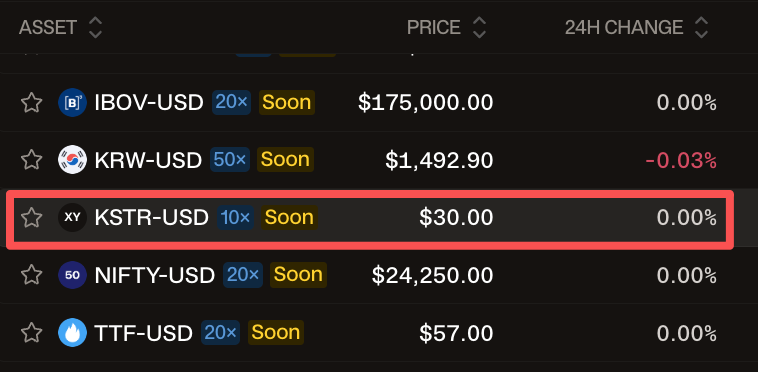
Hyperliquid to list STAR 50 ETF under ticker KSTR

Hyperliquid is set to list a STAR 50 ETF with the ticker KSTR, according to monitoring shared by Ai Yi. The item was carried by Foresight under its market analysis category. The source text does not include added details such as the exact listing schedule, trading parameters, or product structure. At this stage, the reported fact is limited to the upcoming listing and the ticker symbol attached to the product.

00
Hyperliquid to list STAR 50 ETF under ticker KSTR
Bybit
2026-07-13 11:03:27

Bybit lists pre-market perpetuals tied to OpenAI and Anthropic

Bybit has listed U.S. pre-market perpetual contracts for OpenAI and Anthropic under the pairs OPENAIUSDT and ANTHROPICUSDT, with leverage of up to 20x. The exchange said the products give users a way to take part in price discovery for the two AI companies before any public listing. OpenAI and Anthropic, known for developing ChatGPT and Claude respectively, are described in the source as the world’s two highest-valued artificial intelligence companies. Both remain privately held and have not gone public. The new listings add AI-linked exposure to Bybit’s derivatives lineup through pre-market contracts tied to companies that are not yet publicly traded.

00
Bybit lists pre-market perpetuals tied to OpenAI and Anthropic
Polymarket
2026-07-13 11:02:15

Polymarket’s 5-Minute BTC Contract Faces Manipulation Questions

A Foresight report raised questions over Polymarket’s 5-minute BTC contract, saying the market may have shown signs of large-scale manipulation. The piece frames the issue as a core tension in prediction markets: whether they are aggregating information or becoming tools that can influence outcomes. It also says the episode exposes structural risks tied to ultra-short-dated contracts on prediction platforms. The report was categorized as a homepage headline and linked to a post on X as its source.

40
Polymarket’s 5-Minute BTC Contract Faces Manipulation Questions
Bitcoin
2026-07-13 11:02:14

Bitcoin May Need Trillions in Fresh Capital for Another Major Bull Run, On-Chain Reports Say

Bitcoin’s latest drawdown is not being read as a simple repeat of past bear markets. A set of recent on-chain reports points to a tougher reality: each new cycle now appears to require far more capital to produce smaller percentage gains. CryptoQuant CEO Ki Young Ju estimated that while a few million dollars could once double Bitcoin’s price, a comparable move today may require more than $100 billion, and a renewed parabolic advance could demand at least $1 trillion in fresh inflows. At the same time, supply in active circulation keeps shrinking. K33 Research said long-term holders now control 79% of circulating supply, a record high, while Alphractal and other datasets show coins continue moving from short-term trading wallets into dormant addresses. That tighter float can amplify price moves, but several firms, including Bitfinex, Wintermute and Glassnode, say ETF inflows, stablecoin expansion and institutional positioning are still not strong enough to confirm a lasting reversal. Other indicators are flashing deep-cycle stress. CryptoQuant’s realized profit/loss ratio fell to -0.35, a 43-month low, a level that previously aligned with late-bear-market conditions. Even so, macro pressure remains. US spot Bitcoin ETFs posted their worst month since launch in June, with more than $4.5 billion in net outflows, while rate uncertainty continues to weigh on risk assets.

40
Bitcoin May Need Trillions in Fresh Capital for Another Major Bull Run, On-Chain Reports Say
AI agents
2026-07-13 11:02:14

GenLayer pitches a blockchain-based “internet court” for disputes between AI agents

As AI agents start shopping, trading, hiring and paying on users’ behalf, one unresolved question is moving closer to the center of the stack: who handles the disputes when those transactions go wrong? Forbes reports that GenLayer, a blockchain project run by the Cayman Islands-based GenLayer Foundation, has launched an “internet court” designed to resolve conflicts between software agents through AI-assisted adjudication. The system is built around pre-agreed contracts, escrowed payments and a jury process made up of blockchain validators running different models such as Claude, GPT and Gemini. If two sides disagree, the network reviews evidence and issues a decision within minutes. GenLayer says the approach is aimed at smaller claims where hiring lawyers makes little economic sense. The project has backing from 26 crypto and AI companies, including OKX, MetaMask and BNB Chain. According to GenLayer Labs co-founder and CEO Albert Castellana, the network is already live in testing, handling about 350,000 transactions a day and generating 20,000 to 25,000 decisions. The team plans a broader public launch later this year, along with a token meant to attract more validators. The effort arrives as AI-driven commerce expands, arbitration groups publish standards for agent interactions, and traditional courts begin hearing cases tied to AI agents operating across online platforms.

00
GenLayer pitches a blockchain-based “internet court” for disputes between AI agents
Robinhood
2026-07-13 11:02:14

Robinhood case points to Ethereum L1+L2 as the default stack for real-world crypto businesses

A TechFlowPost article by Ethereum community member Ryan Berckmans argues that the logic behind blockchain infrastructure selection is shifting as crypto moves away from token-led narratives and toward cash-flow businesses serving real users. In that framework, Robinhood is presented not as a counterexample to existing layer-1 and layer-2 networks, but as evidence that enterprises making commercially driven decisions often end up choosing Ethereum’s L1+L2 model. The article says Robinhood picked Ethereum as its base layer and then built Robinhood Chain with Arbitrum technology. According to the piece, the network uses Ethereum blobs for data availability, ETH as the native gas token, and a standard bridge secured by Ethereum. Berckmans argues that this setup fits how regulated businesses evaluate risk, liquidity, control, and compliance, especially when they do not need to issue a separate token to support their business model. The article extends that argument to a broader market transition. As regulated institutions, including brokers, payment firms, banks, asset managers, and governments, build around stablecoins, tokenized assets, and onchain services, Berckmans says the industry’s center of gravity is moving toward Ethereum as a settlement and liquidity base, with L2s handling customization and performance. Coinbase’s Base is cited as another example of the same commercial choice.

00
Robinhood case points to Ethereum L1+L2 as the default stack for real-world crypto businesses
Policy Regula
2026-07-13 11:02:07

Prosecutorial Daily article in China proposes treating mixer and privacy coin use as signs of laundering intent

A report cited by BlockBeats said an article published in Procuratorial Daily, the official newspaper of China’s Supreme People’s Procuratorate, laid out a proposed prosecution framework for cryptocurrency money laundering cases. The article was written by researchers from the Yuhu District People’s Procuratorate of Xiangtan, Hunan, and the Law School division of Xiangtan University. The piece suggested that courts could infer criminal intent when a suspect used mixers or privacy coins and failed to provide a reasonable rebuttal. It also proposed using verifiable on-chain records and reports from blockchain analytics firms as evidence in such cases. In a separate recommendation, the article called for a national-level platform to hold and dispose of seized crypto assets through compliant channels such as targeted auctions. The article said Chinese prosecutors had charged more than 3,000 people in cryptocurrency-related money laundering cases since 2024. It also cited Chainalysis data saying Chinese-language laundering networks processed about $16 billion in 2025, accounting for roughly one-fifth of the global crypto money laundering total. BlockBeats noted that the article itself does not carry legal force.

00
Prosecutorial Daily article in China proposes treating mixer and privacy coin use as signs of laundering intent