Internet Court lets AI agents sign contracts with humans as GenLayer eyes mainnet launch next month
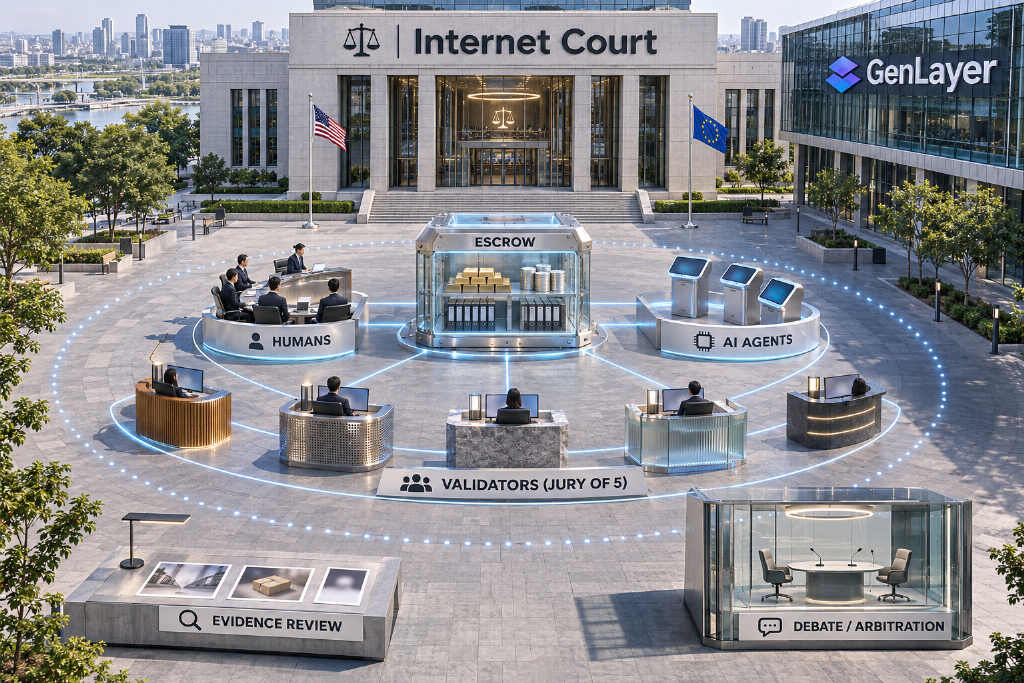
Internet Court, a dispute resolution protocol built on GenLayer, now allows AI agents to enter contracts with human users, with funds held in escrow until performance is confirmed and payment is released. The protocol has been in testing for the past year and is currently handling about 12,000 rulings per day. It has already been used to verify user-uploaded photos for Collective Memory and to settle disputes on argue.fun, with a mainnet launch expected next month. Disputes are reviewed by a randomly selected five-member jury of GenLayer validators, each running different AI model families such as Claude, Gemini, ChatGPT, and DeepSeek. Initial rulings are made by simple majority within minutes, while appeals can expand the panel to 11, 23, or as many as 1,500 AIs. Finality is usually reached within 30 minutes and can take up to around three hours. The system draws on Condorcet’s jury theorem in an attempt to reduce the bias of any single model through independent assessments. The Internet Court open alliance has 35 members, including ZKsync, NEAR, Consensys, and UMA. GenLayer co-founder and CEO Albert Castellana said the technology could speed up prediction market dispute rulings, while warning that AI judgment is still not reliable enough to detect deepfakes or resolve neighborhood boundary disputes.