APLD

US stocks
2026-09-09 13:41:35

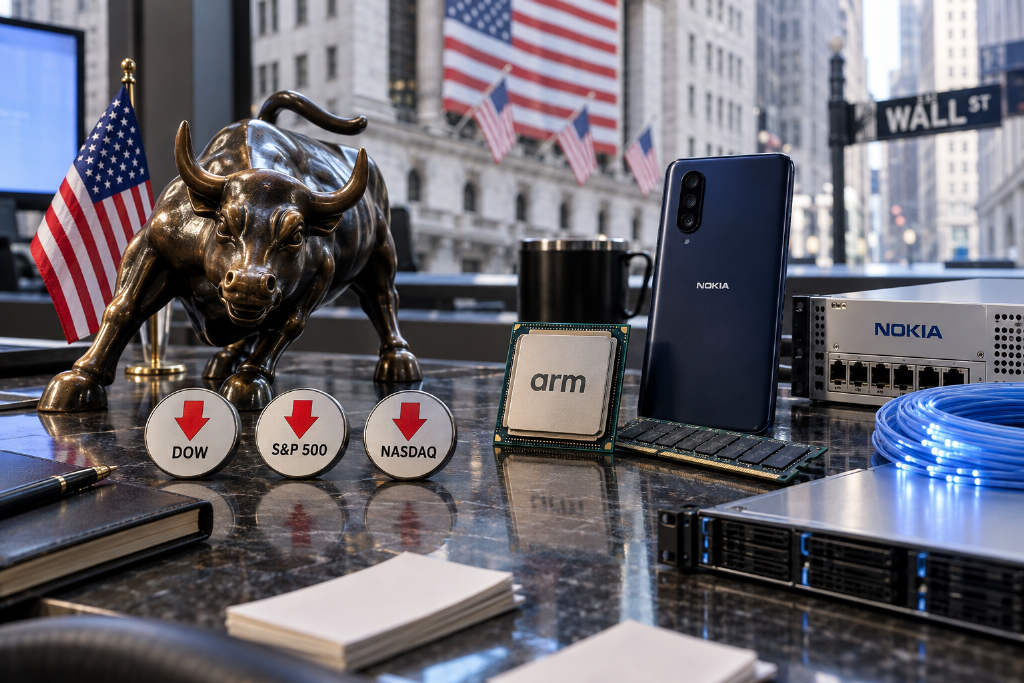
U.S. stocks open lower as Arm and Nokia rise more than 4%

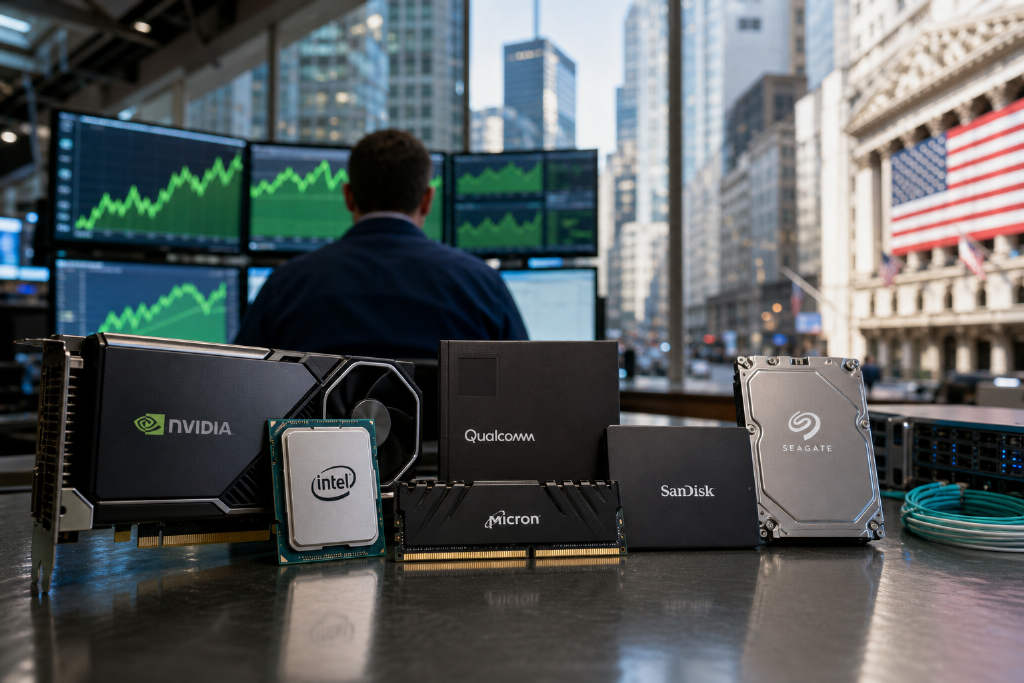
U.S. stocks opened lower on Sept. 9, according to market data from BIT (bit.com), with all three major indexes in negative territory at the open. The Dow Jones Industrial Average fell 0.70%, the S&P 500 slipped 0.29%, and the Nasdaq dropped 0.34%. Even as the broader market moved lower, several hardware-related segments posted gains. Optical communications names led the advance, with Nokia (NOK) up 4.11%, Marvell Technology (MRVL) up 3.38%, Astera Labs (ALAB) up 2.98%, Coherent (COHR) up 2.92%, and Lumentum (LITE) up 2.81%. Memory stocks were broadly higher as well. SK Hynix (SKHY) gained 3.36%, Western Digital (WDC) rose 1.55%, Seagate Technology (STX) added 0.44%, SanDisk (SNDK) climbed 0.43%, and Micron Technology (MU) was up 0.31%. Semiconductor shares also extended gains, led by Arm (ARM), which rose 4.68%. Marvell added 3.38%, Qualcomm (QCOM) gained 2.86%, and AMD advanced 1.86%. In the Neocloud segment, moves were mixed: Nebius (NBIS), Hut 8 (HUT), and Applied Digital (APLD) traded higher, while Cipher Digital (CIFR) and Galaxy Digital (GLXY) declined.

50
U.S. stocks open lower as Arm and Nokia rise more than 4%
US stocks
2026-09-03 12:30:00

ADP Miss Lifts Metals and Utilities as Hecla Jumps 8.69%; Ciena Earnings Up Next

U.S. stocks closed higher on Sept. 2, with the Dow Jones Industrial Average up 0.56%, the S&P 500 rising 0.47%, and the Nasdaq gaining 0.45%. The immediate macro trigger was August ADP private payrolls, which increased by 38,000, below the 47,000 expected. That eased rate-hike bets and pushed investors toward precious metals and utilities. Hecla Mining stood out. The silver miner rose 8.69% to $20.77 even as silver moved less than 1% on the day, a move the report framed as a clear example of operating leverage in mining equities. The same article also compared silver-linked names with gold-focused miners, showing a much stronger reaction on the silver side. Beyond the daily market move, the report examined whether Bitcoin mining companies that have shifted toward AI data center capacity have really broken away from crypto price exposure. Its conclusion was that price action has not truly decoupled; what the market is separating is contract quality, especially the identity and concentration of the paying counterparties. Attention now shifts to Ciena, scheduled to report before the market at 12:30 UTC on Sept. 3. The key question is whether the optical networking company will raise its full-year fiscal 2026 revenue guidance again after previous increases from $5.9 billion to $6.1 billion and then $6.3 billion.

270
ADP Miss Lifts Metals and Utilities as Hecla Jumps 8.69%; Ciena Earnings Up Next
U.S. stocks
2026-09-02 13:36:35

U.S. stocks open with memory and chip names turning higher, while Neocloud and optical communication losses narrow

U.S. stocks opened mixed on Sept. 2, with the Dow up 0.44%, the S&P 500 up 0.07% and the Nasdaq down 0.08%, according to BIT (bit.com) market data. AI-related names recovered after the open, helping memory and semiconductor shares turn higher. Neocloud and optical communication stocks also pared earlier losses. Among memory names, Sandisk, Micron and Seagate led gains, while most semiconductor stocks, including Qualcomm, Nvidia and Intel, moved higher. Several Neocloud and optical communication names remained lower, with Credo down 9.65% and Lumentum edging up 0.22%.

300
U.S. stocks open with memory and chip names turning higher, while Neocloud and optical communication losses narrow
Nvidia
2026-08-26 23:49:46

Nvidia earnings beat lifts AI names in after-hours trading, with NBIS up 6.27% and NVDA up 4.08%

Nvidia’s latest quarterly results lifted a broad range of AI-linked U.S. stocks in after-hours trading on Wednesday, according to market data cited by BlockBeats from BIT (bit.com). The chipmaker reported another quarter that came in above market expectations and said it expects sales to grow by about 70% in the next fiscal year. The move spread across several segments tied to AI infrastructure. In memory, SK Hynix rose 4.48%, SanDisk gained 3.71%, Micron Technology added 3.67%, Seagate Technology climbed 3.15%, and Western Digital rose 3.11%. Neocloud names also advanced, led by Nebius at 6.27%, followed by CoreWeave at 4.76%, Applied Digital at 3.26%, while IREN and Core Scientific each gained 3.16%. Optical communications stocks moved higher as well, including Applied Optoelectronics, Marvell Technology, Credo, Coherent, and Astera Labs. Semiconductor names also posted gains, with Arm up 4.18%, Marvell and Nvidia both up 4.08%, Lam Research up 2.65%, and KLA up 2.42%.

390
Nvidia earnings beat lifts AI names in after-hours trading, with NBIS up 6.27% and NVDA up 4.08%
VanEck
2026-08-15 09:14:43

VanEck’s Matthew Sigel says AI infrastructure is not a bubble, while institutional disappointment with major L1s is weighing on crypto

Matthew Sigel, head of digital assets research at VanEck and manager of the VanEck Onchain Economy ETF (NODE), said the current AI infrastructure boom should not be viewed as a replay of the 19th-century U.S. railroad bubble. Speaking on The Rollup podcast episode “AI Super Cycle,” aired on Aug. 10, 2026, Sigel argued that the key difference lies in financing: railroad expansion relied on government-led land grants and speculative bond issuance, while today’s AI buildout is backed by private-sector contracts, multiyear leasing commitments, customer prepayments, and more than $2 trillion in cloud backlog held by the four largest cloud providers. He added that AI factories can begin producing value once connected to power, fiber, and chips, unlike railroads, which required a completed coast-to-coast network before their utility fully emerged. Sigel also said crypto’s weak price action has less to do with macro conditions and more to do with institutions losing conviction in major layer-1 networks such as Solana and Ethereum. VanEck has cut exposure to mainstream L1s since the U.S. election, he said, after many tokens doubled without a comparable acceleration in real adoption or breakout applications. In their place, the firm has turned more attention to enterprise chains linked to companies including Circle, Stripe, Robinhood, and, as Sigel noted, even research efforts at Wells Fargo. He said regulated institutions want predictable fee structures and are reluctant to place meaningful capital directly on open public chains. Sigel said NODE has outperformed Bitcoin by nearly 100 percentage points over the past 15 months, driven largely by an early bet on Bitcoin miners pivoting toward AI data center infrastructure.

810
VanEck’s Matthew Sigel says AI infrastructure is not a bubble, while institutional disappointment with major L1s is weighing on crypto
VanEck
2026-08-11 04:03:04

VanEck’s Matthew Sigel says AI infrastructure is not a bubble, while institutional disappointment with L1s is weighing on crypto

Matthew Sigel, head of digital assets research at VanEck and manager of the VanEck Onchain Economy ETF (NODE), said the current AI infrastructure trade should not be viewed as a replay of the 19th-century railroad bubble. In his view, the key difference is funding: this cycle is backed by private-sector contracts, multi-year backlog, customer prepayments, and in some cases customer-supplied GPUs, rather than government-led land grants and speculative bond issuance. Sigel said the four largest cloud providers now hold more than $2 trillion in signed backlog, with Microsoft and Oracle accounting for roughly half. Sigel also argued that crypto’s weak tone is not mainly a macro story. He said institutions have grown disappointed with major Layer 1 networks after many tokens doubled following the election without a breakout application or a clear wave of new capital formation. VanEck has reduced exposure to Solana, ETH, and other mainstream L1s since the election, while paying closer attention to enterprise-chain efforts tied to Circle, Stripe, Robinhood, and even Wells Fargo. He said regulated institutions do not want to place significant value directly on open networks and often need to support several chains at once, which weakens the winner-take-all case for any single L1. On portfolio positioning, Sigel said NODE has outperformed Bitcoin by nearly 100 percentage points over the past 15 months, largely by identifying the undervalued power and land controlled by Bitcoin miners shifting toward AI data center use.

1200
VanEck’s Matthew Sigel says AI infrastructure is not a bubble, while institutional disappointment with L1s is weighing on crypto
Roundhill Inv
2026-08-07 00:36:58

Roundhill launches NCLD to target neocloud firms serving AI compute demand

Roundhill Investments launched the Roundhill Neocloud ETF, trading under the ticker NCLD, on Aug. 6, 2026. The actively managed fund is listed on Nasdaq and carries a 0.65% expense ratio. Its focus is the so-called neocloud segment: companies that rent out GPU computing power and operate AI data center infrastructure. Current holdings show a highly concentrated portfolio. Nebius Group accounts for 30.83% and CoreWeave for 27.30%, putting the two names at more than 58% combined. The rest of the top positions include IREN, HUT 8, Terawulf, Applied Digital, Cipher Digital, Galaxy Digital, Core Scientific, and Cleanspark. Several of those companies are known for their roots in bitcoin mining before expanding into AI data center and compute services. According to Roundhill, AI compute demand is growing faster than supply can expand. The article contrasts neocloud providers with traditional cloud platforms such as AWS, Microsoft Azure, and Google Cloud, saying the newer firms are built more directly around GPU-as-a-Service for AI and high-performance computing workloads. It also cites Morgan Stanley’s estimate that global data-center-related capital spending could reach $2.9 trillion by 2028. The source notes that NCLD offers targeted exposure to this theme, but its concentrated holdings and relatively small fund size could bring higher volatility and liquidity risk than broader index ETFs.

1370
Roundhill launches NCLD to target neocloud firms serving AI compute demand
Leopold
2026-07-30 16:26:08

Leopold-linked fund reportedly cut most positions as its former holdings jumped more than 20%

Market data cited by BlockBeats showed that Situational Awareness, the fund tied to 25-year-old Wall Street AI stock picker Leopold, was reported on July 31 to have sold most of its holdings. The move came just before a sharp rally in names previously listed in its Q1 13-f filing. Those stocks all posted gains above 20%, according to BIT(bit.com) market data. CleanSpark rose 21.61%, Riot Platforms added 23.70%, and Applied Digital climbed 21.27%. Core Scientific was up 22.93%, IREN Ltd gained 28.83%, and CoreWeave advanced 24.53%. SanDisk rose 24.34%, while Bloom Energy jumped 27.05%. The report framed the move as Leopold exiting before the rally in the fund’s previously disclosed positions.

1150
Leopold-linked fund reportedly cut most positions as its former holdings jumped more than 20%