
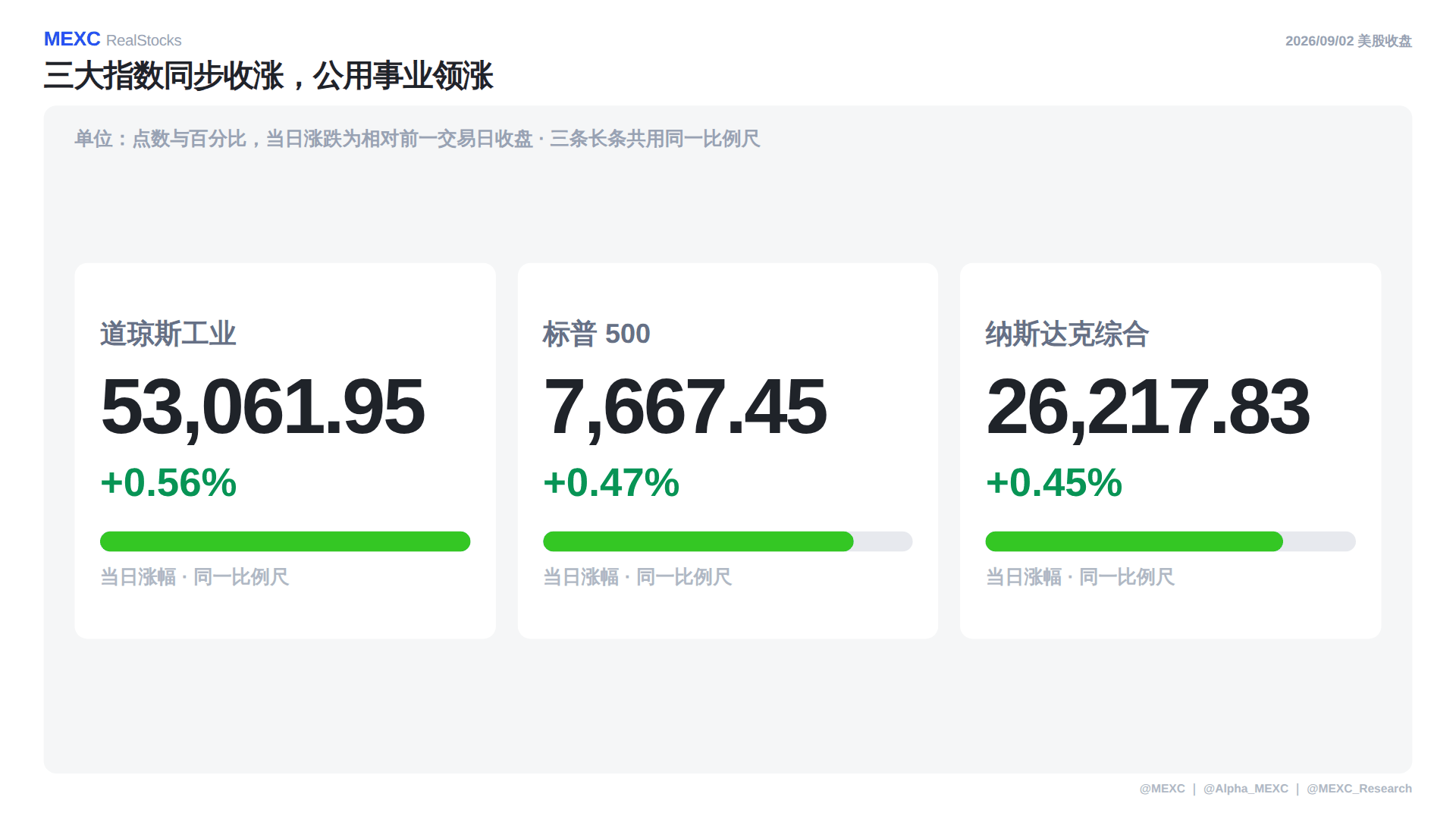
U.S. equities finished higher on Sept. 2, with all three major indexes closing in positive territory. The Dow Jones Industrial Average added 0.56% to 53,061.95, the S&P 500 gained 0.47% to 7,667.45, and the Nasdaq rose 0.45% to 26,217.83. August ADP private payrolls increased by 38,000, below the 47,000 expected, cooling rate-hike bets and lifting both precious metals and utilities.
Indexes rose together, but sector moves told a more uneven story
Sector performance was far less uniform than the index closes suggested. On the Nasdaq classification used in the report, utilities led with a 2.26% gain, communication services rose 1.47%, and industrials lagged with a 1.03% decline. The piece tied that rotation to the same macro driver behind the move in precious metals: once rate expectations soften, capital-heavy and debt-heavy industries tend to respond quickly.
Broadcom (AVGO) was one of the more striking post-earnings cases. The company posted $29.6 billion in revenue for the latest quarter, up 86% year over year. AI semiconductor revenue came in at $16.7 billion, up 221%, and next-quarter guidance was set at $34.8 billion, including $21.7 billion from AI. All three figures were above expectations, yet the stock still closed down 0.66% at $367.24. In after-hours trading it fell by about 6% at one point before narrowing to roughly 3.5%.
The report said the disagreement was not about revenue but about margins. Adjusted operating margin for the current quarter was about 68%, while the company guided next quarter to 66%. Revenue shows how much was sold. Margin shows whether the business is becoming more profitable or less so. When rapid growth is already priced in, even a guidance point that is only slightly worse than the prior quarter can drag on the stock.
Hecla gained 8.69% while silver moved less than 1%
Hecla Mining (HL), a precious-metals producer, ended the session at $20.77, up 8.69%. Its market capitalization stood at $13.9 billion, and the report estimated that roughly $1.1 billion in value was added in a single day. Trading volume was around its average level, suggesting the move came from repricing rather than a surge in turnover.
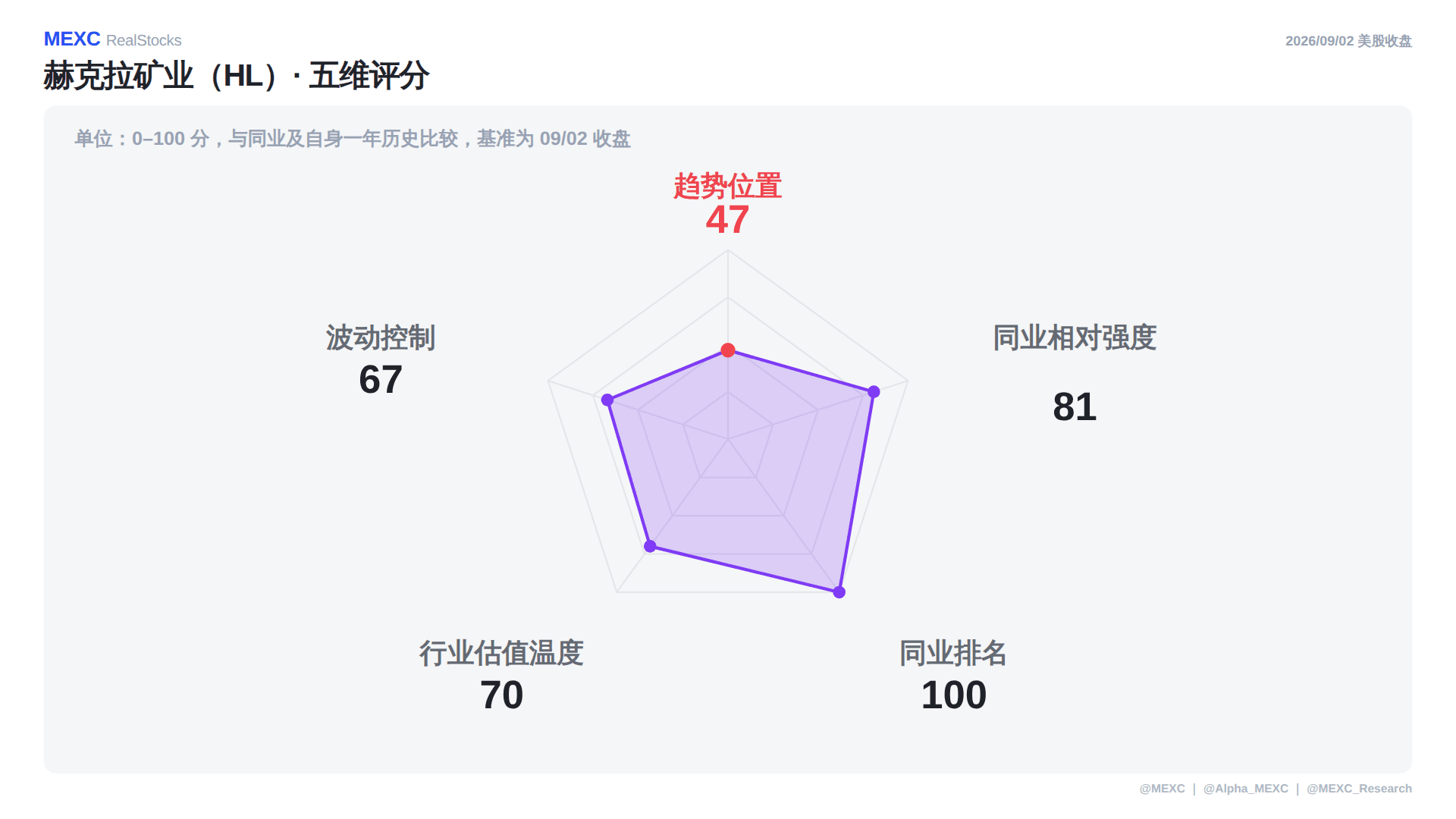
The article also used a five-part scoring framework. Hecla scored 100 in peer ranking and 81 in peer relative strength, but only 47 in trend position. Those measures describe different things. Peer ranking captures who rose the most within a comparable group on that day. Trend position measures how far the stock still is from the top of its own 52-week range. A stock can therefore lead its group in one session and still sit around the middle of its annual range.
The immediate trigger was straightforward. ADP private payrolls for August rose by only 38,000, below the 47,000 expected, and silver turned higher as rate-hike bets cooled. Mining costs tend to stay broadly fixed over a one-year period, while the selling price moves with the metal. That means a 1% move in the underlying metal can translate into a multi-point change in gross profit, and the stock can amplify that change again. The report used that operating leverage to explain the gap between silver's move of less than 1% and Hecla's 8.69% jump.
It also added a clear condition: this rally was driven by softer rate expectations, and two more U.S. data points, nonfarm payrolls and CPI, are still due before the Federal Reserve meeting on Sept. 15-16. Positioning could still reverse with the next release.
The same labor data produced very different results across silver and gold names
The report compared six companies in the precious-metals group using their one-day performance on Sept. 2. On the silver side, Hecla rose 8.69%, Endeavour Silver also gained 8.69%, and Coeur Mining climbed 6.04%. Wheaton Precious Metals, which has exposure to both gold and silver, rose 4.13%. On the gold side, Newmont gained 2.06%, while AngloGold Ashanti slipped 0.28%.
The distinction came from silver's dual identity. It is both a precious metal and an industrial metal, with demand tied to solar, electronics, and soldering. A data point that points to slowing growth and softer rate expectations is mainly a rates story for gold, but for silver it carries both the rates effect and an industrial-demand angle. That gives silver-linked equities more built-in elasticity.
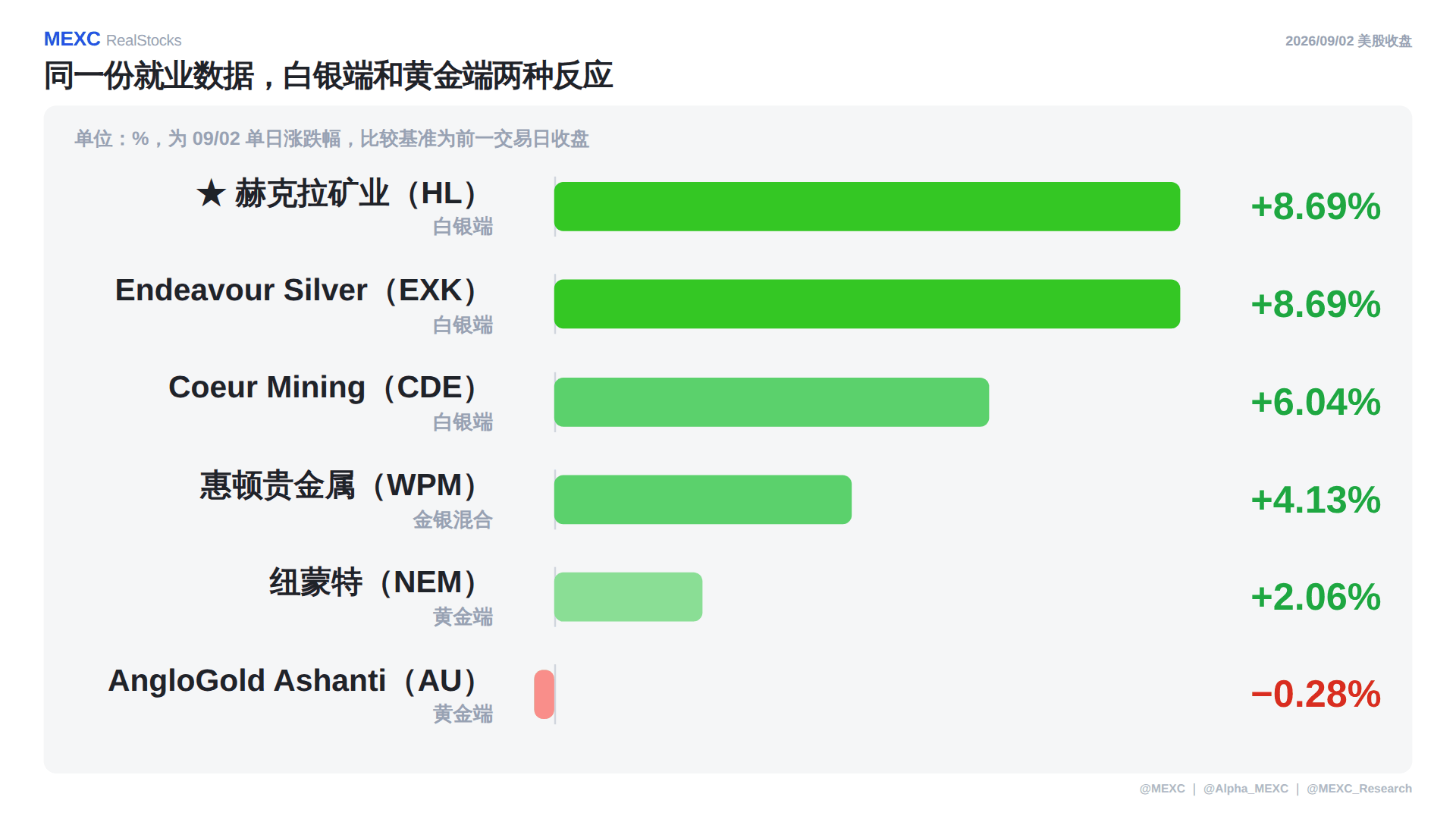
The broader group was up 2.42% on average, but the report argued that the average concealed the internal split. Looking only at the sector-level move would miss how differently the silver and gold ends of the same group traded.
Bitcoin miners moving into AI have not really broken from crypto in price terms
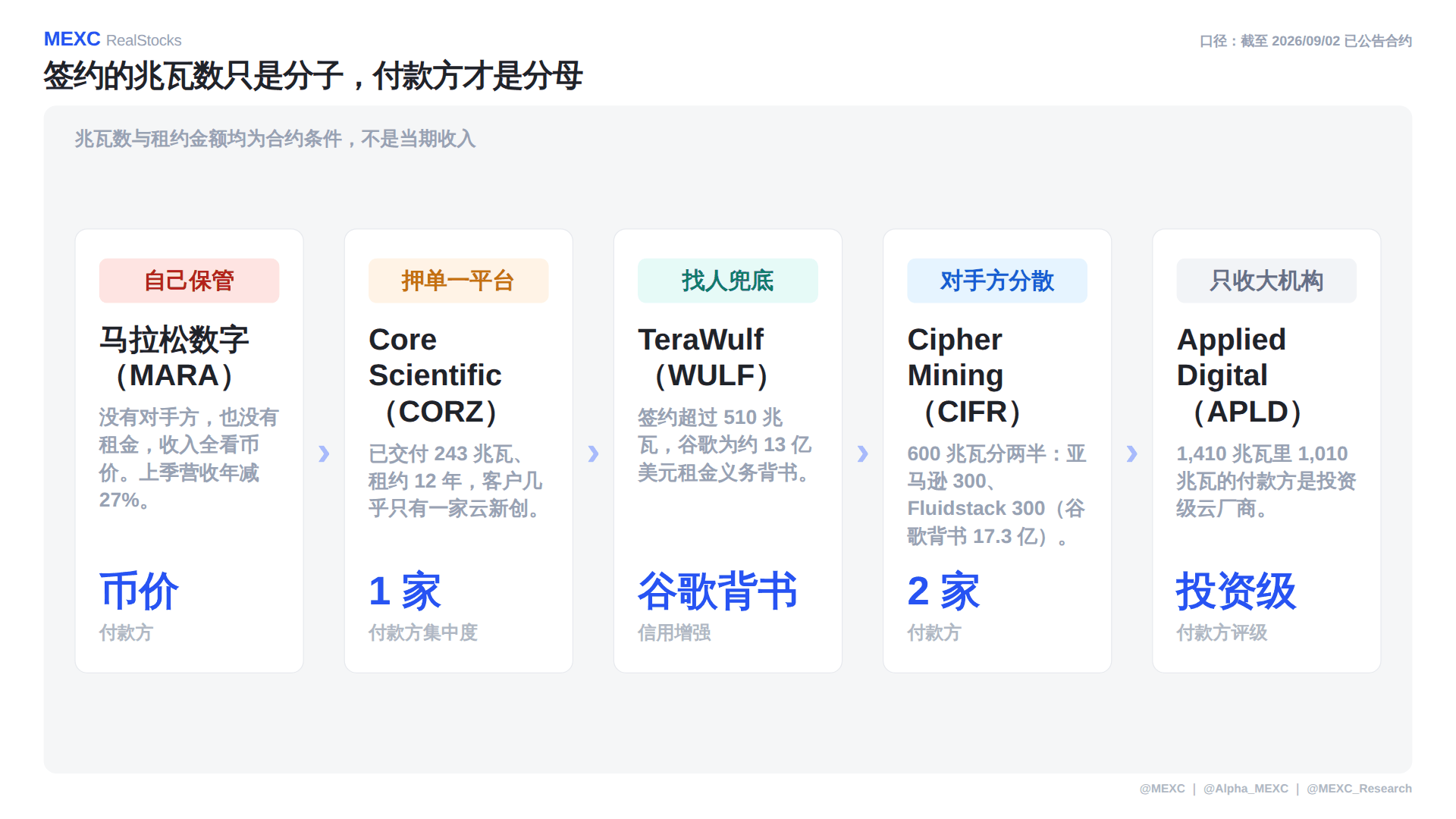
The article then shifted to Bitcoin miners that have signed AI-related hosting or data center agreements. It said all five companies in its comparison are converting mining sites into AI facilities, but the contracted megawatts are only one part of the picture. The payer on the contract matters more than the raw capacity figure.
Marathon Digital (MARA), according to the piece, has not actually made the transition. Its revenue still depends on Bitcoin prices. In the second quarter, hash rate was up 22% year over year, but revenue fell 27% to $174.9 million, and the company sold 2,213 BTC during the same period to add cash.
Core Scientific (CORZ) moved earliest. It has already delivered 243 megawatts under a 12-year lease, but its customer base there is concentrated almost entirely in one cloud startup. To support that buildout, it issued $3.3 billion in project debt carrying a 7.75% coupon.
TeraWulf (WULF) has signed more than 510 megawatts, with Google backing roughly $1.3 billion of the rent obligations tied to part of that capacity. Cipher Mining (CIFR) split 600 megawatts across two payers: Amazon directly signed for 300 megawatts over 15 years, while Fluidstack leased 300 megawatts for 10 years and Google separately backed $1.73 billion of rent obligations. Applied Digital (APLD) has 1,410 megawatts in hand, of which 1,010 megawatts are tied to investment-grade cloud operators.
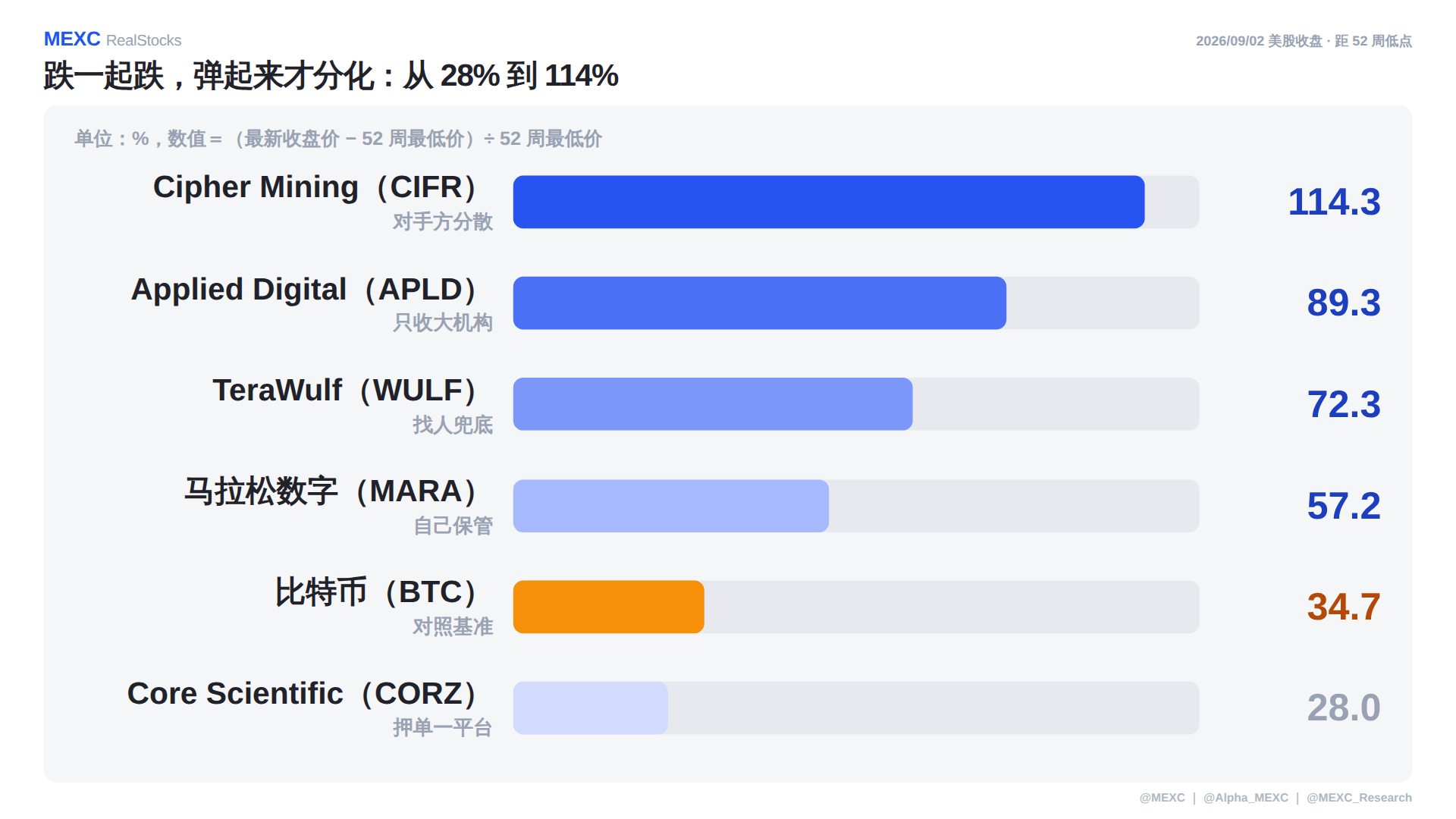
They fall together, and only separate on the rebound
The report used recovery from the 52-week low as one lens. By that measure, Cipher Mining had rebounded 114.3%, Applied Digital 89.3%, TeraWulf 72.3%, and Marathon Digital 57.2%. Bitcoin over the same span was up 34.7%, while Core Scientific had recovered only 28.0%.
But a different impression appears when the lens changes to drawdown from the high. On that basis, all six names were clustered in a band roughly 38% to 55% below their highs. The article's point was simple: they still tend to sell off together, and the real separation only appears in the bounce. Volatility has not narrowed. The market is not rewarding a company merely for claiming an AI transition; it is judging the quality of the contracts behind that transition.
Cipher Mining is being framed as a power-and-site business, not a cloud business
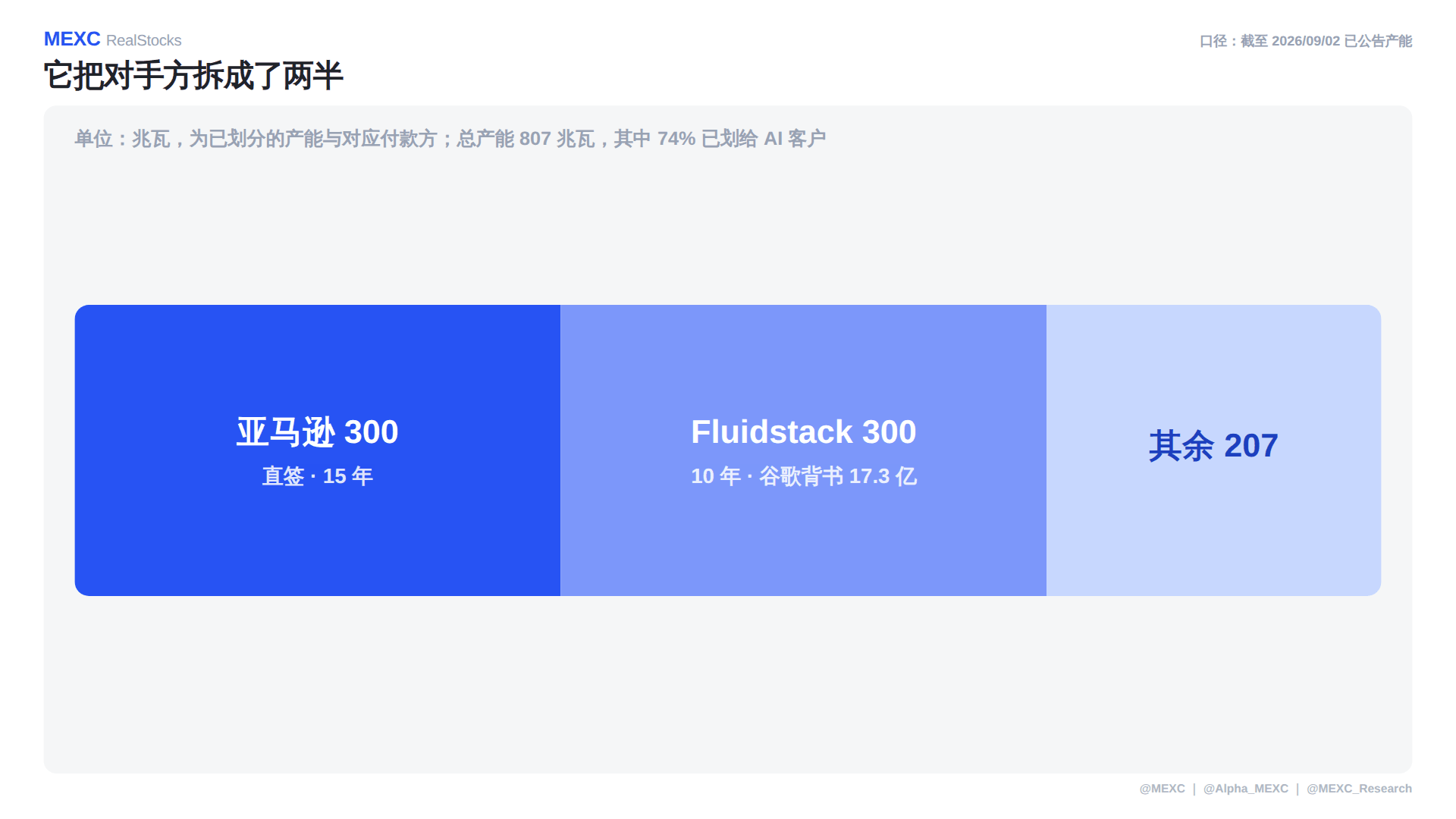
The report described Cipher Mining's model in blunt terms. The company does not buy GPUs and does not sell compute. It provides power, land, and grid interconnection permits. It has only 66 employees. In that framing, the company is not making money from compute cycles; it is making money from infrastructure tied to power delivery.
Its total allocated capacity is 807 megawatts, with 74% already assigned to AI customers. One side of the book is Amazon, which signed directly for 300 megawatts over 15 years. The other side is Fluidstack, which leased 300 megawatts over 10 years, with Google backing $1.73 billion of rental obligations.
That structure gives the company diversification because one default would not necessarily cripple the whole balance sheet. The tradeoff is that revenue is largely locked into rent, and whatever customers ultimately earn from using that electricity does not flow through to Cipher. The article presented this as a business that exchanges upside for predictability.
Across the five miners in the comparison, the report laid out a method for reading AI contracts. First, identify who pays. A contract backed by Amazon, one backed by a startup with Google support, and one tied to a startup that is relying on financing are not equivalent. Second, check concentration. Applied Digital's 1,010 megawatts are spread across investment-grade cloud names, while Core Scientific's 243 megawatts are heavily tied to a single counterparty. Third, ask when the money actually arrives. Contract value is a multi-year total, while near-term cash flow is another question entirely.
Next catalyst: can Ciena raise full-year guidance again?
Ciena (CIEN) is scheduled to report before the market at 12:30 UTC on Sept. 3. The same session also includes weekly jobless claims and remarks from a Federal Reserve governor, while the August ISM services PMI is due at 14:00 UTC. The report still pointed to the following day's August nonfarm payrolls release as the week's real dividing line.
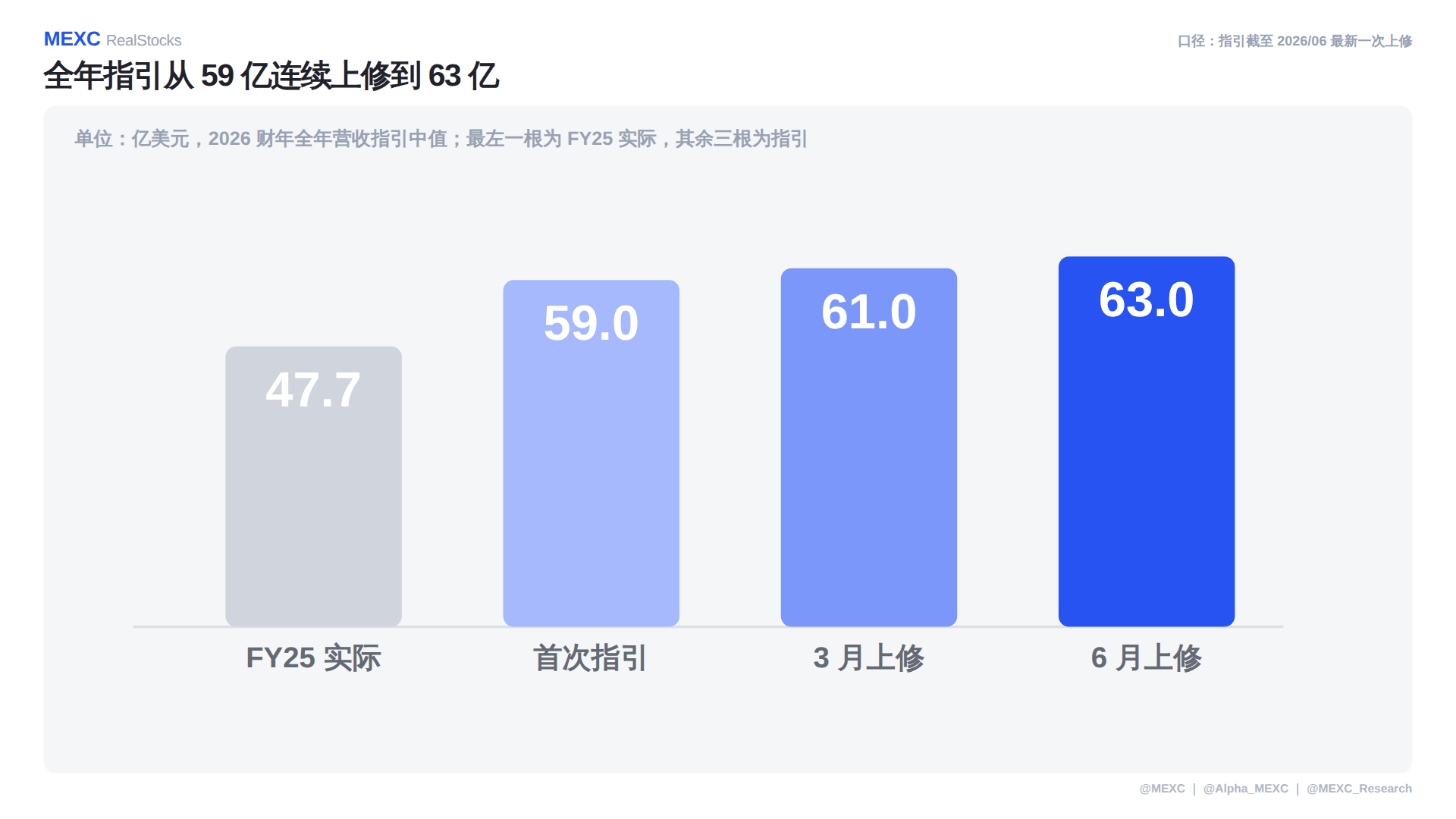
The central question for Ciena is not just whether it meets quarterly revenue estimates, but whether it raises full-year fiscal 2026 guidance again. Using the report's figures, the midpoint of full-year revenue guidance for fiscal 2026, which runs through October, was first set at $5.9 billion in December 2025, lifted to $6.1 billion in March, and then raised again to $6.3 billion in June. The comparison base on the left side of that sequence is fiscal 2025 actual revenue of $4.77 billion, taking midpoint growth from 28% to 32%.
The company's own midpoint guide for the current quarter is about $1.625 billion, up roughly 33% year over year. The article placed Ciena in the second leg of AI capital spending: first the money goes into chips, then into the optical pathways and networking gear that connect compute clusters. Ciena's products sit in coherent optical transport and routing-and-switching equipment used between data centers, in metro networks, and across long-haul backbone links.
That is why the report said full-year guidance matters more than one quarter's top line. A single quarter can be pushed around by delivery timing and revenue recognition, while the full-year midpoint is the company's own statement on demand for the year.
Optical networking is still the line holding up the story
The article broke Ciena's prior-quarter revenue into five segments. Total revenue was $1.57 billion, made up of $1.10 billion from optical networking, $179 million from global services, $174 million from routing and switching, $94 million from platform software and services, and $23 million from Blue Planet automation.
Optical networking remains the segment carrying the report. It generated $1.10 billion, up 42.2% year over year, and represented about 70% of total revenue. The fastest growth came from routing and switching, up 87.9%, but its scale was only $174 million, around one-sixth the size of optical networking.
The report made a point of reading growth together with scale. A small business line can double and still have limited impact on the whole quarter, but it can show where demand is spreading. A 42.2% increase on the largest line is what really shapes the quarter. Beyond the headline numbers, the piece said investors should watch whether routing and switching can remain close to doubling and whether Blue Planet, which was down 16.4%, can stabilize. Margin also matters. Adjusted gross margin was 44.9% last quarter, and the company guided the current quarter to 45%. When volume grows through large direct customers, margin still serves as the quality check.
Five questions the report addressed
Why could Hecla rise 8.69% if silver moved less than 1%?
Because mining costs are broadly fixed over the short run, while the realized selling price moves with the metal. A small move in the metal can have an outsized effect on gross profit, and equity prices can amplify that effect again.
Why did silver-linked names rise 6% to 9% while gold-focused names stayed near flat?
The report's answer was silver's dual role as both a precious and an industrial metal. The same macro release gave silver exposure to both rates and industrial-demand expectations.
How can a stock show a peer rank of 100 and a trend position of 47 at the same time?
Because the two measures track different things: one is a one-day cross-sectional comparison, the other is the stock's position inside its own 52-week range.
If miners are moving into AI, why do their stocks still trade with crypto?
The article argued that decoupling has not happened in price behavior. What is separating is contract quality, not the basic pattern of shared drawdowns and rebounds.
What is the first thing to check in a long-term AI contract?
Not the megawatts, according to the report, but the payer. After that come concentration and the timing of actual cash receipts.