Cosmos Hub2026-10-01 23:33:54Cosmos Hub’s 25-Hour Halt Shows Where Blockchain Consensus Actually BreaksCosmos Hub stopped producing blocks at height 33,086,740 on Sept. 22 after validators representing more than one-third of total voting power went offline, and the network resumed roughly a day later after a coordinated restart. The article argues that the incident was not a direct attack on Cosmos Hub itself. Instead, the chain was pulled into the fallout from a governance exploit on Neutron, where an approved proposal let an attacker use chain-level privileges to change contract administrators and move assets. According to a Cosmos Labs post-mortem cited in the piece, about 1.7 million ATOM was bridged into Cosmos Hub before Neutron stopped, prompting some Hub validators to halt nodes to prevent further movement. Recovery came through a Gaia v28.3.0 patch and a one-time state change that moved 1,227,121 ATOM from the attacker’s address into a 4-of-6 multisig managed by Nansen, Keplr, Enigma, Silknodes, Kiln, and Polkachu. Beyond the incident itself, the article uses Bitcoin, Ethereum, and Solana as comparisons to explain why decentralization does not mean a chain can never stop, and why private key control is not the same thing as control over consensus.80
Cosmos2026-09-29 12:30:00Why Cosmos Hub Stopped Producing Blocks for 25 HoursCosmos Hub halted block production on Sept. 22 after validators representing more than one-third of total voting power stopped participating, freezing the chain at height 33,086,740. The trigger did not originate on Cosmos Hub itself. The sequence began on Neutron, where a governance proposal titled AIATO: AI Agent Takeover was exploited through chain-level governance privileges in the wasmd framework, allowing attackers to reassign contract admin rights for apps including Astroport and Drop. Before Neutron stopped running, Cosmos Labs said the attackers had already moved assets across several networks, including roughly 1.7 million ATOM into Cosmos Hub, where the funds began moving through interchain liquidity routes. To prevent the remaining ATOM from leaving, some Cosmos Hub validators shut down their nodes. That pushed the network below the threshold needed to keep CometBFT consensus live. About four hours later, validators received a recovery plan built around a one-time state change. Cosmos Labs then prepared and tested a Gaia v28.3.0 patch. The patch moved 1,227,121 ATOM from the attacker address into a 4-of-6 multisig controlled by Nansen, Keplr, Enigma, Silknodes, Kiln, and Polkachu. Once validators representing more than 67% of voting power had installed the software, Cosmos Hub coordinated a restart at 12:00 UTC on Sept. 23. Roughly six minutes later, the state change executed at block 33,086,741 and block production resumed.220
Cosmos Hub2026-09-26 01:26:38Cosmos Hub recovers 1.227 million ATOM from Neutron exploit, moves funds to 4-of-6 multisigCosmos Labs said roughly 1.73 million ATOM was moved to Cosmos Hub after a governance attack on Neutron on Sept. 22 led to stolen liquidity from protocols including Astroport. Cosmos Hub itself was not compromised, and user funds were not affected. To stop further movement of the stolen tokens, Hub validators halted the network for about 24.5 hours and resumed block production on Sept. 23 using the patched Gaia v28.3.0 release. During the halt, 1.227 million ATOM remained in the attacker’s Hub address and was transferred, through a one-time state change at restart, into a 4-of-6 multisig controlled by Nansen, Keplr, Enigma, Silknodes, Kiln, and Polkachu. Cosmos Labs added that about 500,000 ATOM had already been swapped for ETH through THORChain and could not be recovered, while another 169,000 ATOM entered the attacker’s address after the network resumed because of a THORChain refund, then was moved to Osmosis and sold. The recovered ATOM will stay in the multisig and can only be returned with authorization from a Cosmos Hub governance proposal.370
Cosmos Hub2026-09-25 20:05:41Cosmos Hub voters move to veto proposal seeking 1.2 million ATOM refund for Neutron attackerA Cosmos Hub governance proposal that seeks to return 1,221,120 ATOM to the address tied to the Neutron attacker is facing overwhelming opposition, with nearly all counted votes favoring a veto as of Friday afternoon Eastern Time. Proposal 1056, posted on Wednesday under the title "ATOM Refund & Justice Bounty," argues that Cosmos Hub representatives coordinated validators to take 1.2 million ATOM from the attacker’s address without justification and asks that the tokens be returned from the Hub’s community pool. It also includes a 500,000 ATOM "Justice Bounty" for yes voters, distributed by staking weight over six months and capped at 5,000 ATOM per voter. The requested payout would go to the address that submitted the proposal, which the report says is different from the address previously swept by the Hub. The disputed funds trace back to a Sept. 21 Neutron governance vote that gave the attacker admin control over contracts run by Astroport and Drop. After validators halted and restarted the chain, 1,227,121 ATOM remaining in the address was moved into a 4-of-6 multisig controlled by Hub validators. Voting ends on Sept. 30, and turnout was about 21% on Friday, below the 40% threshold needed for the proposal to pass.320
Neutron2026-09-25 16:59:041.227 Million ATOM Moved to 4-of-6 Multisig After Neutron Governance AttackCosmos Labs said Neutron suffered a governance attack on Sept. 22 that led to liquidity being drained from protocols including Astroport, with roughly 1.73 million ATOM later moved by the attacker to Cosmos Hub. Cosmos Hub itself was not compromised, and user funds on the Hub were not affected. To stop further outbound transfers of the stolen ATOM, Hub validators halted the network for about 24.5 hours and resumed block production on Sept. 23 using the patched Gaia v28.3.0 release. According to Cosmos Labs, 1.227 million ATOM remained in the attacker’s Hub address during the halt and was moved, through a one-time state change at restart, into a 4-of-6 multisig controlled by Nansen, Keplr, Enigma, Silknodes, Kiln, and Polkachu. Cosmos Labs also said about 500,000 ATOM had already been swapped into ETH via THORChain and could not be recovered, while another 169,000 ATOM was refunded through THORChain after the network restart, returned to the attacker address, then moved to Osmosis and sold. The funds now held in the multisig cannot be returned unless authorized by a Cosmos Hub governance proposal, and they will not be staked, lent, or traded. Neutron said it expects to submit a recovery plan and related governance proposal next week.280
Binance2026-09-20 20:30:15Binance spot data shows sharp swings as ATOM jumps 12.84% in 24 hoursChainCatcher reported, citing Binance spot market data, that crypto trading saw sharp volatility over the past 24 hours. ATOM rose 12.84% during the period and reached a new high for the week. At the same time, several other tokens moved higher before reversing. BAND fell 7.78%, CELR dropped 31.54%, INJ lost 7.24%, LUNA declined 15.68%, ONE slid 28.06%, SKL fell 18.27%, XTZ dropped 11.6%, and AGLD lost 15.09%. The figures point to wide intraday price swings across a group of altcoins on Binance spot markets, with gains in ATOM standing out against pullbacks in the other named tokens.410
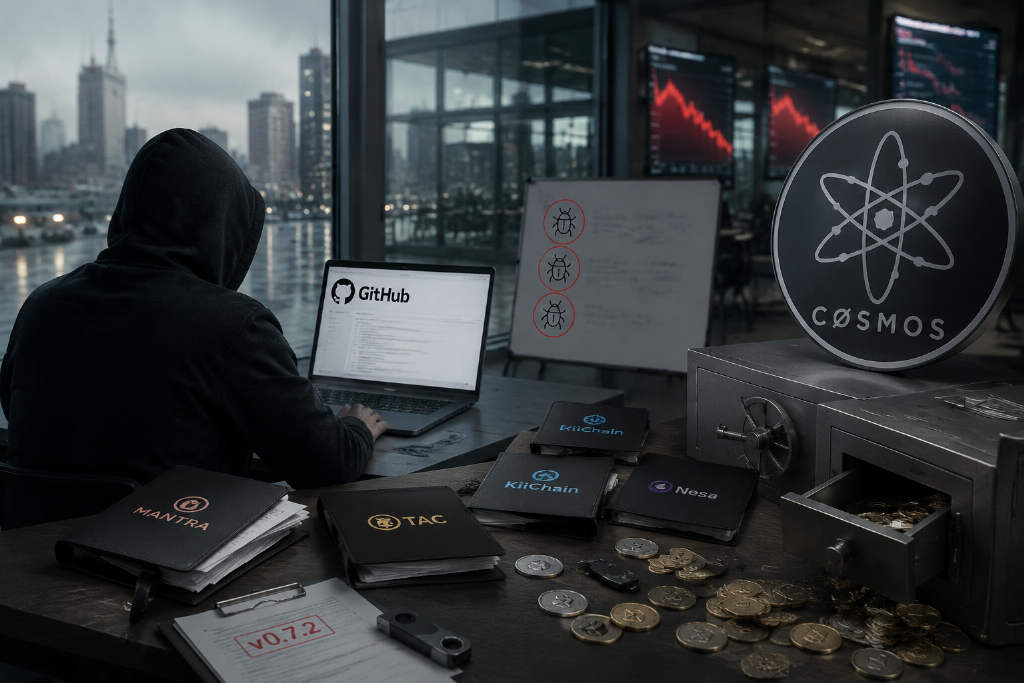
Cosmos2026-08-25 02:41:56Cosmos EVM chains hit by attacks after public patch release sparks warning failuresA string of attacks has hit blockchains using the Cosmos EVM module, including MANTRA, TAC, KiiChain, and Nesa, with treasury-held protocol reserve tokens stolen and quickly sold on the market. The incidents were later linked by market participants to version v0.7.2 upgrade code published by Cosmos Labs on GitHub on Aug. 19. The release note itself said the version contained an important security fix and urged chains to upgrade through a coordinated process as soon as possible. The controversy centers on how the patch was handled. Critics said Cosmos Labs made the security fix public without privately warning downstream teams or issuing any mandatory upgrade notice to projects relying on the module. Developer @justde said the failure was not the existence of a vulnerability itself, but what happened after it became known: who got warned, who got patched, and whether customers or attackers moved first. KiiChain, one of the affected projects, said the incident could have been avoided and disclosed that the exploit required three upstream flaws in Cosmos EVM to be present at the same time. Nesa said on the night of Aug. 24 that it had detected malicious activity exploiting the Cosmos EVM vulnerability on its L1 and halted the chain while applying fixes and remediation measures. According to the report, its token had already dropped more than 94%, from $0.22 to $0.011. RootData data cited in the article also showed ATOM with an $800 million market capitalization, ranking 68th among tokens, down more than 95% from its peak.640
Intel2026-07-30 00:36:34Intel opens part of its Atom processor technology to Rosaic LabsIntel has opened part of its Atom processor technology to chip startup Rosaic Labs, according to a Reuters report cited by BlockBeats on July 30. The arrangement is unusual for Intel because the company has historically rarely licensed core technology tied to its x86 architecture or Atom line to outside firms. Reuters said Intel plans to provide Rosaic with register-transfer level, or RTL, code for Atom processors, allowing the startup to build custom chip designs based on Intel intellectual property. Rosaic was founded in May this year and is led by CEO Amarjit Gill. Its core team includes several former Rivos employees. The report also said Gill and Intel CEO Lip-Bu Tan have a long-standing investment relationship. They previously co-invested in chip startup Nuvia and also worked together in the creation of Rivos. Public filings show Rosaic has met the conditions to launch a $10 million seed financing round.3020