Ethereum
Oct 29, 2026

Teku and Besu update Docker images to address weak certificate key risk

Ethereum validator clients Teku and Besu have updated their Docker images to address a risk tied to weak certificate keys, according to Techub News, which cited Crypto.news. The issue affects some Ethereum validator setups and centers on connections to external services. For operators, the main question is whether their software could accept forged certificates. The update is aimed at reducing that exposure in affected environments. No further technical details, scope figures, or remediation timeline were disclosed in the source brief.

920
Teku and Besu update Docker images to address weak certificate key risk
Ethereum
Oct 29, 2026

eMudhra certificate flaw affects Ethereum clients Teku and Besu

An encryption security flaw tied to Indian certificate authority eMudhra has affected Ethereum clients Teku and Besu, according to ChainCatcher. Researchers said private keys for eight intermediate certificate authorities under eMudhra may be derivable because of insufficient randomness. That could let an attacker forge certificates and trick unpatched software into trusting malicious services. Teku has released version 26.1.3 and Besu has released version 26.1.2, with both removing trust in the affected certificates from their Docker images. The reported risk includes potential man-in-the-middle attacks that could cause some validators to send block fee rewards to an attacker-controlled address, with higher exposure in certain setups using an external signer. Teku said Ethereum mainnet Teku nodes running the default configuration are not affected and do not need to take action. It also said there have been no reports of the flaw being exploited so far. Operators running Teku or Besu directly on hosts without Docker may need to update Java and its trusted certificate store manually, while those still using unsupported Java 26 need to migrate to Java 25.

1250
eMudhra certificate flaw affects Ethereum clients Teku and Besu
Ethereum
Oct 29, 2026

Ethereum clients patch certificate flaw tied to some Teku and Besu setups

Ethereum clients have patched a security flaw after a critical mistake by Indian certificate issuer eMudhra left some Teku and Besu configurations trusting forged certificates, according to CoinDesk. The issue raised the possibility that an attacker could redirect ETH rewards in affected environments. At the same time, the report said default Ethereum mainnet nodes were not exposed to the problem. The incident was limited to certain setups rather than standard default deployments, narrowing the scope of immediate risk. CoinDesk identified Teku and Besu as the affected clients and said patches have already been made available. The report did not indicate that default mainnet node operators were impacted.

860
Ethereum clients patch certificate flaw tied to some Teku and Besu setups
DTCC
Oct 28, 2026

DTCC launches tokenized securities service on Canton and Besu, covering 34 assets worth about $30 trillion

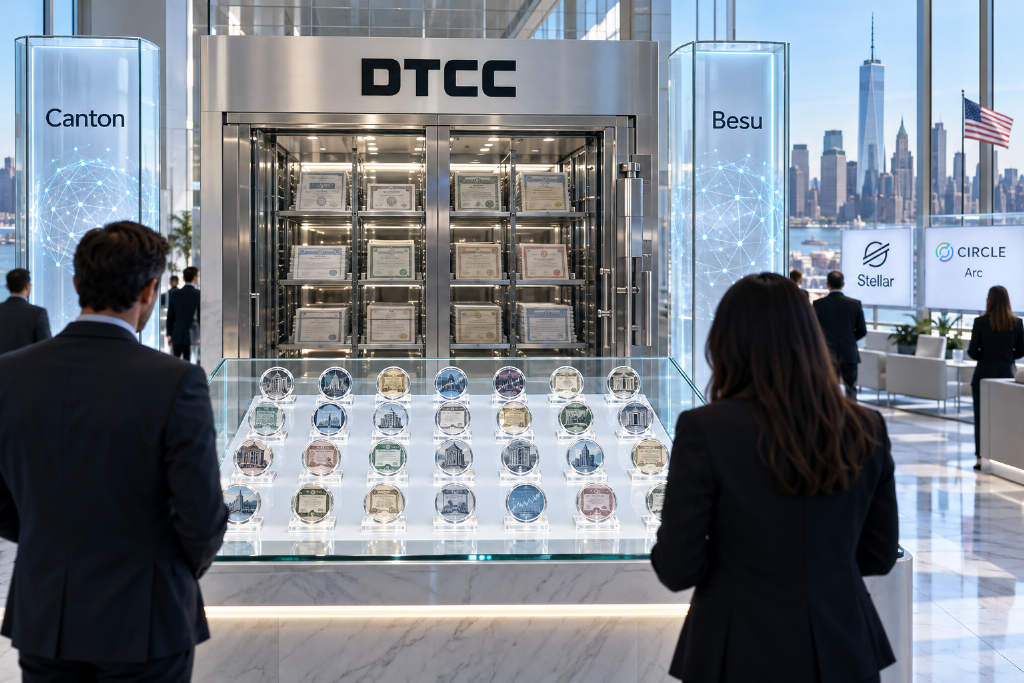
The Depository Trust & Clearing Corporation, a central piece of U.S. market infrastructure, has gone live with a tokenization service that places selected traditional securities on blockchain rails. The service is available on Canton Network and DTCC’s private Besu blockchain, initially covering select large-cap Russell 1000 stocks, exchange-traded funds and U.S. Treasury bills, notes and bonds. DTCC’s product site lists 34 eligible securities at launch, representing roughly $30 trillion in market value, according to a DTCC spokesperson cited by CoinDesk. The rollout matters because DTCC sits at the core of how U.S. securities markets clear, settle and hold assets. Through its subsidiaries, the firm supports much of the country’s stock and bond trading, with more than $114 trillion in securities held at its depository. DTCC said 20 firms have signed agreements to access the service, including JPMorgan, Citi, Morgan Stanley, Bank of America, Barclays, Fidelity Investments, Citadel Securities, State Street and UBS. The tokens are backed one-for-one by securities held at DTCC subsidiary Depository Trust Company, while official ownership records remain with DTC. DTCC said eligible firms can tokenize securities during business hours, with a target processing time of 15 minutes or less, and then move those assets between registered wallets around the clock, subject to compliance restrictions. The company also plans to add Stellar and Circle Internet’s Arc blockchain next year, along with tools for digital-cash settlement and collateral use.


880
DTCC launches tokenized securities service on Canton and Besu, covering 34 assets worth about $30 trillion
DTCC
Oct 17, 2026

DTCC details 25-security tokenization plan across Canton and Besu

The Depository Trust & Clearing Corporation, or DTCC, has outlined a tokenization rollout covering 25 securities, with the initiative set to run on Canton and Besu. According to the article summary, the tokens will be backed on a 1:1 basis by securities held at The Depository Trust Company, or DTC. The report also says Stellar and Circle’s Arc are expected to be part of the setup in 2027. The source material provides only a brief summary and does not include additional operational details, timelines beyond 2027, or the names of the securities involved. As presented, the key points are the scope of the rollout, the use of Canton and Besu as the underlying networks, the 1:1 backing structure tied to securities held at DTC, and the expected inclusion of Stellar and Arc at a later stage.

1550
DTCC details 25-security tokenization plan across Canton and Besu
DTCC
Oct 17, 2026

DTCC outlines tokenization plan for 25 securities across Canton and Besu

The Depository Trust & Clearing Corporation, or DTCC, has disclosed a new securities tokenization plan centered on two blockchain networks: Canton and Besu. Under the proposal, 25 securities are set to be tokenized in the initial phase. DTCC said the related tokens will be backed on a 1:1 basis by securities held in custody by its subsidiary, The Depository Trust Company, or DTC. The announcement also included a later expansion roadmap. DTCC said the scope of tokenized assets will be extended to the Stellar network and Arc, a network launched by Circle. The expected implementation timeline for that next step is 2027. The update focuses on the structure, supported networks, custody backing, and rollout schedule disclosed by DTCC.

1790
DTCC outlines tokenization plan for 25 securities across Canton and Besu
Ethereum
Aug 24, 2026

Besu fixes five security flaws in version 26.7.1 after findings by CertiK

Ethereum client Besu fixed five security vulnerabilities in version 26.7.1, which was released on July 27, after the issues were identified by blockchain security firm CertiK. Besu then published four detailed security advisories on Aug. 14, with technical details held back until after the patch rollout so node operators had time to upgrade first. According to CertiK Security Engineering Director and Senior Audit Partner Jialiang Chang, that patch-first approach created an 18-day buffer for operators to identify affected deployments, test the new release, and coordinate upgrades with validators or consortium participants. The disclosed issues touched block propagation handling, future-height consensus proposal caching, WebSocket subscription limits, and JSON-RPC filter creation. If left unresolved, the flaws could let attackers drain node memory or thread resources, affecting node availability and consensus processing. Bitcoin.com News said CertiK used its Chain Scan method in a private multi-node test network to run adversarial testing across peer-to-peer, HTTP RPC, WebSocket RPC, and consensus interfaces, and provided reproducible testing tools to the Besu team.

2120
Besu fixes five security flaws in version 26.7.1 after findings by CertiK
Ethereum
Aug 24, 2026

Ethereum client Besu fixes five security flaws found by CertiK

Ethereum client Besu fixed five security vulnerabilities identified by blockchain security firm CertiK in version 26.7.1, released on July 27, and later published four detailed security advisories on Aug. 14. The vulnerability details were held back at first to give node operators time to upgrade. CertiK Security Engineering Director and Senior Audit Partner Jialiang Chang said the patch-first approach created an 18-day window for operators to identify affected deployments, test the new release and coordinate upgrades with validators or consortium participants. The issues touched block propagation handling, caching of future-height consensus proposals, WebSocket subscription limits and JSON-RPC filter creation. If left unpatched, an attacker could exhaust node memory or thread resources, affecting node availability and consensus processing. CertiK said it used its Chain Scan method to run adversarial testing against peer-to-peer, HTTP RPC, WebSocket RPC and consensus interfaces in a private multi-node test network, and provided reproducible test tools to the Besu team.

1970
Ethereum client Besu fixes five security flaws found by CertiK
Total 9 items
Go topage