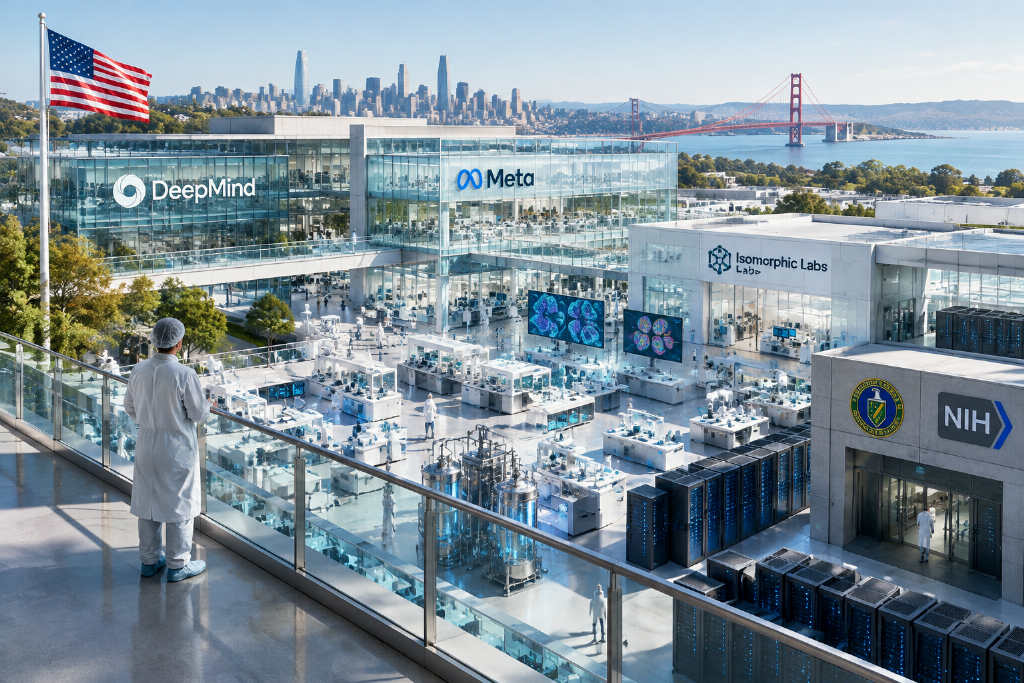
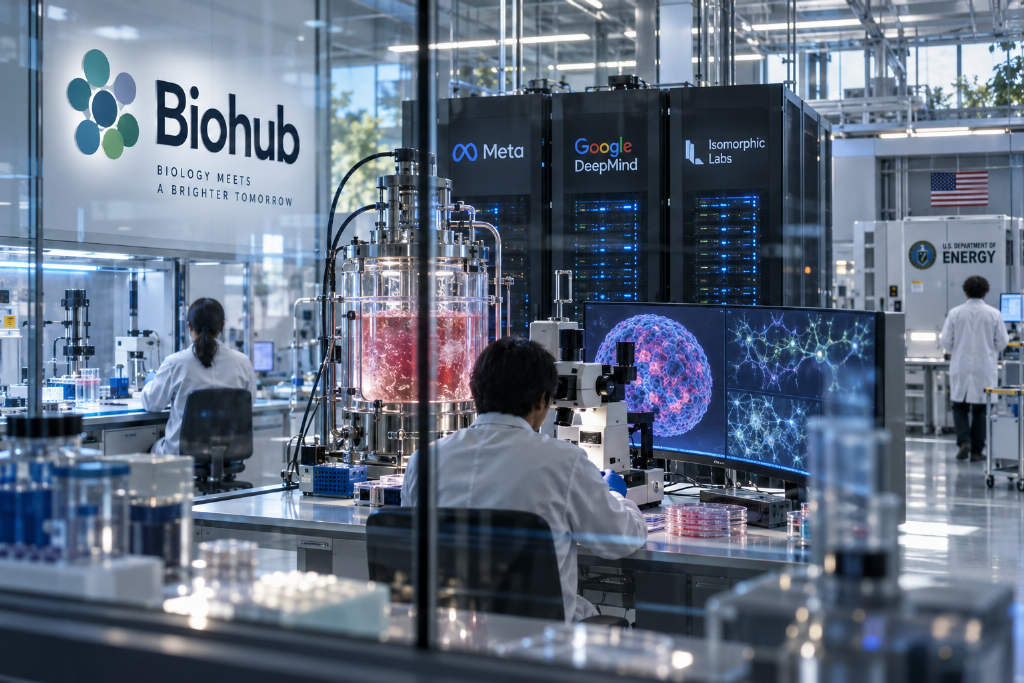
Biohub2026-10-08 02:18:55Biohub says its virtual cell data effort has reached $1.8 billion with DeepMind, Meta and U.S. agencies joiningChan Zuckerberg Biohub said Google DeepMind, Isomorphic Labs, Meta, the U.S. Department of Energy and the National Institutes of Health have joined its Virtual Biology Initiative, a data-building project aimed at supporting future “virtual cell” AI models. The group put the total value of the effort at $1.8 billion, though the figure combines several different buckets rather than entirely new funding. According to the announcement, Biohub’s own $500 million commitment was disclosed in April, with $400 million earmarked for internal measurement technology and $100 million for outside research. The Department of Energy is contributing more than $500 million over five years through the Genesis Mission for lab measurement, modeling and computing. NIH’s role centers on coordinating datasets, databases and knowledge bases built from more than $500 million in prior federal investment, while Biohub helps standardize them for AI training. Google DeepMind, Isomorphic Labs and Meta are contributing a combined $300 million, with no company-by-company breakdown released. Biohub science lead Alex Rives told Reuters that current cell datasets cover hundreds of millions of cells, while accurate predictive models may require billions and eventually trillions. He said the first datasets could be ready in about a year, and that partners want to compress work that would normally take decades into five years. Biohub and its partners are trying to build the data foundation first; accurate virtual cell models do not yet exist.10
Biohub2026-10-07 18:01:42Biohub leads $1.8 billion effort to build AI models that predict cell behaviorBiohub, a research organization backed by Mark Zuckerberg and Priscilla Chan, is leading a $1.8 billion initiative aimed at training AI models that can predict cell behavior. The project has support from Meta, Google DeepMind, Isomorphic Labs, and the U.S. Department of Energy, which are set to contribute data, laboratory equipment, and computing resources. According to the information cited by Techub News, the first dataset for the effort is expected to be ready in about a year. The update was attributed to The Decoder.20