CFO

Bank of Ameri
2026-08-10 05:02:42

BofA raises memory outlook through 2027, sees Samsung preparing large buyback and special dividend

Bank of America Securities said the memory upcycle is still running and lifted its outlook for the global DRAM and NAND markets through 2028, with the strongest stretch extending into 2027. In its Aug. 7 global memory technology weekly report, the firm projected global DRAM industry revenue at $57.3 billion in 2026, rising to $84.7 billion in 2027 and $91.7 billion in 2028, while NAND revenue is seen at $35.75 billion, $46.75 billion and then lower in 2028. The report also said HBM remains the key driver, with the HBM market expected to reach $7.74 billion in 2026 and $15.28 billion in 2027, alongside higher shipment mix and pricing. BofA also pointed to a sharper-than-seasonal rebound in spot pricing. NAND spot prices for 512Gb to 1Tb products rose 5% to 6% this week, while 256Gb products gained more than 10%. DRAM spot prices increased 1% to 2% from the prior period. Against that backdrop, the bank said Samsung Electronics may soon announce major shareholder returns in the form of buybacks and a special dividend. It estimated the special dividend could exceed KRW 30 trillion and the repurchase program could top KRW 40 trillion, based on Samsung’s framework of returning 50% of 2024-2026 free cash flow to shareholders after annual dividends already paid.


1070
BofA raises memory outlook through 2027, sees Samsung preparing large buyback and special dividend
Web3
2026-08-09 09:50:16

Web3 layoffs deepen as AI becomes the public excuse and exchange revenue models come under strain

A WuBlockchain-republished feature argues that the latest wave of layoffs across Web3 has been framed as an AI story on the surface, while the deeper driver is financial pressure and a weakening business model across much of the industry. The report says crypto exchanges and related firms have spent more than half a year cutting teams, reorganizing departments, and tightening internal controls, with employees often losing access to Slack, email, and internal systems before they even receive formal notice. Several named interview subjects in the article, identified by pseudonyms including Kevin, Richard, Xiaoyu, and John, describe abrupt dismissals, disputed severance, and a workplace culture where performance reviews, surveillance software, and difficult KPI structures can be used to turn layoffs into “performance-based” exits. The piece also ties the employment shock to broader structural changes in crypto. It says exchange revenues that once depended heavily on trading fees and listing fees are under pressure as retail participation weakens, token quality deteriorates, liquidity dries up, and onchain derivatives platforms such as Hyperliquid pull activity away from centralized venues. Coinbase’s May announcement of about 700 global job cuts, described by the company as an “AI-native reorganization,” is cited alongside claims from former employees and people familiar with the matter that the impact in India was much larger. The article ultimately argues that AI has become a convenient label, while the harder issue is that parts of Web3 no longer generate durable revenue in the way they once did.

1010
Web3 layoffs deepen as AI becomes the public excuse and exchange revenue models come under strain
SanDisk
2026-08-09 05:18:54

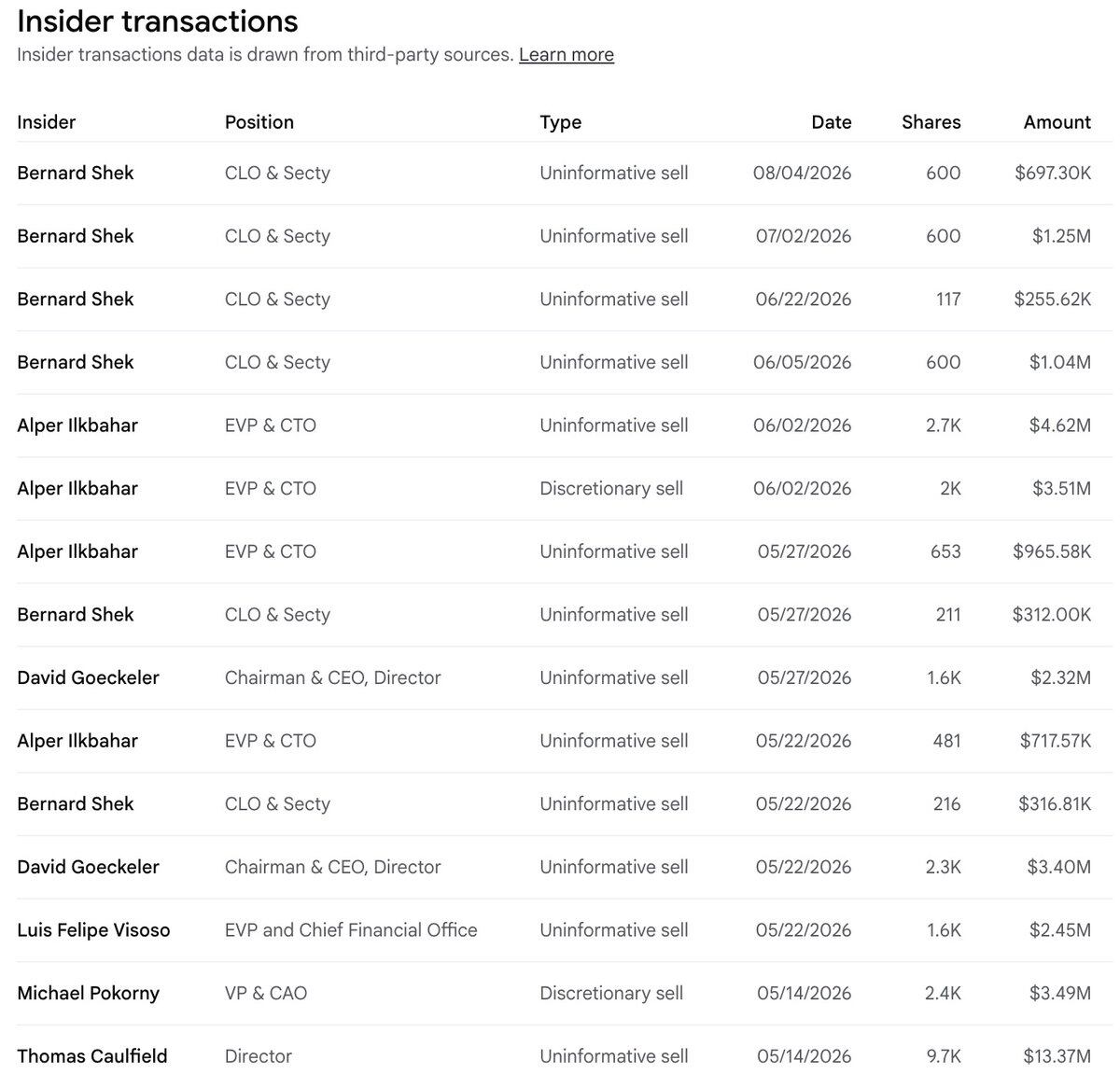
SanDisk Executives Cash Out Millions in Insider Stock Sales

Odaily Planet Daily reports that a post by Marcos Milla on X has drawn attention to rising insider stock sales at SanDisk. According to Milla's disclosure, CEO David Goeckeler sold around $5.7 million worth of shares. CTO Alper Ilkbahar's sale was valued at approximately $9.8 million. Director Thomas Caulfield sold about $13.4 million in shares. CFO Luis Felipe Visoso sold roughly $2.5 million. Milla added that other executives also recorded sales in the millions of dollars. Adding up the named transactions puts the aggregate well into the tens of millions. Milla described the selling as having increased recently, and the post tied the individual figures to each executive's role at SanDisk. The disclosure points to a wave of insider selling across SanDisk's senior management and board. The exact dates of the individual transactions were not stated in the news report, and no reason for the sales was given. Odaily Planet Daily first carried the disclosure, citing Milla's X post.

970
SanDisk Executives Cash Out Millions in Insider Stock Sales
Circle
2026-08-08 12:01:24

Circle says it has 150+ USDC distribution deals, confirms Hyperliquid arrangement includes Coinbase and Circle

Circle used its fiscal 2026 second-quarter earnings call to answer a cluster of questions around USDC distribution incentives, its revenue-sharing structure with Coinbase, and how USDC held through Hyperliquid is attributed between the two companies. Management said Circle has signed more than 150 distribution agreements tied to USDC growth, product development, and token distribution, arguing that incentive-based channel expansion has been part of the company’s playbook for a long time rather than a new response to a single market challenge. The call also clarified that the Hyperliquid arrangement involves three parties: Coinbase, Circle, and Hyperliquid. As of quarter-end, about 90% of the USDC held by Hyperliquid was attributed to Coinbase’s platform and about 10% to Circle’s platform, according to Circle’s CFO. Circle did not disclose the exact commercial terms or the final split of economics between the parties. The company stressed that the 90%/10% figure describes where the balances are booked, not how final revenue is shared. The article also points to on-chain addresses on HyperEVM that appear to mirror that structure, with roughly $4.952 billion tied to Coinbase’s side and about $550 million tied to Circle’s side. Circle said those balances can be observed on-chain, but the detailed profit-sharing arrangement remains undisclosed.

1050
Circle says it has 150+ USDC distribution deals, confirms Hyperliquid arrangement includes Coinbase and Circle
AI companies
2026-08-07 01:44:00

The Women Running the Rest of AI Companies

OpenAI’s Fidji Simo and Anthropic’s Daniela Amodei are two of the most visible examples of a broader pattern in AI: many companies put a woman in charge of everything except the core model work. In a long PANews market analysis, the author argues that these executives often oversee fundraising, people, finance, legal, government relations, PR, commercialization and, in some cases, product. Their role is not just to raise money or fix problems after the fact. They help decide where resources go, when products ship and whether a technical path is still worth pursuing. The piece names several China-side examples, including Zhang Yutong at Kimi, Yun Yeyi at MiniMax and Yi Weishu at Vivix. It says the position is shaped less by gender than by the organizational needs of AI firms, which function more like commercialized labs than traditional companies. The article also notes that trust, not a single job skill, is what allows these “second-in-command” figures to expand from financing into operations, growth and strategy.

1130
The Women Running the Rest of AI Companies
Block
2026-08-06 11:11:40

Block lifts full-year outlook after Q2, says AI now touches nearly all production code changes

Block raised its full-year guidance after releasing second-quarter results, lifting gross profit expectations to $12.51 billion from $12.33 billion and adjusted operating income guidance to $3.47 billion from $3.34 billion. CFO Amrita Ahuja said strong execution in the first half created momentum for growth in the second half. In its shareholder letter, the fintech company said agentic AI had, by June, assisted in writing and reviewing nearly all production code changes. The update follows a February move in which Block cut 4,000 jobs as part of an AI-driven restructuring. Owen Jennings, who leads the business, also said the amount of code changes per engineer is now up 150% from the start of the year. The report was cited by Cointelegraph and published by Techub.

1070
Block lifts full-year outlook after Q2, says AI now touches nearly all production code changes
Circle
2026-08-05 14:48:48

Circle CFO: No Quarterly Dividend Planned, Platform Investment Offers Better Returns

Circle's CFO Jeremy Fox-Geen said on the earnings call that the company has no plans to introduce quarterly dividends. He explained that as the world shifts from legacy systems to blockchain-based internet financial services, Circle faces a major opportunity to become a leading internet platform company. Maintaining a strong balance sheet and investing in the platform, he argued, will deliver far higher returns to shareholders than quarterly distributions. He emphasized that Circle is a growth stock with significant future market potential, not a capital-return stock buying back shares or paying dividends at this stage.

970
Circle CFO: No Quarterly Dividend Planned, Platform Investment Offers Better Returns
Robinhood
2026-08-05 14:39:57

Robinhood’s Q2 case for a bigger basket: Gold, Chain and Social seen as cross-sell engines

A commentary on Robinhood’s second-quarter results argues that the company’s growth story is no longer captured by the idea of a simple “financial supermarket.” The piece says Robinhood is increasingly expanding revenue by getting existing users to trade more often, use more products and deepen activity across stock trading, options, crypto, retirement accounts and subscriptions, rather than relying mainly on first-time customer acquisition. The article points to a series of metrics disclosed around the quarter. By the end of Q2 2026, paid users rose 7% year over year from 26.5 million to 28.4 million, while average revenue per user climbed 24% from $151 to $187. Robinhood CFO Shiv Verma said investors should focus on net deposits, the Rule of 40, and the number of business lines generating at least $100 million in annual recurring revenue. Legend and the credit card business were the latest additions, bringing that total to 13. The commentary also highlights Robinhood Gold as a key driver, noting penetration nearly doubled in two years from 8.2% to 17%. It further argues that Robinhood Chain and the planned broad rollout of Robinhood Social by the end of the third quarter could act as horizontal catalysts, reducing friction between products and pulling trade discovery, execution and retention into one platform. The author’s broader conclusion is that Robinhood is turning one customer relationship into a multi-product revenue node spanning both traditional finance and crypto.

290
Robinhood’s Q2 case for a bigger basket: Gold, Chain and Social seen as cross-sell engines