CMBS

AI
2026-08-07 00:20:16

AI debt caution spreads to data center CMBS as Pure DC drops planned €1 billion bond sale

Investor caution toward AI-linked borrowing is showing up well beyond the largest funding markets. According to people familiar with the matter, two of the past three commercial mortgage-backed securities deals tied to data center financing had to widen pricing from initial discussions to draw enough demand, including offerings linked to KKR-backed CyrusOne and Blackstone-backed QTS Realty Trust. Over the past 12 months, risk premiums for CMBS tied to data centers have also risen across the board. That shift was underscored in mid-July when Oaktree Capital-backed UK data center operator Pure Data Centres, or Pure DC, abandoned a planned record €1 billion unsecured bond sale and turned instead to bank financing. The company had been marketing the bond while signs were emerging that investor appetite for AI-related data center debt was weakening. At the same time, CoreWeave’s sharp declines in stock and bond prices following news that Meta was building out its own cloud infrastructure made buyers more careful on terms. Pure DC ultimately concluded that the parallel bank loan option offered better conditions. The move reflects a broader repricing. Some investors are starting to treat AI data centers more like traditional office and retail property risk, focusing on overbuilding, tenant concentration and the chance that technological change could erode asset values.

1860
AI debt caution spreads to data center CMBS as Pure DC drops planned €1 billion bond sale
Galaxy Digita
2026-07-19 12:03:13

Galaxy says on-chain capital markets for AI inference are starting to take shape

Galaxy Digital research vice president Lucas Tcheyan argues that an “on-chain inference capital market” is beginning to emerge as AI inference, GPU supply, payment rails, tokenization tools and financing infrastructure converge into a more integrated system. In the piece, republished by WuBlockchain and translated by TechFlow, he frames inference as a fast-growing economic layer that is moving beyond centralized APIs controlled by companies such as OpenAI and Anthropic. The report breaks the market into several connected parts. On the off-chain side, GPU index providers including Ornn and Silicon Data are trying to standardize compute pricing, while ICE and CME have announced plans for GPU futures. On-chain, the stack includes decentralized inference providers, model developers, router layers, agent payment standards, tokenized access markets and credit protocols that finance GPU hardware. Tcheyan focuses on four examples. Venice turns future inference access into transferable claims through its VVV and DIEM token structure. Pearl and Ambient try to tie network security to real inference work through “useful proof of work,” though both still face open questions around real demand and token value capture. USD.AI takes a different route by using stablecoin deposits to fund GPU-backed loans for smaller compute operators. Galaxy’s conclusion is that the sector remains early: financing has found the clearest product-market fit so far, while the broader tokenized inference economy still needs to prove durable demand, execution and pricing power.

3280
Galaxy says on-chain capital markets for AI inference are starting to take shape
AIDC
2026-07-16 15:03:50

Uweb report says listed companies’ AIDC shift hinges on contracts, power access and financing routes

A research report jointly published by Uweb and the TGG Stablecoin and RWA Innovation Center at Hong Kong Polytechnic University’s Faculty of Business argues that the global AIDC, or AI data center, market has entered a super-cycle of physical buildout. The report says demand is no longer a forward-looking narrative but already visible in hyperscaler spending and Nvidia’s data center revenue, with power access and grid connection now emerging as the real constraints on expansion. The study groups listed companies in mainland China, Hong Kong and the United States into four buckets based on how far their transitions have actually materialized, while also separating out native data center operators and major cloud or AI platform companies as reference cases. It finds that U.S.-listed Bitcoin miners converting to AI hosting generally carry more “substance” because they already control power, sites and cooling systems, while many mainland Chinese cross-sector entrants are starting from zero. In Hong Kong, the picture sits between those two, with native IDC upgrades and acquisition-led entrants both present. The report also flags several risks tied to the AIDC boom, including depreciation mismatches for GPUs, customer concentration under take-or-pay contracts, and rising leverage. On the financing side, it highlights public REITs, ABS and CMBS in data centers, along with early moves toward GPU compute futures, as tools that could reshape how operators fund expansion and hedge revenue volatility.

2220
Uweb report says listed companies’ AIDC shift hinges on contracts, power access and financing routes
Galaxy Digita
2026-07-16 04:54:26

Galaxy maps the emerging market for AI inference as a financial asset, from GPU futures to tokenized access and on-chain credit

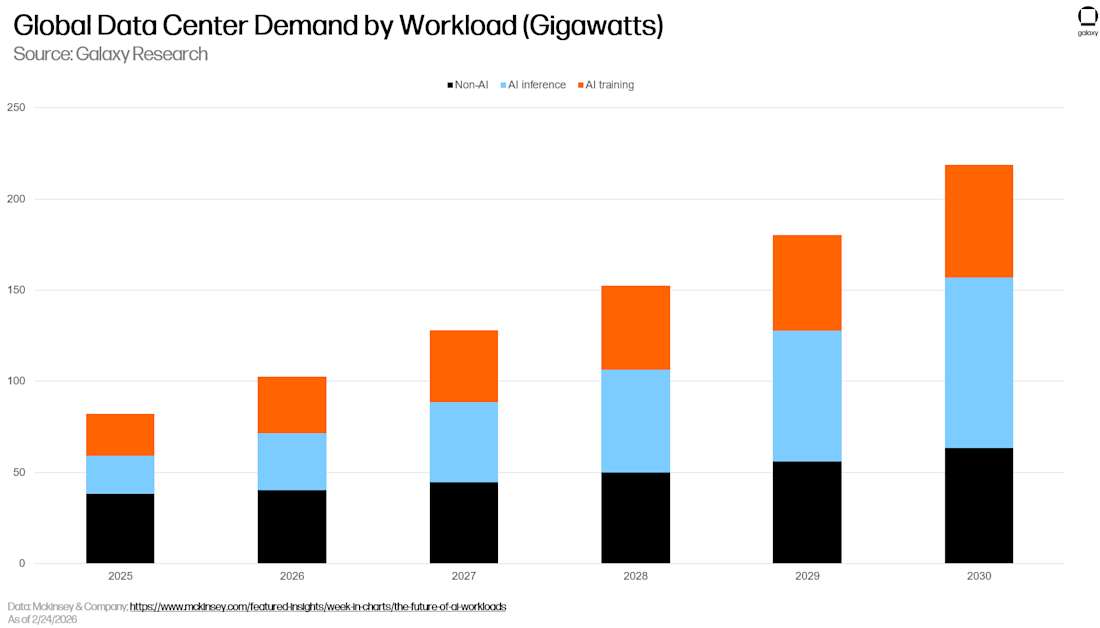
Galaxy Digital has laid out a broad framework for what it calls the “inference capital markets,” arguing that AI inference is moving from a purely technical service into an asset class that can be priced, hedged, financed and traded. In a research report written by Galaxy Digital Vice President of Research Lucas Tcheyan and circulated in Chinese by TechFlow, the firm links several parallel developments into one market structure: the rise of GPU price indexes, planned GPU futures from Intercontinental Exchange and CME Group, tokenized claims on future AI inference, useful proof-of-work networks that subsidize inference production, and stablecoin-funded lending against GPU hardware. The report’s central claim is that inference has now overtaken training as the main driver of global GPU demand, while autonomous agents are emerging as a new class of machine-native buyers that can pay for model output programmatically. Galaxy argues that the market is still early and fragmented. It sees progress on the off-chain side, where Ornn, Silicon Data and Compute Desk are building reference pricing for compute, and where Kalshi, ICE and CME are already moving toward tradable GPU-linked products. On-chain, the report highlights Venice’s VVV and DIEM system for tokenized inference access, Pearl and Ambient’s different attempts to turn inference production into useful proof-of-work, and USD.AI’s stablecoin-based credit model for financing AI hardware. Even so, the report says the sector has not yet solved its hardest questions: whether real demand for verifiable, censorship-resistant inference will grow beyond a niche, how token value can be tied to actual product usage instead of emissions and speculation, and whether legal enforcement and collateral recovery in GPU-backed lending can hold up in a true stress cycle.

1670
Galaxy maps the emerging market for AI inference as a financial asset, from GPU futures to tokenized access and on-chain credit