Bessent
4 days agoNews Editor

Bessent says Treasury can work with SEC and CFTC to advance crypto framework

U.S. Treasury Secretary Bessent said at the Ripple Swell conference that Congress’s failure to pass the CLARITY Act was disappointing, but added that the Treasury still has significant convening power and can work with the Securities and Exchange Commission and the Commodity Futures Trading Commission to move a crypto regulatory framework forward through agency action. He described the SEC and CFTC as "great partners" in that effort. Bessent also said the CLARITY Act could have helped prevent a repeat of "debanking," though he argued similar outcomes can still be avoided by putting regulatory best practices and safeguards in place. He added that stablecoins would expand demand for the U.S. dollar and U.S. Treasuries, making them an important source of financing for the Treasury.

270
Bessent says Treasury can work with SEC and CFTC to advance crypto framework
Binance
5 days agoNews Editor

Binance files Brazil crypto license application ahead of central bank deadline

Binance has filed an application with Brazil’s central bank for a crypto-asset service provider license through its local entity, BBrasil, in a move aimed at keeping its operations running ahead of the Oct. 30 regulatory deadline. The company said the filing, submitted on Oct. 23, is intended to allow users in Brazil to continue accessing crypto assets, stablecoin trading, payments and investment services while the regulatory process moves forward. At the same time, Binance has rolled out changes for Brazilian users that took effect Tuesday. Those measures include restrictions on crypto lending, margin trading and other services, along with the delisting of 22 crypto assets in the country. Thiago Sarandy, general manager of Binance Brazil, said the company supports a regulated market that takes into account the characteristics of virtual assets and hopes ongoing talks with the central bank will allow it to restore products that were paused to comply with current rules. Under central bank requirements, existing crypto service providers must submit authorization requests by Oct. 30 to keep operating under transitional arrangements. Binance’s filing does not mean approval has been granted, and the exchange still needs to wait for the central bank’s formal review before it can know whether its local business will be fully compliant.

270
Binance files Brazil crypto license application ahead of central bank deadline
US midterms
5 days agoNews Editor

US midterms put crypto policy in play as Congress control and CLARITY Act prospects hang in the balance

With one week left before the Nov. 3 U.S. midterm elections, the crypto industry is watching Congress as closely as the White House. The presidency is not on the ballot, but control of the House and Senate will shape which digital asset bills move, who chairs the key committees, and how aggressively lawmakers scrutinize regulators and conflicts of interest tied to crypto businesses. That matters because the Digital Asset Market Clarity Act, or CLARITY Act, stalled in the Senate in September after a procedural vote failed to reach the 60-vote threshold needed to advance debate. The bill has become a focal point for firms seeking clearer lines between Securities and Exchange Commission and Commodity Futures Trading Commission oversight. Industry money is already deeply involved. Fairshake and its affiliated groups, Fellowship PAC, and Coinbase-backed Stand With Crypto have spent or pledged support across both parties, backing candidates seen as more open to digital asset legislation. Polling and election maps suggest Democrats are favored to retake the House, while the Senate remains much less settled. For crypto companies, the election is not simply about whether one party is friendlier than the other. It is about who sets the agenda, what compromises become necessary, and whether any version of a market structure bill can survive the next Congress.

390
US midterms put crypto policy in play as Congress control and CLARITY Act prospects hang in the balance
Israel
6 days agoNews Editor

Netanyahu says blockchain could be one option to bypass sanctions, drawing objections from Israel’s central bank

Israeli Prime Minister Benjamin Netanyahu said in a Channel 10 interview on Oct. 23 that Israel should prepare for possible sanctions, including measures targeting its banks, by building an economy capable of working around them. When asked whether blockchain could serve as an alternative, he said it was "one of them" and added that he had already requested a plan. The remarks quickly triggered criticism from the Bank of Israel, more than 100 economists, and several political rivals ahead of Israel’s Oct. 27 vote. The central bank said cryptocurrencies cannot be used to bypass sanctions and argued that preserving economic ties with Israel’s main trading partners is the right course. Economists warned that such a plan would cost jobs and foreign investment, while opposition figures attacked both its practicality and its implications for national security. Critics also pointed to a technical problem: blockchain transactions are traceable, and Israeli authorities have themselves used that visibility in enforcement actions, including sanctions announced in July against 37 crypto wallets linked by the National Bureau for Counter Terror Financing to Iran’s Revolutionary Guards.

270
Netanyahu says blockchain could be one option to bypass sanctions, drawing objections from Israel’s central bank
Federal Reserve
6 days agoNews Editor

Fed, ECB and BOJ decisions headline a packed week for crypto, with Coinbase earnings also due

A dense calendar is set to shape crypto markets in the week starting Oct. 26, with central bank decisions, U.S. macro data, crypto protocol deadlines and major earnings all landing within a few days. According to CoinDesk’s weekly preview, the Federal Reserve and Bank of Canada are due on Wednesday, followed by the European Central Bank on Thursday and the Bank of Japan on Friday. Attention is expected to center less on the rate numbers themselves and more on policy guidance, including remarks tied to the Fed’s December meeting. MEXC CEO Vugar Usi Zade told CoinDesk that markets have largely priced in a hold, making official commentary more important than the decision alone. Beyond macro, the schedule includes an IRS comment deadline, Unichain’s planned sequencer transfer, Balancer’s BIP-928 wind-down steps, DAO governance votes, token unlocks and a run of industry events. Earnings from Galaxy Digital, Robinhood, Coinbase, Strategy, PayPal, Mastercard and others add another layer of potential volatility for digital asset traders.

260
Fed, ECB and BOJ decisions headline a packed week for crypto, with Coinbase earnings also due
SEC
6 days agoNews Editor

SEC crypto rule closes comment period, putting a regulated ICO path in view

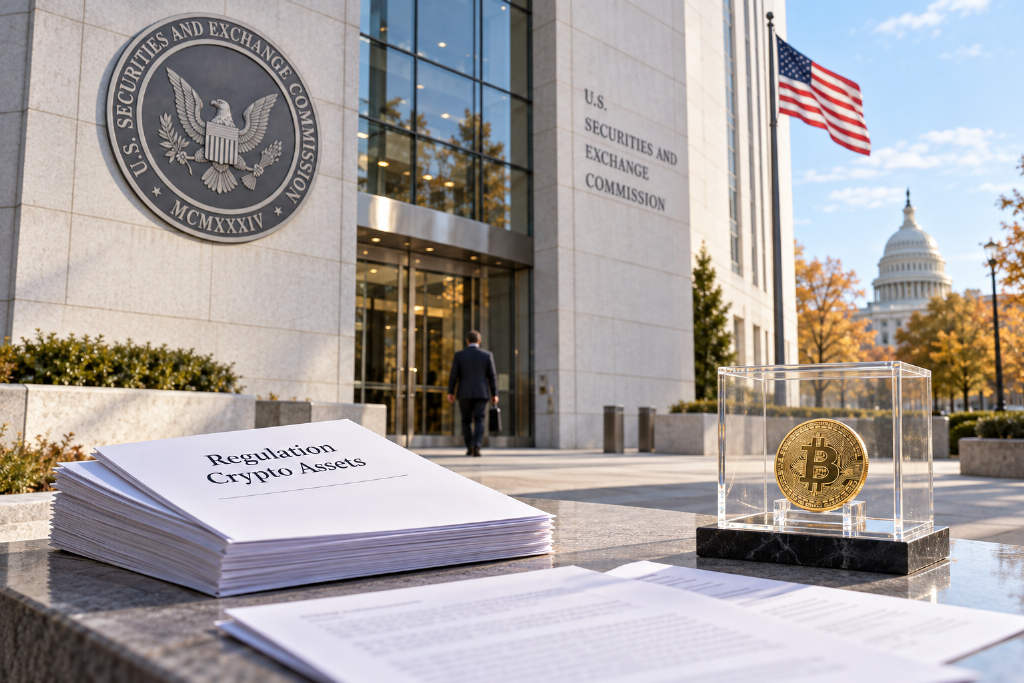
The U.S. Securities and Exchange Commission’s proposed Regulation Crypto Assets has reached the end of its public comment period, closing on Oct. 20 after being introduced on Aug. 18, 2026. The proposal is designed to move token fundraising away from a system shaped largely by enforcement actions and toward a dedicated framework for public crypto offerings. Its core features include a startup exemption allowing up to $5 million over four years without an audit or licensed intermediary, two higher-tier exemptions capped at $20 million and $75 million annually, a Safe Harbor process that would let issuers file Form TR to end a token’s securities status after development commitments are completed or permanently abandoned, and partial federal preemption of state registration rules. Public feedback has been mixed but mostly reform-oriented rather than outright hostile. According to a public tracker built by BI Norwegian Business School researcher Mert Erinc, the SEC had received 171 comment letters by Oct. 20, with 165 coded. Of those, 8 were clearly supportive, 115 conditionally supportive, 14 opposed, 3 mixed, and 25 procedural or off-topic. The sharpest disputes center on four areas: fundraising caps, disclosure standards, insider resale restrictions, and the design of the Safe Harbor exit mechanism. The article argues that the rule has a relatively high chance of advancing after revisions, with the biggest implications being a legal route for token fundraising, a clearer process for exiting securities treatment, and a more unified federal-state regulatory boundary.

470
SEC crypto rule closes comment period, putting a regulated ICO path in view
UK
6 days agoNews Editor

U.K. banks drew more than 10,000 complaints in 90 days over crypto transaction limits

More than 10,000 complaints were filed in the U.K. over bank restrictions on crypto transactions during a 90-day period between May and August, according to advocacy group Stand With Crypto. The group said 10,092 complaints were submitted by 9,800 individuals across all 650 parliamentary constituencies, with Lloyds Banking Group receiving the most, followed by Barclays and NatWest. The figures were collected through a voluntary online tool and were not adjusted for each bank’s market share, meaning they do not represent all customers or complaint rates across the banking sector. The report highlights tension between the U.K.’s stated ambition to become a global crypto hub and the practical barriers consumers face when trying to move money to digital asset platforms, including firms registered with the Financial Conduct Authority. Coinbase’s head of European policy, Katie Harries, said blanket restrictions, rigid limits and unclear policies are making access harder and could weigh on the growth of the country’s digital asset sector. Stand With Crypto is calling on banks to publish clearer explanations of their rules and to give customers meaningful ways to challenge blocked transfers.

330
U.K. banks drew more than 10,000 complaints in 90 days over crypto transaction limits
South Africa
8 days agoNews Editor

South Africa’s Crypto Rules Split Across Licensing, AML and Draft Cross-Border Reporting

South Africa’s crypto-asset regime is moving on two separate tracks. Licensing and anti-money laundering obligations are already in force, while a dedicated framework for cross-border crypto transfers remains at the draft stage. Since 2022, crypto assets have been treated as financial products under the Financial Advisory and Intermediary Services Act, bringing certain advisory and intermediary activities under the Financial Sector Conduct Authority’s licensing perimeter. Firms may also face registration, customer due diligence, record-keeping and suspicious transaction reporting duties under the Financial Intelligence Centre framework. The article argues that there is no single all-purpose crypto license in South Africa. A trading platform may need to assess financial services authorization, AML controls, tax reporting and cross-border capital flow rules separately, often under different agencies and legal bases. It also highlights the Financial Intelligence Centre’s Travel Rule requirements, which take effect from April 30, 2025, and the South African Revenue Service’s Crypto-Asset Reporting Framework, effective from March 2, 2026. At the same time, the South African Reserve Bank and National Treasury released a draft manual in August 2026 that would bring some transfers between local authorized CASPs, foreign CASPs and unhosted wallets into a reporting framework overseen by FinSurv. That proposal, together with draft capital flow regulations, was still under revision as of Oct. 20. For firms entering the market, the practical starting point is to map customers, wallets, platforms, bank accounts and contracting entities before deciding which rules apply.


410
South Africa’s Crypto Rules Split Across Licensing, AML and Draft Cross-Border Reporting
Total 1667 items
Go topage