DPC

Bitcoin ETF
2026-09-22 09:31:01

Bitcoin spot ETFs pull in $999 million as X adds live market quotes for stocks and crypto

A PANews daily roundup put several crypto and tech developments in focus, led by strong U.S. spot ETF flows and a new market data feature on X. According to SoSoValue, U.S. spot Bitcoin exchange-traded funds recorded $999 million in net inflows on Sept. 21 Eastern Time, extending the streak to three straight days. BlackRock’s IBIT led with $381 million, while ARKB from Ark Invest and 21Shares added $289 million. Spot Ether ETFs also posted $270 million in net inflows the same day, with BlackRock’s ETHA and Fidelity’s FETH leading the list. On the product side, X rolled out live quote displays for stocks and cryptocurrencies. The feature includes a trading button that routes users to Coinbase, Gemini, Kraken, Moomoo and Interactive Brokers. The roundup also covered a Bloomberg report that the U.S. Department of Justice is investigating whether Binance may have violated Iran sanctions, a governance incentive proposal vote launched by World Liberty Financial, xAI’s release of Grok 4.7, and fresh revenue figures from the Bittensor ecosystem. In market data and on-chain activity, PANews highlighted a 14-year-dormant wallet moving 600 BTC, a brief USDe depeg on Binance, and new ETH accumulation by BitMine and several whale addresses.


40
Bitcoin spot ETFs pull in $999 million as X adds live market quotes for stocks and crypto
Google
2026-09-21 10:02:32

Google fined €403 million by Irish regulator over location data violations

Google has been fined €403 million by Ireland’s Data Protection Commission, according to a Techub News brief citing Crypto Briefing. The penalty stems from an investigation into how the company handled users’ location data. Ireland’s regulator said Google’s conduct breached the European Union’s General Data Protection Regulation, or GDPR. The report did not provide additional details on the specific practices at issue, but it identified the handling of location data as the focus of the case. The fine adds to the list of major GDPR enforcement actions taken by European regulators against large technology companies. In this case, the Irish DPC was the authority named in the report, and the amount of the penalty was specified as €403 million.

30
Google fined €403 million by Irish regulator over location data violations
Binance Stock
2026-09-21 07:00:50

Binance Stocks to Add Trading for 25 Equities on Sept. 21

Binance Stocks will add trading for 25 equities at 13:30 UTC on Sept. 21, 2026, according to an official announcement cited by Odaily. The newly listed stock tickers are AADX, ADIG, ALIT, BOT, BXDC, CYPH, DHC, DPC, EROC, FDXF, FRVO, HAWK, IAUM, INIO, LCLN, LFTO, LGL, LYTE, ONT, RAM, SIVR, SKDD, SKUU, SVC, and UG. The notice specifies the launch time and the full list of additions, without providing extra details in the brief update. The information was published as a 7x24 newsflash by Odaily on Sept. 21, 2026.

00
Binance Stocks to Add Trading for 25 Equities on Sept. 21
Binance
2026-09-21 07:04:27

Binance Stock Trading to Add 25 Listings on Sept. 21, Including AADX and BOT

Binance will open trading for 25 additional stock listings on its stock trading platform at 21:30 Beijing time on Sept. 21, 2026, according to an official announcement cited by BlockBeats. The newly added names include Applied Aerospace & Defense (AADX), RoboStrategy, Inc. (BOT), Blackstone Digital Infrastructure (BXDC), Cypherpunk Technologies Inc. (CYPH), iShares Gold Trust Micro (IAUM), abrdn Silver ETF Trust (SIVR), GraniteShares 2x Short SK Hynix (SKDD), and GraniteShares 2x Long SK Hynix (SKUU). The full list also covers ADI Global Distribution, Alight, Diversified Healthcare Trust, DPC Holdings, ERock, FedEx Freight Holding, Fervo Energy, HawkEye 360, INNIO, Lincoln Intl, Liftoff Mobile, LGL Group, Roundhill Photonics & Optics ETF, Onterris, Roundhill T-REX 2X Long DRAM, Service Properties Trust, and United Guardian. The schedule and list were published in an official Binance notice and reported by BlockBeats on Sept. 21.

10
Binance Stock Trading to Add 25 Listings on Sept. 21, Including AADX and BOT
Marvell
2026-08-06 08:33:11

Marvell unveils Bravera SC6 SSD controller for PCIe Gen6 AI data center storage

Marvell said on Aug. 4 that it has launched the Bravera SC6 SSD Controller, model MV-SF1410, aimed at the PCIe Gen6 NVMe SSD market for AI data centers, hyperscale cloud operators, and enterprise database deployments. The company said the chip is built for a shift in AI system design toward tiered memory architectures, where NVMe SSDs act as a high-capacity memory layer rather than serving only as conventional storage. According to Marvell, that setup can provide tens to hundreds of terabytes of capacity at a lower cost than GPU HBM and DRAM, helping keep GPUs utilized while reducing infrastructure costs. Bravera SC6 supports PCIe Gen6, remains backward compatible with PCIe Gen1 through Gen5, and complies with the NVMe 2.2 specification. It also features 16 NAND channels, transfer speeds of up to 3600 MT/s, support for ONFI and Toggle NAND, and compatibility with SLC, MLC, TLC, and QLC flash. Marvell said samples are expected to become available in the fourth quarter of 2026.

2320
Marvell unveils Bravera SC6 SSD controller for PCIe Gen6 AI data center storage
Quantum Compu
2026-07-16 03:30:34

Quantum computers are not about to break Bitcoin, and the article’s timeline points no earlier than 2035

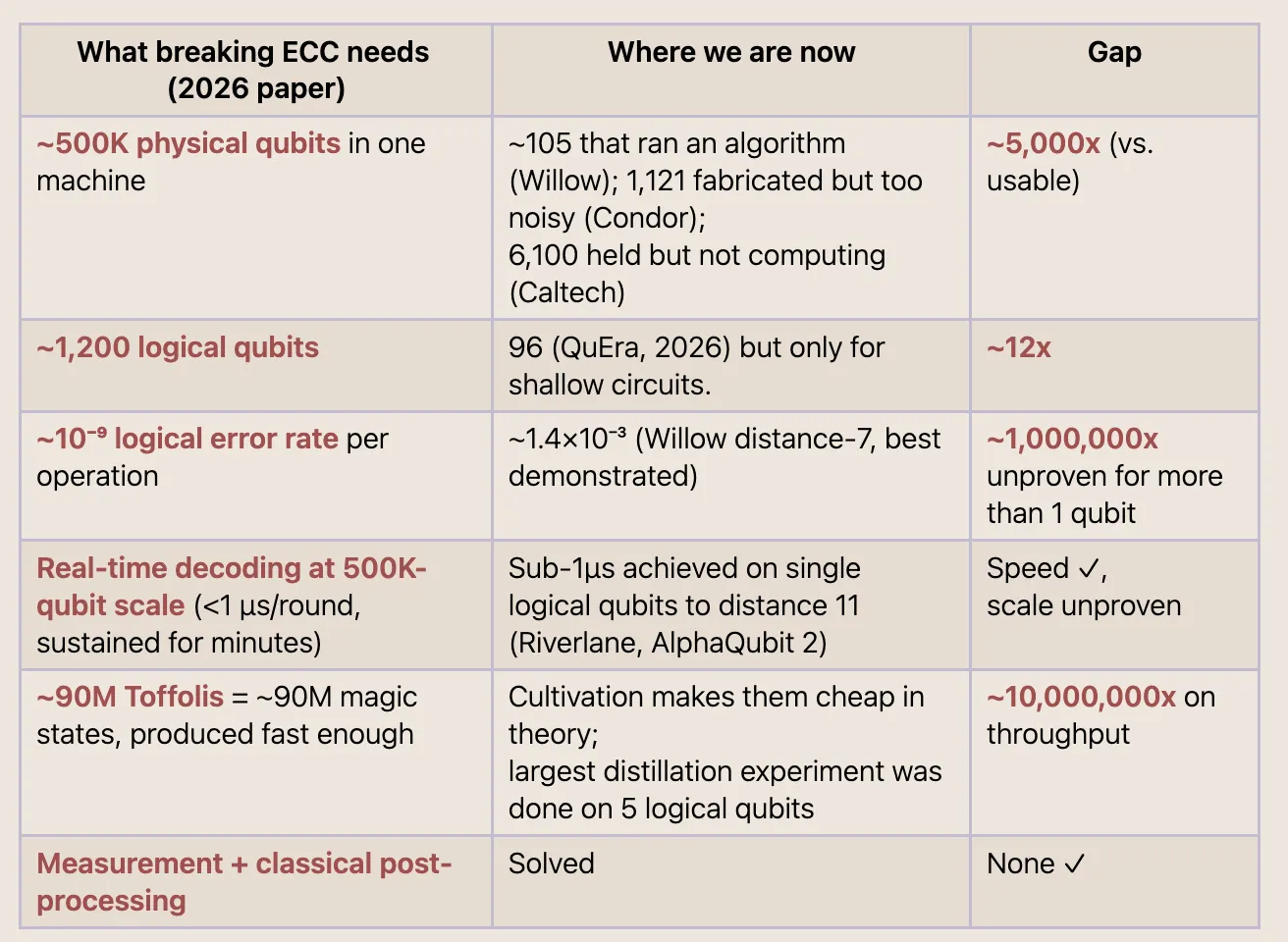
Fears that quantum computers could soon crack Bitcoin keep resurfacing, but the source article argues the gap between theory and practical attack capability remains vast. In theory, the hardware required to break elliptic curve cryptography, or ECC, has fallen sharply, from about 317 million physical qubits in 2022 to fewer than 500,000 in a 2026 paper. That is a major change on paper. The problem is that current machines can only run real algorithms with about 105 usable qubits, leaving several orders of magnitude still missing. The article walks through what would actually be needed to run Shor’s algorithm against ECC, including logical qubits, error correction, decoding speed, and the production of magic states needed for non-Clifford gates such as Toffoli gates. It says the 2026 design would require around 1,200 logical qubits, about 90 million sequential Toffoli gates, roughly 500,000 physical qubits under current error-correction assumptions, and a runtime measured in minutes. It also separates abstract cryptographic risk from actual wallet exposure. For Bitcoin, addresses only become vulnerable once a public key is revealed on-chain, which is why the article highlights roughly 6.7 million BTC as already exposed. Ethereum faces a related issue because it uses the same secp256k1 curve and ECDSA signatures, while its persistent account model makes repeated address use more common.

1520
Quantum computers are not about to break Bitcoin, and the article’s timeline points no earlier than 2035
Quantum Compu
2026-07-16 03:04:03

Quantum computing is still far from breaking ECC, despite sharp gains in theory

A TechFlowPost article translated from Derrick Cui argues that practical quantum attacks on elliptic curve cryptography, or ECC, are still several orders of magnitude away even after major theoretical advances. The piece says recent research has cut the estimated hardware needed to break ECC from about 317 million physical qubits in 2022 to fewer than 500,000 in 2026, but today’s machines can run real algorithms on only about 105 qubits. It walks through what would actually be required to attack ECC with Shor’s algorithm, including logical qubits, error correction, decoding, Toffoli gates and magic-state distillation, then compares those requirements with current hardware. The article also discusses what a quantum break would mean for Bitcoin and Ethereum. In Bitcoin, the main risk is tied to addresses whose public keys have already been revealed on-chain, while Ethereum’s persistent account model would leave any wallet that has sent a transaction exposed if quantum attacks were available today. The piece concludes that the gap between theory and deployable machines remains enormous, and that no reliable timeline can be inferred from current progress alone.

620
Quantum computing is still far from breaking ECC, despite sharp gains in theory