Dragonfly
Sep 1, 2026

Dragonfly partner says Anthropic and OpenAI IPOs could channel gains to San Francisco real estate and crypto

Dragonfly managing partner Haseeb Qureshi said in a post on X that the initial public offerings of Anthropic and OpenAI could amount to the largest liquidity transfer in history from global institutions to "San Francisco futurists." In his view, the most concentrated beneficiaries of that capital would be San Francisco real estate and cryptocurrencies. Qureshi also pointed to employee lockup mechanics, saying such restrictions typically expire 180 days after an IPO. Based on that timeline, he said that if Anthropic goes public in mid-October as expected, the process would likely begin in April 2027 and continue with OpenAI’s IPO the following year. The comments were cited by ChainCatcher as part of a market analysis update.

1300

Dragonfly partner says Anthropic and OpenAI IPOs could channel gains to San Francisco real estate and crypto
Dragonfly
Aug 31, 2026

Dragonfly partner Omar Kanji says today is his last day at the firm

Dragonfly partner Omar Kanji said today is his last day at the crypto venture capital firm after four years. In his post, Kanji thanked Rob Hadick, Haseeb Qureshi, Feng Bo, and Tom Schmidt, and also expressed gratitude to his colleagues and the founders he worked with. He added that he is excited about what comes next and said more details will be announced later. The update was carried by ChainCatcher as a 7x24 news flash.

1570
Dragonfly partner Omar Kanji says today is his last day at the firm
City Protocol
Aug 26, 2026

City Protocol raises $11 million across seed and pre-Series A rounds as Venzo reaches $30 million TVL

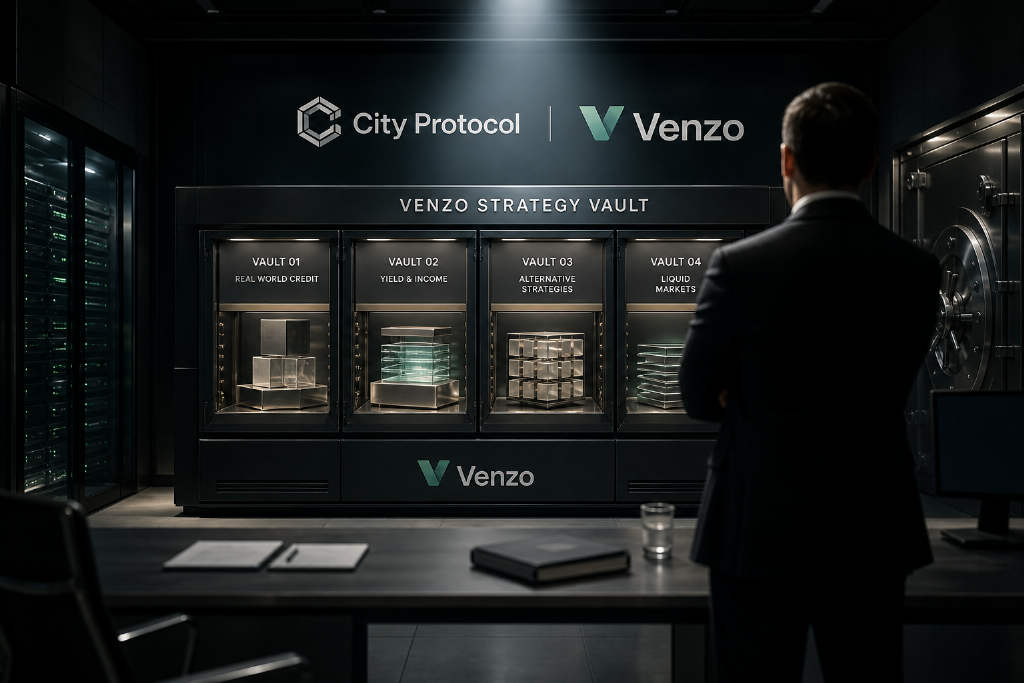
City Protocol, an infrastructure provider focused on bringing structured products on-chain, said it has completed seed and pre-Series A financing rounds totaling $11 million. Investors named by the project include Dragonfly, Jump Crypto, CMT Digital, Stratified Capital, Adaverse and Mirana. The company says it is building an integrated stack for the issuance, operation and distribution of on-chain structured products, with tokenization, vault and issuance-and-operations layers designed as reusable modules. Its flagship product, Venzo, runs on top of that infrastructure and currently offers four strategy vaults with $30 million in total value locked. According to the announcement, the product is deployed on EVM-compatible networks and uses chain abstraction to present a unified user experience. Venzo is also running its first-season Polis points campaign and plans to roll out a non-custodial thematic portfolio product line in the near term. City Protocol said its ecosystem has so far attracted more than 51,000 verified City ID users and over 9,400 ecosystem NFT holders.

1600
City Protocol raises $11 million across seed and pre-Series A rounds as Venzo reaches $30 million TVL
AI agents
Aug 6, 2026

Sapiom Raises $35M Series A Led by Dragonfly for AI Agent Infrastructure

Sapiom, an AI agent infrastructure platform, has raised $35 million in a Series A round led by Dragonfly, according to a press release distributed by Business Wire. The round saw participation from Accel, Gradient, Coinbase Ventures, Operator Collective, Formus Capital and VanEck Ventures, with existing investors Okta Ventures, Menlo Ventures, Anthropic and Array Ventures also following on. Founded just 11 months ago, Sapiom had previously completed a $15 million seed round, bringing cumulative funding to $50 million. The company says its mission is to remove the infrastructure barriers that prevent AI agents from advancing from the demo stage into production environments. Alongside the financing, Sapiom introduced three products: Router, Agent Studio and Runtime. Haseeb Qureshi, managing partner at Dragonfly, will join Sapiom's board of directors. Use of the proceeds was not disclosed.

2930
Sapiom Raises $35M Series A Led by Dragonfly for AI Agent Infrastructure
Dragonfly
Aug 4, 2026

Dragonfly partner says Coldcard flaw could be found by AI for about $2

Dragonfly managing partner Haseeb Qureshi said on X that security is increasingly becoming a cost competition between attackers using frontier AI to scan for vulnerabilities and defenders paying for AI-based hardening. He said Claude was able to find the Coldcard-related flaw in eight minutes, while GLM reproduced it in 20 minutes, which in his view suggested Coldcard had made almost no investment in AI security hardening. Qureshi estimated that the discovery cost of reproducing the attack with GLM 5.2 was only about $2, meaning an AI model could identify the vulnerability for roughly that amount. He warned that small companies will struggle to survive in security-sensitive product categories and argued that any security-sensitive product should undergo AI security scanning on every release.

2020
Dragonfly partner says Coldcard flaw could be found by AI for about $2
Dragonfly
Jul 30, 2026

Dragonfly partner says crypto helped lay the groundwork for today’s AI boom

Dragonfly partner Haseeb said on X that today’s AI boom might not have emerged in its current form without the development of the crypto industry. He pointed to more than a decade of experience accumulated by Bitcoin miners in securing power, choosing remote sites and building large-scale infrastructure, arguing that this know-how has become an important foundation for the expansion of AI data centers. Haseeb also said demand from crypto mining helped Nvidia make the shift from a gaming GPU maker to a supplier of AI compute chips. In the same post, he added that core teams at several newer AI cloud providers, including CoreWeave, Crusoe, Together AI and Nscale, all have backgrounds in crypto. His remarks frame crypto not only as a consumer of computing resources, but also as an industry that contributed talent, infrastructure experience and early hardware demand that later proved relevant to AI.

2580
Dragonfly partner says crypto helped lay the groundwork for today’s AI boom
crypto venture capital
Jul 29, 2026

Active crypto VC firms drop to 150 in July, the lowest level since November 2020

Only 150 unique venture capital firms took part in crypto funding rounds in July, according to CryptoRank data through July 28, marking the lowest monthly count since November 2020. The number shows how sharply the investor base has contracted since the last bull market. At the peak in May 2022, 1,177 investors participated in crypto rounds in a single month, which means activity has fallen 87% from that high. Quarterly data points in the same direction, with 651 firms participating in crypto rounds in the second quarter, down about 75% from 2,564 in the second quarter of 2022. The report says many smaller funds, family offices, and angel syndicates that crowded into deals during 2021 and 2022 have mostly left the market, leaving a tighter group of established firms to lead rounds. That does not automatically mean less capital is being deployed. Large firms are still backing infrastructure and real-world asset plays, and Dragonfly closed a $650 million fourth fund in February. At the time, Dragonfly managing partner Haseeb Qureshi told Fortune that blockchain venture investors face a “mass extinction,” while also arguing that dedicated crypto venture capital could lose its reason to exist by 2030 if dominant platforms continue to capture users and liquidity.

2340
Active crypto VC firms drop to 150 in July, the lowest level since November 2020
crypto venture capital
Jul 28, 2026

Active crypto VC firms fall to 150 in July, down 87% from the 2022 peak

Dragonfly managing partner Haseeb Qureshi said crypto venture capital may be approaching a “last vintage funds” phase as mature networks become harder for startups to challenge. He argued this does not mean the crypto industry is disappearing. Instead, scale, liquidity, and network effects are becoming more concentrated on a small number of established platforms. Qureshi said that by 2030, many of the most important companies in crypto may already have been built. Large platforms could still expand, but the room for new entrants to overturn the market may be limited. In his view, investors may be underestimating the possibility that growth in the crypto market will not necessarily keep producing investable startups. Data from Cryptorank shows that as of July 28, only 150 independent venture firms took part in crypto funding rounds during July, the lowest level since November 2020. That figure is well below the peak of 1,177 active investment firms recorded in May 2022, a drop of about 87%. Qureshi also said he is cautious on startups built around a single financial product on platforms such as Hyperliquid, arguing that if the platform controls distribution, those companies look more like distributors than durable businesses.

2390
Active crypto VC firms fall to 150 in July, down 87% from the 2022 peak
Total 59 items
Go topage