EPS

UBS
2026-08-11 05:31:27

UBS keeps Buy on Micron, says AI memory shortage still supports earnings re-rating

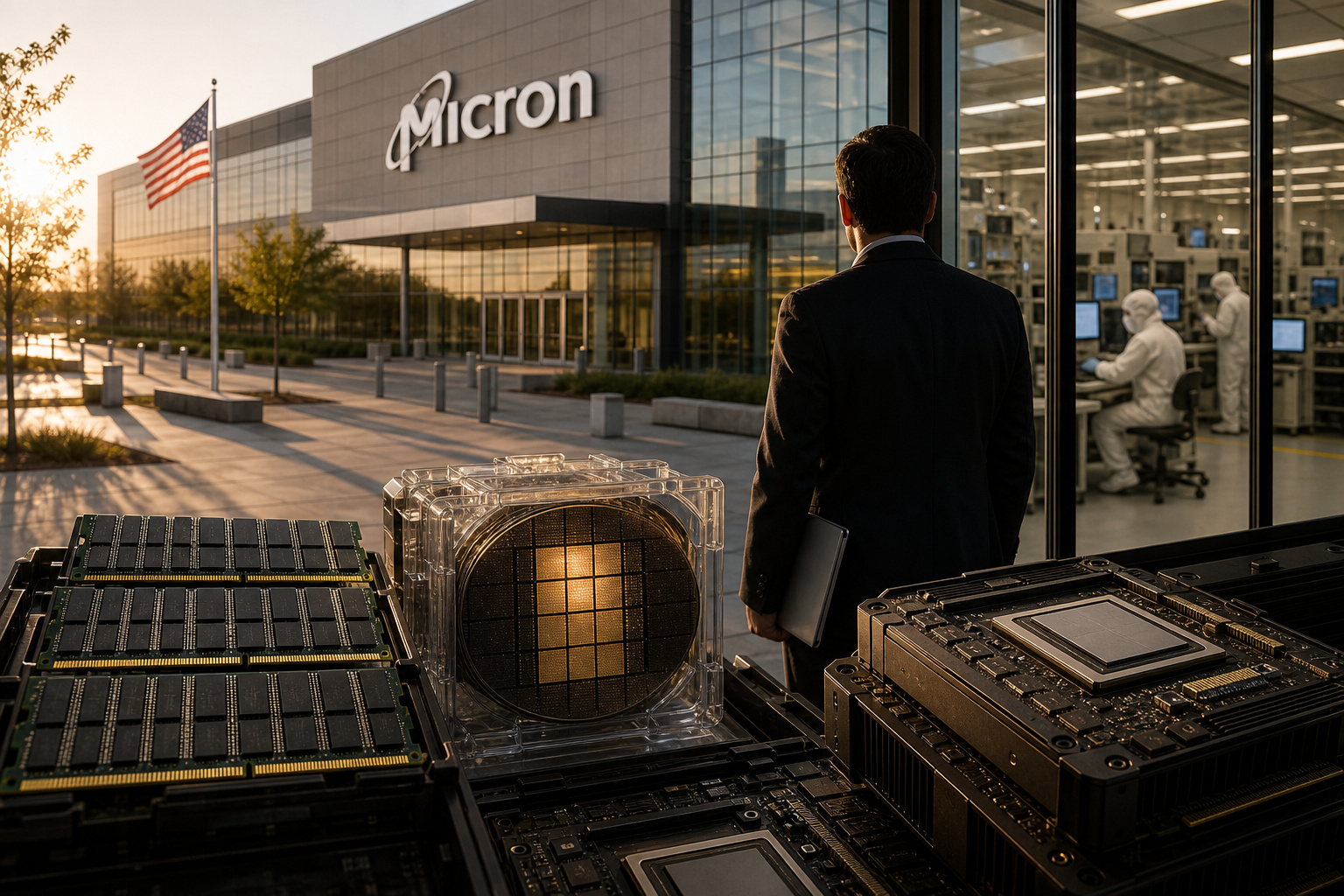
UBS maintained its Buy rating on Micron and kept a $1,625 price target in its latest report, implying about 85% upside from the stock’s Aug. 7 close of $877.57. The bank said short-term noise has emerged in NAND pricing, but supply-demand tightness in DRAM, especially high-bandwidth memory, has exceeded its earlier expectations. The note came after a sharp swing in storage names. SanDisk and Western Digital fell after earnings guidance missed elevated expectations, weighing on sentiment around the AI memory supply chain. Micron then slipped modestly after reports that Apple had tested memory chips from China’s CXMT. Even so, UBS said the market’s pricing of the AI memory cycle has not broken down. UBS centered its thesis on HBM, raising its estimate for 2027 total HBM consumption to 61.5 billion Gb from 58.7 billion Gb as more VR300 units enter the supply chain, despite lower HBM capacity per GPU than previously expected. It also projected stronger pricing across HBM and DDR, while arguing DRAM will remain in undersupply at least through the second quarter of 2028. On earnings, UBS trimmed Micron’s fiscal 2026 and 2027 EPS forecasts, raised its fiscal 2028 EPS estimate, and said cumulative free cash flow could exceed $450 billion by 2028.

1640
UBS keeps Buy on Micron, says AI memory shortage still supports earnings re-rating
Bank of Ameri
2026-08-10 03:32:47

BofA says Bull & Bear at 9.7 leaves little upside, urges investors to rotate or step back

Bank of America said its Bull & Bear indicator rose to 9.7 in its August 6 Flow Show report, the highest level since 2021 and near a sell signal, as policy support for financial conditions clashes with rising political and valuation risks. Over the past week, cash funds took in $53.7 billion, equity funds drew $32.9 billion, and bond funds added $23.1 billion, while crypto saw $600 million of inflows and technology funds posted their first outflow in six weeks. The bank argued that the market’s main tension now lies between liquidity backstops on one side and stretched sentiment, widening AI hyperscaler credit spreads, and midterm election uncertainty on the other. Its recommendation was not to add risk but to "retreat or rotate" out of risk assets and into defensive sectors, duration-sensitive assets, and the U.S. dollar. BofA also said midterm elections are the biggest macro variable for the second half, while July nonfarm payrolls could shape the rate outlook and determine whether duration and defensive trades become a contrarian opportunity.

1760
BofA says Bull & Bear at 9.7 leaves little upside, urges investors to rotate or step back
Bank of Ameri
2026-08-10 03:01:13

BofA’s Michael Hartnett stays tactically bearish but strategically bullish on stocks

Bank of America chief investment strategist Michael Hartnett said in the latest Flow Show report that his market view remains split between short-term caution and a longer-term pro-risk allocation. Tactically, he said investors should rotate out of risk assets and toward defensive assets, duration trades and the U.S. dollar. Strategically, he is still sticking with a long-stocks, short-bonds stance because, in his view, U.S. policymakers now treat equities as a systemically important asset that is too big to fail. Hartnett noted that BofA’s bull-and-bear indicator rose from 9.4 to 9.7, its highest level since the meme-stock bubble in early 2021, pointing to extremely optimistic sentiment. At the same time, he flagged growing stress signals from credit markets, including widening credit spreads and CDS for AI hyperscale data center operators, along with the first net outflow from tech stocks in six weeks. He also outlined what could end the current bull run: a bond-market selloff marked by rising yields and a weaker dollar, or a more immediate warning sign of rising yields paired with falling bank stocks. In the political and macro backdrop, Hartnett said gold remains a hedge against tail risks tied to the U.S. election cycle, while Republican control of the Senate would be a positive market outcome.

1180
BofA’s Michael Hartnett stays tactically bearish but strategically bullish on stocks
Morgan Stanle
2026-08-09 02:32:40

Morgan Stanley flips bullish on Samsung and SK Hynix, sees more than 60% upside for both

Morgan Stanley semiconductor chief analyst Shawn Kim has reversed the cautious call he made in July on memory stocks, saying the harshest phase of the recent correction is nearing an end. In his latest report, Kim described the pullback as a temporary disruption inside an "AI supercycle" rather than a turn in industry fundamentals. He linked the July sell-off in Korean equities and the memory supply chain to the unwinding of leveraged AI hedge fund positions, retail margin deleveraging, and profit-taking after memory price growth peaked on a year-over-year basis. The bank said memory valuations have fallen to unusually low levels, with the sector trading at about 3x forward 12-month earnings, and argued that the market is assigning little to no long-term growth premium. Morgan Stanley also said the pace of earnings downgrades has cooled sharply from prior highs. Looking ahead, the report forecasts a later-cycle transition in the memory industry in the fourth quarter of 2026, with stock drivers shifting toward shareholder returns, long-term agreements, and free cash flow. Despite making different earnings revisions for the two companies, the bank kept a bullish stance on both SK Hynix and Samsung Electronics and said each has implied upside of more than 60% from current share prices.

1400
Morgan Stanley flips bullish on Samsung and SK Hynix, sees more than 60% upside for both
Nvidia
2026-08-08 06:43:09

Nvidia’s Rubin Ultra memory cut hits HBM outlook as global memory stocks slide, while CXMT avoids the same shock

Nvidia’s reported decision to reduce the mainstream HBM configuration on its next-generation Rubin Ultra GPU has shaken expectations across the memory sector. According to the source text, the design under evaluation moved from a planned 12-Hi, roughly 384GB HBM setup to an 8-Hi, 192GB version, nearly halving memory capacity per card. The GPU package was also reduced from 4-die to 2-die, with power dropping from 2300W to 1800W. SK hynix ADR fell 4.97% on the day of the news, and its South Korean shares dropped more than 10% the next day. The report places that development alongside a wider pattern in memory equities: record earnings, weaker share prices. Sandisk posted fiscal 2026 fourth-quarter revenue of $8.97 billion, up 372% year over year, yet its shares still fell after guidance for the next quarter came in below market expectations. SK hynix and Samsung Electronics saw similar market reactions despite posting historic profit figures. The article argues that investors are repricing the sector around slowing growth rather than peak profit levels. It also turns to China’s domestic substitution story. CXMT was described as the world’s fourth-largest DRAM supplier by market share, with progress in DDR5 and LPDDR5 and fast capacity expansion, but still lacking large-scale HBM production. That has left it in a different position from Korean HBM leaders, even as it gains ground in mainstream DRAM.

1030
Nvidia’s Rubin Ultra memory cut hits HBM outlook as global memory stocks slide, while CXMT avoids the same shock
Google
2026-08-08 10:00:01

SemiAnalysis says Gemini is slipping in the AI race as Google turns TPU capacity into a bigger business

SemiAnalysis argued in an Aug. 7 report that Google’s Gemini franchise may be losing ground in the frontier AI model race, even as Alphabet’s broader AI business keeps expanding through Google Cloud Platform. The report tied that view to major leadership changes at DeepMind, the departure of senior researchers including Jeff Dean and Oriol Vinyals, and weaker momentum in Gemini’s product roadmap after Gemini 3 Pro. At the same time, SemiAnalysis said Google may be making a different bet: selling TPU systems and AI compute to outside customers, including Anthropic, one of Gemini’s clearest rivals. The firm estimated that more than 20% of TPU shipments from the third quarter of 2026 through the fourth quarter of 2027 could go directly to Anthropic, on top of hundreds of thousands of leased TPUs and more capacity promised to Anthropic and Meta. The report said this shift could materially reshape Google Cloud’s growth profile. Alphabet has already confirmed that Google Cloud began directly delivering TPU systems into customer data centers in the second quarter and started recognizing that revenue. SemiAnalysis estimated TPU system sales contributed about $1.2 billion in the quarter and projected GCP growth could top 100% in 2027, with Google’s external AI business approaching $200 billion by the end of that year.

1950
SemiAnalysis says Gemini is slipping in the AI race as Google turns TPU capacity into a bigger business
JPMorgan
2026-08-08 05:26:21

JPMorgan says U.S. and European companies posted broad EPS beats in Q2

JPMorgan said the second-quarter earnings season is now in its later stages, with roughly 80% to 85% of companies in the United States and Europe having already reported results. The bank said earnings were strong across both regions, with a broad set of companies delivering earnings per share above market expectations. It also noted that the share of companies reporting EPS above consensus rose noticeably in both markets. Despite elevated expectations heading into the reporting season, aggregate EPS for S&P 500 constituents continued to move higher, according to JPMorgan. At the same time, the proportion of companies cutting earnings guidance fell to its lowest level since 2021. On a regional basis, year-over-year earnings growth reached 25% in the U.S. and 23% in Europe, both above consensus forecasts. Revenue growth also remained solid, coming in at 14% in the U.S. and 10% in Europe. JPMorgan said energy accounted for a large share of earnings growth in both regions, helped by higher energy prices driven by geopolitical conflict, while financials and technology also made notable contributions.

1060
JPMorgan says U.S. and European companies posted broad EPS beats in Q2
Bank of Ameri
2026-08-08 02:58:21

BofA reiterates Buy on SanDisk, keeps $2,500 price target

Bank of America reiterated its Buy rating on SanDisk after the company’s latest earnings report and kept its $2,500 price target unchanged. Based on the cited reference price, that target implies roughly 85% upside. The bank said the market still underestimates the durability of SanDisk’s earnings power, even though memory chips have long been treated as a cyclical business. In BofA’s view, several forces are reshaping the NAND market: demand from AI data centers, growth in enterprise SSDs, and long-term supply agreements. The bank also said it expects SanDisk’s fiscal 2027 earnings per share to reach about $233.85. On valuation, BofA argued SanDisk looks more attractive at roughly 6x forward earnings, compared with Micron at about 12x. The report was cited by The Street.

1090
BofA reiterates Buy on SanDisk, keeps $2,500 price target