GPIF

Japanese yen
2026-09-07 23:47:03

Yen hits strongest level since February as stop-loss selling and BOJ rate-hike bets build

The Japanese yen strengthened to 153.87 against the U.S. dollar by press time, marking its highest level since February, as a break below USD/JPY 155 triggered a wave of stop-loss orders and options-related hedging flows. Bloomberg reported that the move gathered pace after the pair slipped under a level seen by State Street Investment Management as an important support area following earlier intervention episodes. Traders said the break forced options dealers to sell dollars in the spot market, amplifying yen gains in thin holiday trading as U.S. markets were closed. Fresh data from Japan’s Ministry of Finance added to the shift in sentiment. Official foreign exchange reserves fell to $1.208 trillion at the end of August, down $79.6 billion from a month earlier, a decline of about 6.18% and the largest monthly drop on record. The figures reflected Japan’s earlier intervention campaign, during which authorities spent JPY 15.4 trillion between late July and late August to buy yen and sell dollars. At the same time, attention has turned to the Bank of Japan’s upcoming policy meeting, with comments from board member Hajime Takata reinforcing expectations that policy normalization remains in play, including the possibility of a 25-basis-point move.

40
Yen hits strongest level since February as stop-loss selling and BOJ rate-hike bets build
JPMorgan
2026-09-04 02:31:11

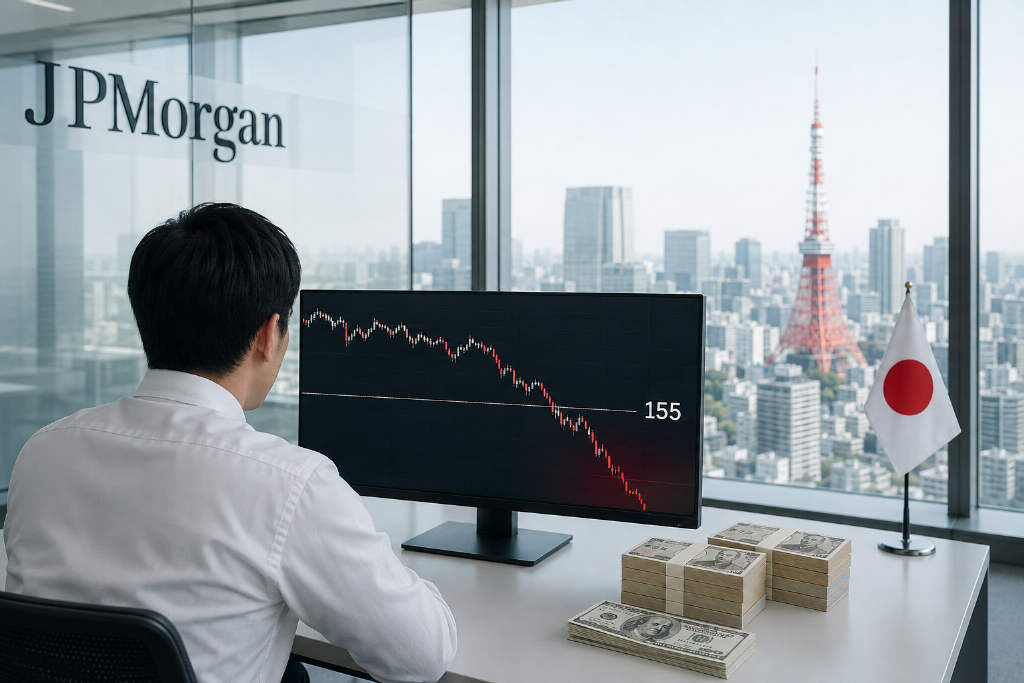
JPMorgan warns USD/JPY break below 155 could trigger yen-short unwind and send pair toward 142-146

JPMorgan has warned that a break below 155 in USD/JPY could trigger a concentrated unwind of roughly 16 trillion to 17 trillion yen in outstanding short-yen positions, equivalent to about $102.6 billion. According to strategists including Junya Tase, recent price action suggests large yen shorts may not have been fully cleared, raising the risk that selling could accelerate if the pair slips through that level. In that scenario, the bank said USD/JPY could theoretically fall into the 142-146 range. The pair earlier touched 160.39 this week before retreating to around 155.30, while the yen was on track for a roughly 2.7% weekly gain against the dollar, its best showing since July. JPMorgan said the move has been driven by rising expectations for further Bank of Japan rate hikes, speculative short covering, and stronger hedging demand from domestic Japanese investors. Swap markets are now almost fully pricing in a 25-basis-point BOJ hike this month and see about an 80% chance of another increase in December. Still, JPMorgan said expectations around the BOJ and GPIF portfolio reallocation may be overstretched and that a sharp break below the 155-165 range is not its base case. Japan’s top FX official Atsushi Mimura also said he was "not satisfied" with current yen moves and that Japan stands ready to respond to market volatility. Bank of America is currently short USD/JPY with a target of 149, while TD Securities remains moderately bearish on the dollar for the rest of the year.

120
JPMorgan warns USD/JPY break below 155 could trigger yen-short unwind and send pair toward 142-146
Arthur Hayes
2026-09-03 08:09:06

Arthur Hayes says GPIF may revisit domestic and overseas allocation, calls it the start of a "money-printing party"

Arthur Hayes said on Sept. 3 that Japan’s Government Pension Investment Fund, or GPIF, is considering a fresh review of how it allocates assets between domestic and overseas markets. In his view, that possible shift was also one of the reasons the euro fell by about two big figures against the Japanese yen during the day. Hayes said any change in GPIF’s portfolio mix could trigger large-scale capital reallocation. He described the potential outcome as the start of a "money-printing party." He also pointed readers to his latest article, "Atencion," for more detail on his thinking.

90
Arthur Hayes says GPIF may revisit domestic and overseas allocation, calls it the start of a "money-printing party"
Federal Reser
2026-09-03 08:11:34

Bitunix analyst says September CPI is the key to the Fed outlook as high-rate pressure spreads across global bonds and risk assets

A Bitunix analyst, citing the latest view from Bank of America, said the U.S. August nonfarm payrolls report due Friday may shape rate expectations, but is unlikely to determine the Federal Reserve’s September decision on its own unless labor data deteriorates sharply. The analyst said the bigger test remains the Consumer Price Index report scheduled for Sept. 11, which will show whether inflation is cooling enough for the Fed to move away from a higher-rate stance. The note argues that the market’s recent repricing of rate expectations is no longer centered only on whether the labor market is slowing. It now depends more directly on whether inflation is sticky enough to justify keeping borrowing costs elevated. That shift is already visible in bond markets, with long-dated U.S. yields staying high and government bond yields in Japan, Germany and the U.K. also moving up. According to the analysis, persistently high long-end yields keep discount rates and funding costs elevated, limiting valuation room for equities and cryptocurrencies. The analyst also pointed to the Bank of Japan’s Sept. 18 decision, intervention risk near USD/JPY 160, and renewed asset-allocation discussions at Japan’s GPIF as additional factors that could alter global capital flows in September.

120
Bitunix analyst says September CPI is the key to the Fed outlook as high-rate pressure spreads across global bonds and risk assets
Arthur Hayes
2026-08-12 06:38:45

Arthur Hayes ties yen stress, Fed FIMA facility and Bitcoin upside, with an unexpected nod to Taiwan

BitMEX co-founder Arthur Hayes used his latest essay, "Yen-quake," published on Aug. 11, to argue that the long era of cheap yen may be nearing an end and that any U.S.-Japan effort to support the currency through the Federal Reserve’s FIMA Repo Facility could amount to a fresh channel for dollar liquidity. In his view, that matters well beyond foreign exchange: if Japan can obtain dollars by posting U.S. Treasuries to the Fed instead of selling those bonds outright, the result could support the yen without forcing heavy liquidation of U.S. assets, while also expanding the Fed’s balance sheet in practice. Hayes says that kind of liquidity backdrop has historically favored scarce assets such as Bitcoin and gold. The essay also opened with an unexpected Taiwan reference. Recalling the 2011 earthquake in Japan, Hayes wrote that one question on his mind at the time was whether he could physically handle another run of Taiwan’s Spring Scream festival in Kenting, later adding in a footnote: "This is the most underrated music festival in Asia, I fucking love Taiwan." He said he is currently adding exposure to Bitcoin, physical gold, gold miners and ETH, while describing Ethena’s ENA as a higher-risk, higher-upside trade tied to the liquidity thesis.

950
Arthur Hayes ties yen stress, Fed FIMA facility and Bitcoin upside, with an unexpected nod to Taiwan
Strategy
2026-08-11 09:41:00

Strategy builds a $4.65 billion cash reserve as Trump Media posts $360.6 million crypto loss in the first half

PANews’ daily roundup on Aug. 11 centered on two balance-sheet stories with direct relevance to crypto markets. Strategy said it sold 1,690 BTC last week and lifted its U.S. dollar reserve to about $4.65 billion, while also raising roughly $653 million through its at-the-market equity program. CEO Phong Le said the company had adjusted its approach because bitcoin alone could not meet investor demand, adding that institutional investors place greater value on cash and that Strategy now holds $4.75 billion in cash, enough to cover roughly 2.7 years of preferred dividends. Trump Media, by contrast, reported a first-half loss of $360.6 million tied to the decline in crypto asset prices. As of June 30, the company held 9,477.16 BTC with a fair value of $557.1 million, down by 65 BTC from the end of March, while its Cronos holdings stayed unchanged at about 756.1 million tokens but fell in fair value from $68 million at the end of 2025 to $40.6 million. The report also noted that most of its bitcoin had been pledged as collateral. Elsewhere, South Korea approved tougher crypto rules that tighten scrutiny of exchange major shareholders and remove the 1 million won threshold for the Travel Rule, extending it to all transfers. U.S. spot bitcoin ETFs recorded a net outflow of $145 million on Aug. 10, with BlackRock’s IBIT seeing the largest single-day net outflow at $53.56 million.

1270
Strategy builds a $4.65 billion cash reserve as Trump Media posts $360.6 million crypto loss in the first half
Arthur Hayes
2026-08-11 06:02:12

Arthur Hayes says a FIMA route could channel $1.373 trillion in Treasury-backed liquidity and lift Bitcoin, gold

BitMEX co-founder Arthur Hayes argues that U.S. and Japanese officials may favor a little-used route to support the yen without directly dumping U.S. Treasuries: Japan’s Ministry of Finance could repo its Treasury holdings through the Federal Reserve’s FIMA facility, obtain dollars, then sell those dollars to buy yen in the foreign-exchange market. In Hayes’ framework, that would amount to a balance-sheet expansion at the Fed because outstanding FIMA lending would rise alongside the collateral posted. He says the mechanism would strengthen the yen while injecting fresh dollar liquidity into the global system. Hayes lays out three possible ways to drive yen appreciation: aggressive rate hikes by the Bank of Japan, forced repatriation by Japanese institutions such as GPIF, or FIMA-backed Treasury financing. He dismisses the first two as politically and financially difficult, and says the third path is the one officials are most likely to choose. He estimates that the Japanese government and GPIF together hold about $1.373 trillion in U.S. Treasuries, a pool large enough, in his view, to matter if FIMA limits are loosened. Based on that thesis, Hayes says he is already heavily positioned in Bitcoin, physical gold and gold miners. He also names Ether and Ethena’s ENA token as crypto assets he sees as offering more upside if dollar liquidity expands and Bitcoin’s basis trade improves.

1380
Arthur Hayes says a FIMA route could channel $1.373 trillion in Treasury-backed liquidity and lift Bitcoin, gold
Arthur Hayes
2026-08-11 03:34:19

Arthur Hayes says yen stress could push the Fed into a FIMA-driven balance-sheet expansion

BitMEX founder Arthur Hayes argued in his Aug. 11 essay "Yen Quake" that mounting pressure in the yen and Japanese government bond market could force the U.S. Federal Reserve into a form of indirect balance-sheet expansion through the FIMA facility. In his framework, Japan could pledge U.S. Treasuries to the Fed, obtain dollar funding, intervene in FX markets by selling dollars for yen, and then use the repatriated yen to support domestic bonds and equities. Hayes described the process as a kind of "shadow QE" that would add global dollar liquidity. He laid out three possible paths: a Bank of Japan rate hike, Japanese institutions selling overseas assets, or a FIMA-based funding route, which he said was the most likely. Hayes also listed four expected effects if that mechanism is used: Fed balance-sheet growth tied to FIMA collateral, a stronger yen, lower Japanese bond yields, and higher Japanese equities. For crypto markets, Hayes said the bigger implication is liquidity. He argued that more dollar creation would be supportive for Bitcoin, though he cautioned that a rapid yen move in the short term could still pressure crypto prices first. He added that Maelstrom is already heavily long Bitcoin and said gold and USD/JPY would likely provide the earliest signals.

1160
Arthur Hayes says yen stress could push the Fed into a FIMA-driven balance-sheet expansion