IPO
Jul 25, 2026

GSR executive cites Apollo data showing IPOs have lagged the market since 2019

Odaily reported that GSR head of strategic communications Frank Chaparro shared an Apollo Global Management chart on X tracking IPO investment returns. The chart covered U.S. IPO stocks from 1980 to 2024 and measured their average market-adjusted returns over the first three years after listing. According to the data shown in the chart, newly listed stocks have generally underperformed the broader market over the medium to long term. The pattern was particularly severe in the 2019 to 2024 period. Chaparro summed up the takeaway bluntly, saying that participating in IPOs has been a “losing bet” since 2019. The post highlighted how weak post-listing performance has stood out in recent years, based on Apollo’s long-range statistics.

2550

GSR executive cites Apollo data showing IPOs have lagged the market since 2019
GSR
Jul 22, 2026

GSR executive says one Aave metric can tell whether crypto’s rebound is real

Andy Baehr, managing director of asset management at GSR, said the easiest way to judge whether the latest crypto rebound has real staying power is to watch one number on Aave: the USDC borrowing rate. In his view, as long as that rate stays close to US risk-free yields, the market remains in a low-energy state with little appetite to pay up for leverage. On the podcast Bits & Bips, Baehr described today’s market as stuck closer to “ambivalence” than “conviction,” meaning rallies can appear strong for a moment and then fade just as quickly. He laid out three signals he is watching. The first is DeFi lending rates, which he called the clearest real-time gauge of leverage demand. The second is whether the market can form consensus around a peak in Federal Reserve hawkishness under Chair Kevin Warsh. The third is whether the CLARITY Act, whose odds on Polymarket have fallen from 75% in May to under 40%, unexpectedly passes. Baehr also argued that a sustainable rally needs multiple layers of follow-through buying, not just a single burst. He pointed to last year’s rally as an example, with an ETH short squeeze followed by crypto-native buying and then ETF inflows. For now, he said, the simplest test is still Aave: if borrowing costs remain around 3.75% to 4.1%, near risk-free rates, the market is still short on conviction.

1800
GSR executive says one Aave metric can tell whether crypto’s rebound is real
GSR
Jul 22, 2026

GSR executive says Aave borrowing rates show crypto’s rebound still lacks real leverage

Andy Baehr, managing director of asset management at GSR, said the simplest way to judge whether crypto’s latest rebound has real staying power is to watch borrowing rates on Aave rather than price charts alone. Speaking on Unchained’s Bits & Bips podcast, Baehr argued that as long as USDC borrowing costs on Aave remain close to US Treasury yields — roughly 3.75% to 4.1% by his estimate — the market is not displaying the kind of urgency that usually accompanies a durable uptrend. He framed the market as sitting closer to “ambivalence” than “conviction,” with recent rallies resembling one-stage rockets that flare up and then lose thrust. In his view, a stronger move would require stacked layers of demand: derivatives positioning, spot participation, ETF inflows and eventually additional buying from digital asset treasury companies. He also said the market is still waiting for clarity around the Fed’s hawkish peak, a condition he described with the idea of a “Fed solstice,” the point at which investors broadly understand where tightening ends. Baehr also pointed to the CLARITY Act as an underappreciated catalyst. He noted that Polymarket odds of passage had fallen from 75% in May to below 40%, but added that if the bill were to pass, markets would likely treat it as a genuine surprise, a type of event he said tends to generate strong price reactions.

1820
GSR executive says Aave borrowing rates show crypto’s rebound still lacks real leverage
cryptocurrency
Jul 19, 2026

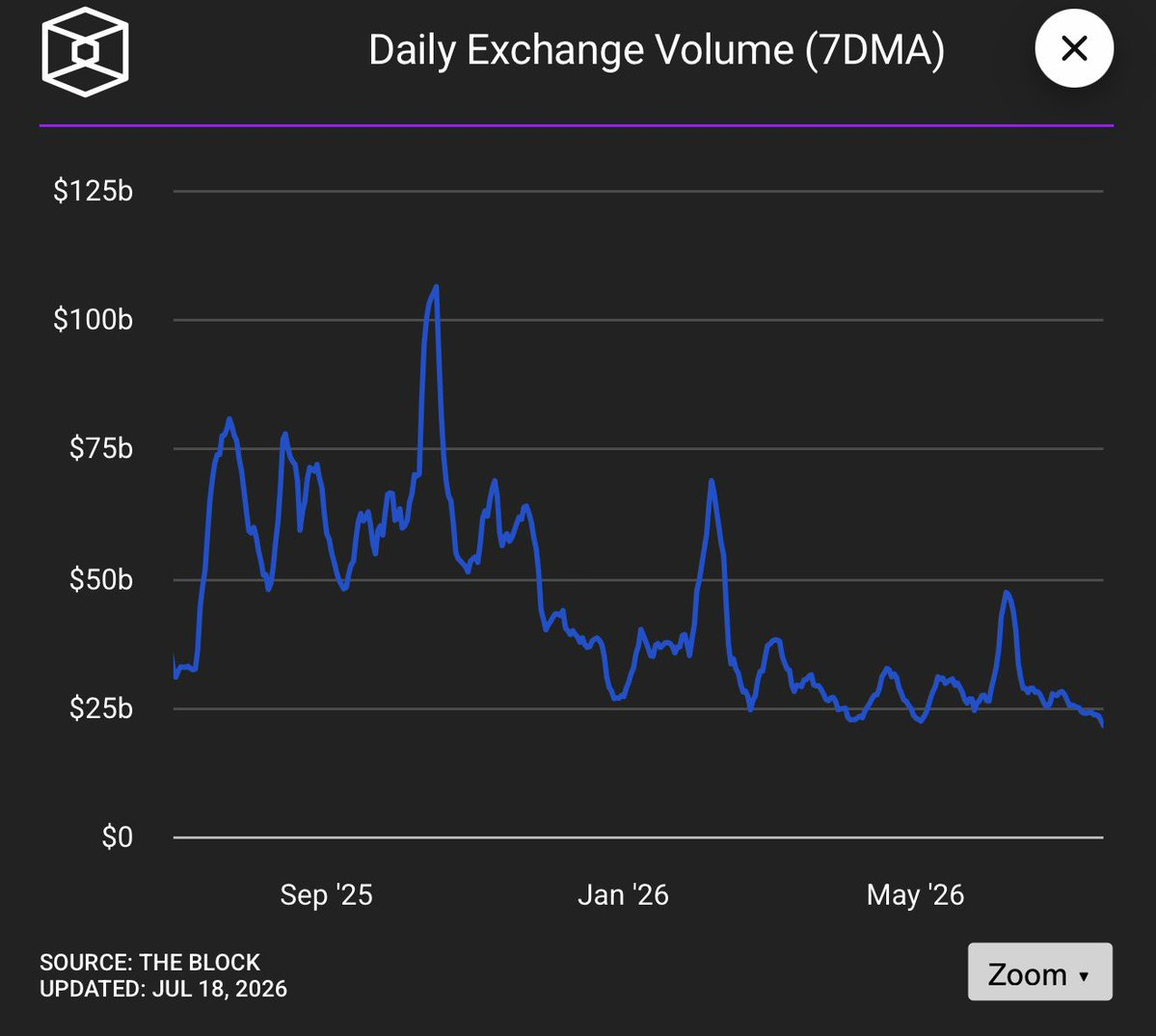
GSR research head says crypto spot volumes remain weak, with 7-day average down nearly 80% from peak

Crypto spot trading activity is still muted, according to GSR Head of Research Frank Chaparro, who said on July 19 that volumes remain far below their previous high. He said the current 7-day moving average for crypto spot trading stands at $21.4 billion, compared with a peak of $104.3 billion recorded in October 2025. That puts the current figure down by nearly 80% from the high. Chaparro also pointed to investor hesitation as the key risk now facing the sector. In his view, the wait-and-see mood in the market is the most concerning factor in crypto at the moment. The comments, cited by TechFlowPost, frame weak spot activity not just as a volume issue, but as a sign of broader caution across the market.

1760
GSR research head says crypto spot volumes remain weak, with 7-day average down nearly 80% from peak
Total 47 items
Go topage