GSR
Oct 5, 2026

GSR moved 578,010 LINK to Binance over two days, worth about $8.25 million

Market maker GSR has continued transferring LINK to Binance, according to on-chain tracking data cited by Odaily and monitored by Onchain Lens. The latest transfer involved 303,010 LINK, valued at about $4.29 million, after the tokens were received from a Gnosis Safe. The same wallet had also sent 275,000 LINK, worth roughly $3.96 million, to Binance two days earlier. Over the past two days, the wallet’s total transfers to Binance reached 578,010 LINK, with an estimated combined value of about $8.25 million. The report described the activity as continued selling of LINK by GSR.

1170

GSR moved 578,010 LINK to Binance over two days, worth about $8.25 million
crypto market making
Sep 21, 2026

Crypto market-making reshuffle: GSR gains Standard Chartered backing as concentration rises

A BigTime industry review says crypto market making is becoming more institutional even as trading volumes have cooled from their September 2025 peak. The report points to three broad trends: weaker conditions are pushing smaller firms out and lifting concentration, traditional finance is buying into established crypto firms to gain market access and operating capability, and leading market makers are expanding into broader crypto capital-markets businesses. GSR sits at the center of that shift. BigTime describes the firm as a long-standing market maker that has added cross-jurisdiction licensing, brought in Standard Chartered’s SC Ventures as its first external strategic shareholder, and moved into ETFs and advisory work. The report also notes that derivatives now dominate trading activity, institutional trading accounts for 72% of the market, and crypto ETF assets are nearing $100 billion. The piece compares major players, flags the mixed post-listing performance of firms such as Circle, Bullish, Gemini and CoinShares, and argues that valuation ranges may be more useful than point estimates for this segment. It also says tokenized real-world assets and related products are becoming a shared expansion path for top firms including GSR and Wintermute.

1320
Crypto market-making reshuffle: GSR gains Standard Chartered backing as concentration rises
crypto market making
Sep 21, 2026

BigTime maps the crypto market-making sector, with GSR and rival firms shifting toward institutional business

BigTime has published a sector report on crypto market makers, arguing that the business is being reshaped by lower trading activity, rising institutional participation and a broader push into capital-markets services. The report says overall trading volume has kept falling from its September 2025 peak, while institutional trading share has climbed to a record 72%. It also points to derivatives activity, near-$100 billion ETF assets and a record stablecoin supply as signs that market structure is no longer retail-led. The report outlines several industry trends. It says the post-crash shakeout after the October 2025 sell-off increased concentration among market makers, while banks are increasingly using equity stakes and partnerships to gain crypto capabilities rather than building market-making desks themselves. Standard Chartered’s SC Ventures investment in GSR is cited as a leading example, alongside ties involving B2C2, FalconX and SBI. BigTime also highlights FalconX’s IPO filing in May 2026 and compares it with the sharply mixed post-listing performance of Circle, Bullish, Gemini and CoinShares. On strategy, the report says leading firms including Wintermute and GSR are moving beyond pure market making into brokerage, ETFs, tokenized assets and advisory work, effectively positioning themselves as broader crypto capital-markets platforms.

1500
BigTime maps the crypto market-making sector, with GSR and rival firms shifting toward institutional business
ChainFeeds
Sep 21, 2026

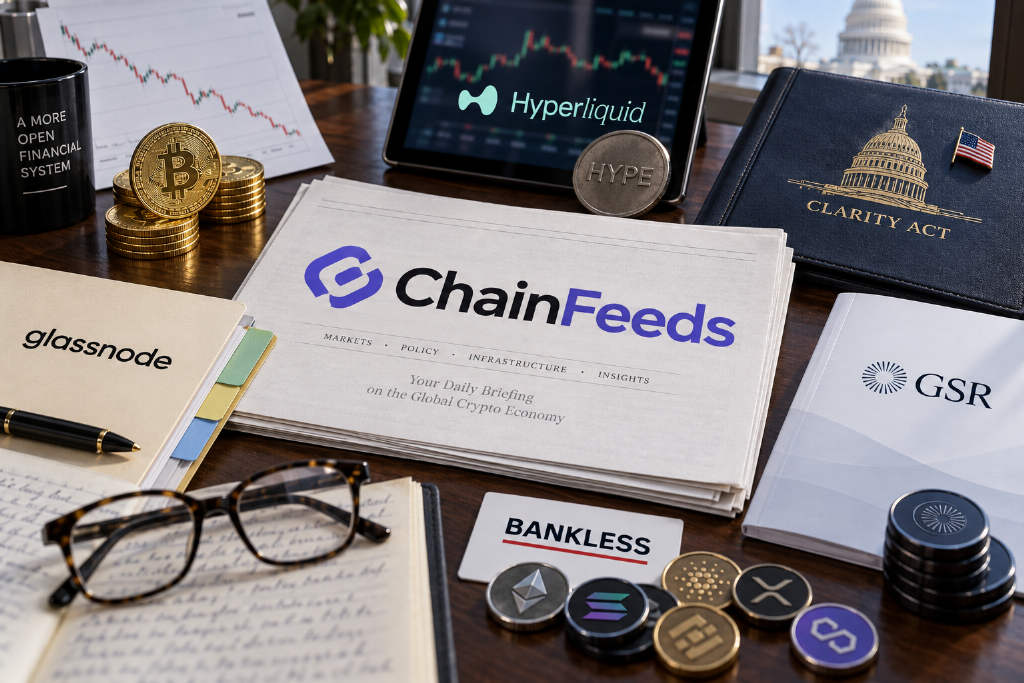
ChainFeeds roundup: HYPE lending surge, altcoin rotation calls, and GSR’s warning on low-float token launches

ChainFeeds’ Sept. 21 research roundup pulled together five separate threads shaping the crypto market: Michael Saylor’s argument that the digital asset industry should keep moving without waiting for the CLARITY Act; Hyperliquid’s new lending feature, which drew $269 million in borrowing on day one and gave HYPE a new role as on-chain collateral; Glassnode’s view that Bitcoin has slipped below a key cost basis while fresh capital demand is fading; Bankless co-founder David Hoffman’s call that altcoin season has already begun; and GSR’s long-range review of token launch structures, which found that low-circulating, high-FDV launches have repeatedly produced weak post-listing returns. The report spans regulation, market structure, token design and project-specific momentum. It also includes a separate list of daily headlines, from Uniswap domain claims involving SBF to a ZetaChain vote on moving ZETA to Solana, a TRUMP token transfer to BitGo, and an update on stolen assets tied to the Fetch.ai attacker. Taken together, the roundup offers a snapshot of how policy signals, leverage, liquidity conditions and issuance mechanics are interacting across the crypto market.

1090
ChainFeeds roundup: HYPE lending surge, altcoin rotation calls, and GSR’s warning on low-float token launches
GSR
Sep 20, 2026

GSR says low-float, high-FDV token listings have repeatedly led to weak post-launch returns

GSR analyzed more than 2,300 token listings across major exchanges since 2013 and found a consistent pattern: the lower the initial circulating supply and the higher the fully diluted valuation, the worse the token’s subsequent performance tended to be. The report says median initial circulation fell sharply from 38% in 2017 to about 13% in 2020, recovering only partially in later years. It also found a strong link between listing valuation and float. Tokens listed below a $10 million FDV had a median initial circulation of 97%, while those above $1 billion had a median of 13%. Performance data in the study was similarly weak. On a median basis, tokens fell below their listing price within three days and were down 50% within 90 days. Among tokens listed above a $1 billion FDV, $1 invested was worth just $0.19 after 360 days, equal to a median one-year return of -81%. Tokens with less than 20% initial circulation retained only about $0.23 to $0.26 per $1 after a year, while those with 30% to 50% initial circulation held about $0.55. GSR argues this is not only a crypto issue and points to similar dynamics in the IPO market. The firm also outlines three areas for improvement: pricing public buyers in a way that leaves upside, releasing enough supply for real price discovery, and widening access so more participants can enter earlier.

1660
GSR says low-float, high-FDV token listings have repeatedly led to weak post-launch returns
Token Launches
Sep 20, 2026

GSR says lower launch valuations and broader token distribution may break the post-listing slide

A new study from crypto trading and market-making firm GSR argues that the industry’s low-float, high-fully diluted valuation token launch model has repeatedly produced weak post-listing performance. Drawing on a dataset covering more than 2,300 token listings on major exchanges since 2013, the report says the median token falls below its listing price within three days and is down 50% within 90 days. For tokens that listed at a fully diluted valuation above $1 billion, the median one-year return was -81%, leaving the median invested dollar worth $0.19 after 360 days. GSR links the pattern to a structure in which only a small share of supply trades at launch, allowing modest demand to support a high headline valuation before scheduled unlocks add supply into the market. The report also says the same broad setup has appeared in public equities, where companies stay private longer and list only a limited portion of shares. As alternatives, GSR points to lower public entry valuations, higher initial circulating supply, and wider public access through channels such as public sales, on-chain auctions, reputation-based allocations, and co-investment platforms. It also notes that Europe’s MiCA framework and the draft U.S. CLARITY Act could make direct public token sales more feasible.

2320
GSR says lower launch valuations and broader token distribution may break the post-listing slide
GSR
Sep 20, 2026

GSR study says median listed token falls below issue price within three days

Crypto trading and market-making firm GSR said in a research report that it reviewed more than 2,300 token listings on major exchanges since 2013, with the dataset including delisted tokens. According to the report, the median listed token dropped below its issue price within three days and was down 50% within 90 days. The authors were Josh Riezman, GSR’s chief legal and strategy officer, and research analyst Slater Santer. The report also said median circulating supply at listing fell from 38% in 2017 to 13% in 2020, then only partially recovered in most later years to the mid-teens and low-20% range. By issuance FDV, median circulating supply declined as valuations rose, and tokens launched above $1 billion FDV posted a median one-year return of -81%.

1180
GSR study says median listed token falls below issue price within three days
Ink
Sep 9, 2026

Ink, GSR and legal advisers launch Charter Foundation to cut token issuance setup costs

According to The Block, the Ink Foundation tied to Kraken’s Ethereum layer-2 network Ink has joined crypto market maker GSR, law firms Carey Olsen, Renno & Co, Cooley and Fenwick, plus audit and security firms ChainSecurity and Zellic, to launch the Charter Foundation. The group is building a standardized shared legal framework for crypto teams preparing token launches. The report says many projects now rely on a three-entity structure before a token generation event, typically involving a Labs entity, a Cayman Islands foundation and a British Virgin Islands issuing subsidiary. Setting up that structure, along with paying for independent directors before TGE, often costs more than $100,000. Charter plans to set up a dedicated Cayman exempted company for each project as part of the launch structure, with governance support from offshore compliance specialists. The group says this can reduce upfront legal structuring costs by more than half. After a token is successfully issued, the Cayman entity would convert into an independent foundation and separate from Charter, with the stated goal of preserving the project’s long-term independence.

2090
Ink, GSR and legal advisers launch Charter Foundation to cut token issuance setup costs
Total 47 items
Go topage