Bitcoin
Aug 27, 2026

Bitcoin’s 23% weekly jump lifts battered miners past some AI-linked stocks

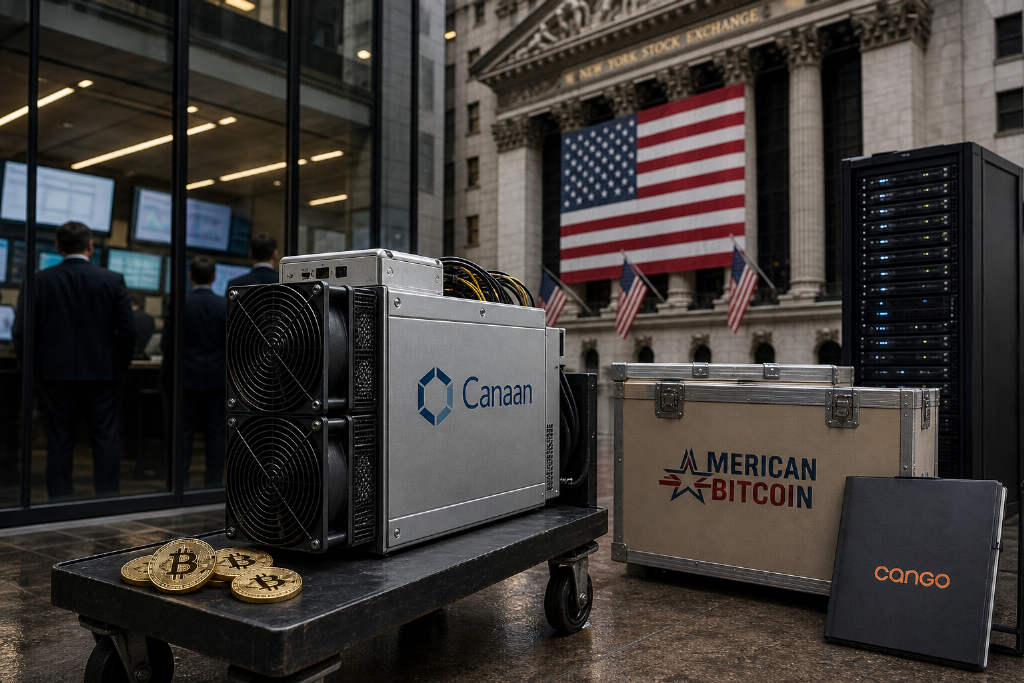
Bitcoin’s August rebound has sharply lifted some of the mining sector’s weakest names, with Canaan, American Bitcoin and Cango posting gains of 41% to 67% as investors appeared to favor direct BTC exposure again. In its latest Miner Weekly newsletter, BlocksBridge Consulting said Bitcoin rose roughly 23% over the past week, outpacing most AI-related infrastructure stocks. By comparison, CoreWeave gained about 21%, Nebius rose 17% and IREN added 15%, while some miners with heavier exposure to artificial intelligence and high-performance computing were flat or declined. BlocksBridge attributed Bitcoin’s move to three drivers: the US Treasury Department’s Aug. 19 decision to at least double liquidity-support buybacks for longer-dated Treasury securities, a more optimistic regulatory tone after a White House meeting with crypto executives where President Donald Trump urged Congress to pass a “fair version” of the CLARITY Act, and a sharp short squeeze that liquidated more than $1.6 billion in crypto positions over 24 hours. The report also said publicly traded Bitcoin miners have spent roughly $15 on AI data centers for every $1 of AI-related revenue generated.


1730
Bitcoin’s 23% weekly jump lifts battered miners past some AI-linked stocks
Bitcoin
Aug 27, 2026

Bitcoin’s 23% Weekly Jump Lifts Mining Stocks, With Some Outpacing AI Names

Bitcoin mining shares rebounded sharply after Bitcoin rose about 23% over the past week, reversing weakness seen earlier in the sector. According to BlockBeats, some mining stocks posted gains that exceeded those of AI infrastructure names, pointing to renewed investor interest in direct Bitcoin exposure. Canaan, American Bitcoin and Cango were up between 41% and 67% over the recent period, while CoreWeave gained about 21%, Nebius rose 17%, and IREN added 15%. Some miners that had previously shifted toward AI and high-performance computing, or HPC, were flat or down. BlocksBridge Consulting said Bitcoin’s latest move was driven by three factors: the U.S. Treasury’s expansion of long-dated Treasury buybacks, the Trump administration’s push for Congress to pass the crypto market structure bill known as the CLARITY Act, and a short squeeze triggered after Bitcoin’s breakout. The report added that liquidations across the crypto market topped $1.6 billion within 24 hours. Even as many miners have moved into AI and HPC infrastructure in recent years, the report said Bitcoin prices still have a significant effect on mining equities. BlocksBridge previously estimated that since 2026, nine listed miners generated about $341 million in AI and HPC revenue while spending $5.11 billion in related capital expenditures.

1570
Bitcoin’s 23% Weekly Jump Lifts Mining Stocks, With Some Outpacing AI Names
Bitcoin
Aug 27, 2026

Bitcoin’s August rebound lifts beaten-down mining stocks, reversing part of the AI trade

Bitcoin’s rebound in August has helped fuel a sharp rally in several previously lagging crypto mining stocks, according to a Cointelegraph report citing new research from BlocksBridge Consulting. The report said Bitcoin gained about 23% over the past week, outpacing most AI-related infrastructure names and helping shift market attention away from miners with stronger artificial intelligence and high-performance computing exposure. Shares of Canaan, American Bitcoin, and Cango rose between 41% and 67%, while CoreWeave gained about 21%, Nebius rose 17%, and IREN added 15%. BlocksBridge said some miners with heavier AI and HPC exposure were flat or lower during the same period. The firm pointed to three catalysts behind Bitcoin’s move: a U.S. Treasury announcement on Aug. 19 to at least double the scale of long-term Treasury liquidity support for buybacks, rising regulatory optimism after a White House meeting with crypto executives and Donald Trump’s call for Congress to pass the CLARITY Act, and a short squeeze following Bitcoin’s breakout that led to more than $1.6 billion in crypto liquidations over 24 hours. BlocksBridge also said public Bitcoin miners’ investment in AI data centers was about 15 times their AI-related revenue.

1490
Bitcoin’s August rebound lifts beaten-down mining stocks, reversing part of the AI trade
Hyperliquid
Aug 26, 2026

Hyperliquid-linked group asks SEC and CFTC for a unified framework on perpetual contracts

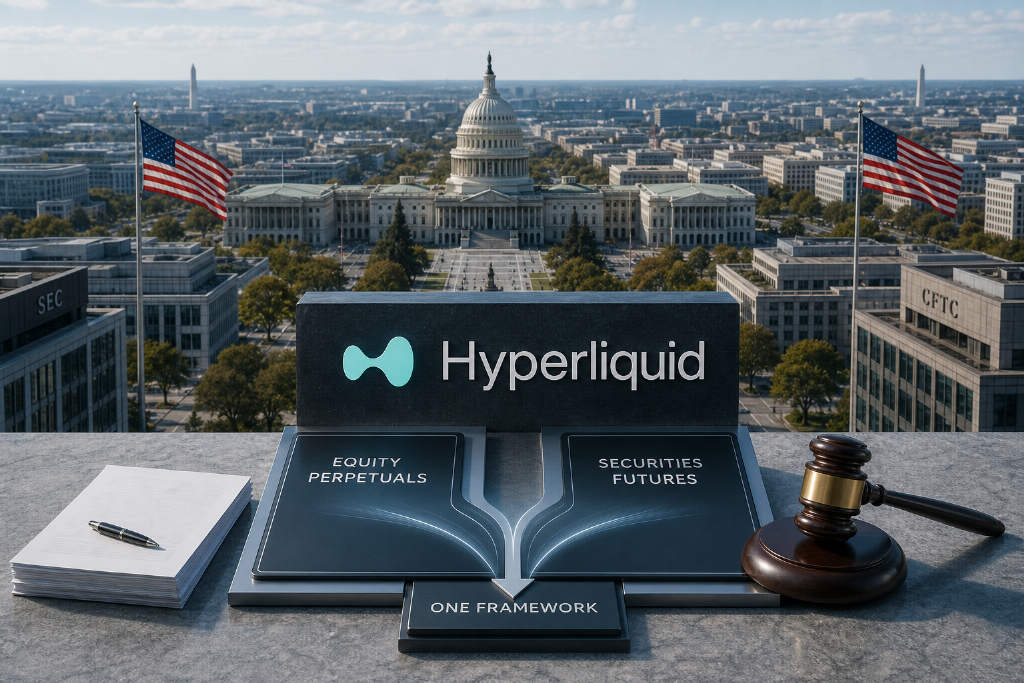
A policy group tied to Hyperliquid has asked the U.S. Securities and Exchange Commission and the Commodity Futures Trading Commission to stop fighting over jurisdiction and adopt a common enforcement framework for perpetual contracts. In a formal comment letter submitted on Aug. 25, the Liquidity Policy Center argued that regulation should be based on the economic structure of the contract itself rather than the asset used as the underlying reference. The group said the current system splits oversight depending on whether a perpetual contract tracks bitcoin, equities, or commodities, creating uncertainty for exchanges and the firms that list these products. The letter points to securities futures as a precedent for joint oversight, but says the existing model was designed for traditional products with lower trading volumes and may not be sufficient without clearer standards on which registrants can list specific instruments. The filing comes as scrutiny around perpetual futures rises in the U.S. According to the report, CME and ICE have raised concerns about potential price manipulation on platforms including Hyperliquid and want the venue registered with the CFTC. The letter also highlights Hyperliquid’s scale, saying its HIP-3 market has handled more than $480 billion in cumulative volume in 10 months, with about $4 billion in open interest.

1510
Hyperliquid-linked group asks SEC and CFTC for a unified framework on perpetual contracts
Bitcoin mining
Aug 26, 2026

ViaBTC CEO Yang Haipo Says AI Is Raising the Value of Prime Power Sites, Not Necessarily Forcing Bitcoin Mining Out

ViaBTC CEO Yang Haipo argues that the current shift of listed mining companies toward AI and HPC does not mean Bitcoin mining is being eliminated. In his view, AI and mining are not competing for the same machines, since GPUs are not viable for Bitcoin mining and SHA-256 ASICs cannot run large models. The real competition is for upstream resources: chip capacity, capital, land, power, and, most importantly, sites with ready grid access and supporting infrastructure. Yang points to recent operating data to show why miners are reallocating resources. Core Scientific posted a self-mining gross margin of negative 56% in the second quarter, while its data center colocation business delivered nearly $80 million in gross profit. TeraWulf, meanwhile, derived about 71% of its revenue from HPC leasing in the same period. He says this explains why mining firms are redirecting power capacity, land, and capital toward AI workloads. Still, he argues Bitcoin mining retains a role where power is intermittent, stranded, or hard to monetize otherwise, including rooftop solar surplus, curtailed renewable generation, associated gas, remote small hydropower, and negative-price power periods. He also says Bitcoin’s difficulty adjustment mechanism helps the network reprice mining economics after hash rate declines, while 2028’s fifth halving will be the next clearer stress test for the sector.

1590
ViaBTC CEO Yang Haipo Says AI Is Raising the Value of Prime Power Sites, Not Necessarily Forcing Bitcoin Mining Out
Zcash
Aug 24, 2026

Zcash mining revenue estimated at $727 per megawatt-hour

Techub News, citing data from TheEnergyMag, said estimated mining revenue for Zcash stands at $727 per megawatt-hour. The figure is described as more than three times the estimated revenue level for high-performance computing, or HPC, and more than four times the revenue from Bitcoin mining. The item was attributed to Cointelegraph in the source note. No additional timeframe or methodology details were provided in the brief. The report focuses on a direct comparison of estimated revenue per unit of power, highlighting a gap between Zcash mining, HPC workloads and Bitcoin mining based on the cited dataset.

1420
Zcash mining revenue estimated at $727 per megawatt-hour
Hyperliquid
Aug 24, 2026

HPC tells SEC and CFTC eligible equity perpetuals can fit securities futures rules

Hyperliquid Policy Center, or HPC, has submitted a comment letter to the U.S. Securities and Exchange Commission and the Commodity Futures Trading Commission arguing that eligible equity perpetual contracts can be treated as securities futures. In the filing, HPC said this category already sits within a shared regulatory structure overseen by the two agencies, which would let exchanges compete on execution quality rather than on which regulator has jurisdiction. The group also said a core legal question remains unsettled in the United States: whether perpetuals should be classified as futures or swaps. HPC argued that perpetual contracts share several futures-like traits, including standardized terms, the ability to offset positions, and forward value, even though they do not have a fixed expiration date. Instead, prices continue to converge through a funding-rate mechanism. The letter set out four recommendations, including confirming that the securities futures definition can cover cash-settled equity perpetuals with futures characteristics, preserving listing flexibility for trading venues, keeping classification consistent across both agencies, and updating the securities futures framework for newer product structures. HPC added that Hyperliquid perpetuals have recorded more than $480 billion in trading volume over the past 10 months.

1370
HPC tells SEC and CFTC eligible equity perpetuals can fit securities futures rules
Hyperliquid
Aug 24, 2026

Hyperliquid’s U.S. compliance push centers on permissioned HIP-3 deployments

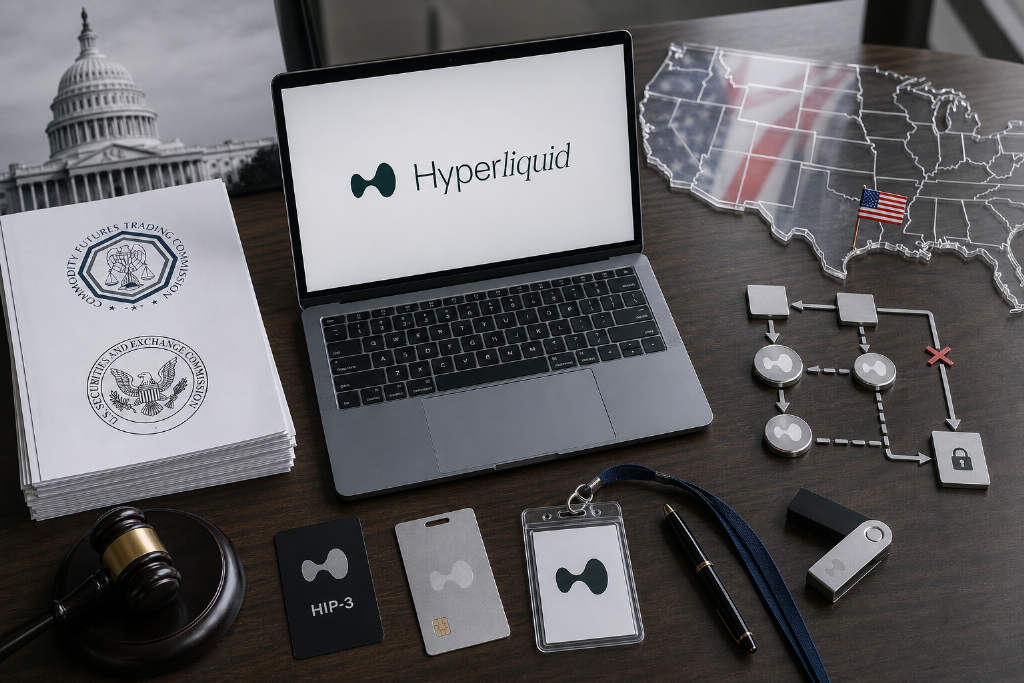
Hyperliquid is still geoblocked in the United States because its permissionless on-chain market structure does not fit cleanly within U.S. derivatives law, which assigns trading, clearing, and customer onboarding to registered intermediaries. According to the MarsBit report, Hyperliquid Policy Center has been pressing the Commodity Futures Trading Commission and the Securities and Exchange Commission to modernize those rules so regulated firms can use HyperCore while taking on the required compliance duties themselves. The article says Hyperliquid has spent the past year reframing itself from a decentralized perpetuals venue into a broader piece of market infrastructure spanning perpetuals, spot, and prediction markets. That argument rests on a modular stack: HyperCore handles matching, margin, and settlement; deployers configure markets and stake 500,000 HYPE; builders route users and order flow. The tension is that U.S. law expects those roles to sit inside registered entities, while Hyperliquid puts them into protocol logic and self-custodied access. MarsBit also points to testnet updates that could support a compliant access model. Permissioned HIP-3 deployers can whitelist users, and a payload-level “PA” authority lets a DEX perform account actions such as reduce-only orders, cancellations, and internal USDC transfers. In the report’s framing, those tools could allow U.S. brokers and institutions to offer regulated access to Hyperliquid markets without changing the protocol’s role as neutral infrastructure.

6190
Hyperliquid’s U.S. compliance push centers on permissioned HIP-3 deployments
Total 98 items
Go topage