INT

BlackRock
2026-08-10 16:08:51

BlackRock Canada Lists Two ETFs, Putting 3% of IBQT Into Bitcoin

BlackRock Canada launched two exchange-traded funds on Monday, and both have started trading on the Toronto Stock Exchange. The new products are the iShares Equity + Bitcoin ETF Portfolio (IBQT) and the iShares Core MSCI All-International Equity Index ETF (XINT). IBQT allocates 97% of its assets to Canadian, U.S., international and emerging-market equities, with the remaining 3% in bitcoin. That bitcoin exposure is obtained through BlackRock's Canadian iShares Bitcoin ETF (IBIT). In practical terms, IBQT holds other iShares ETFs rather than individual stocks. XINT tracks the MSCI ACWI ex North America IMI index, a benchmark that covers more than 40 developed and emerging markets outside Canada and the United States and includes over 5,000 companies. Both funds are managed by BlackRock Asset Management Canada through the RBC iShares alliance. The two vehicles take different routes: IBQT wraps global stock exposure and a small bitcoin allocation into one portfolio, while XINT is an international-equity index fund with no North American exposure and no crypto component.

1040
BlackRock Canada Lists Two ETFs, Putting 3% of IBQT Into Bitcoin
US stocks
2026-08-10 08:07:01

US Premarket: Semiconductors, Memory, Optical Stocks Edge Higher; AAOI Up 5%

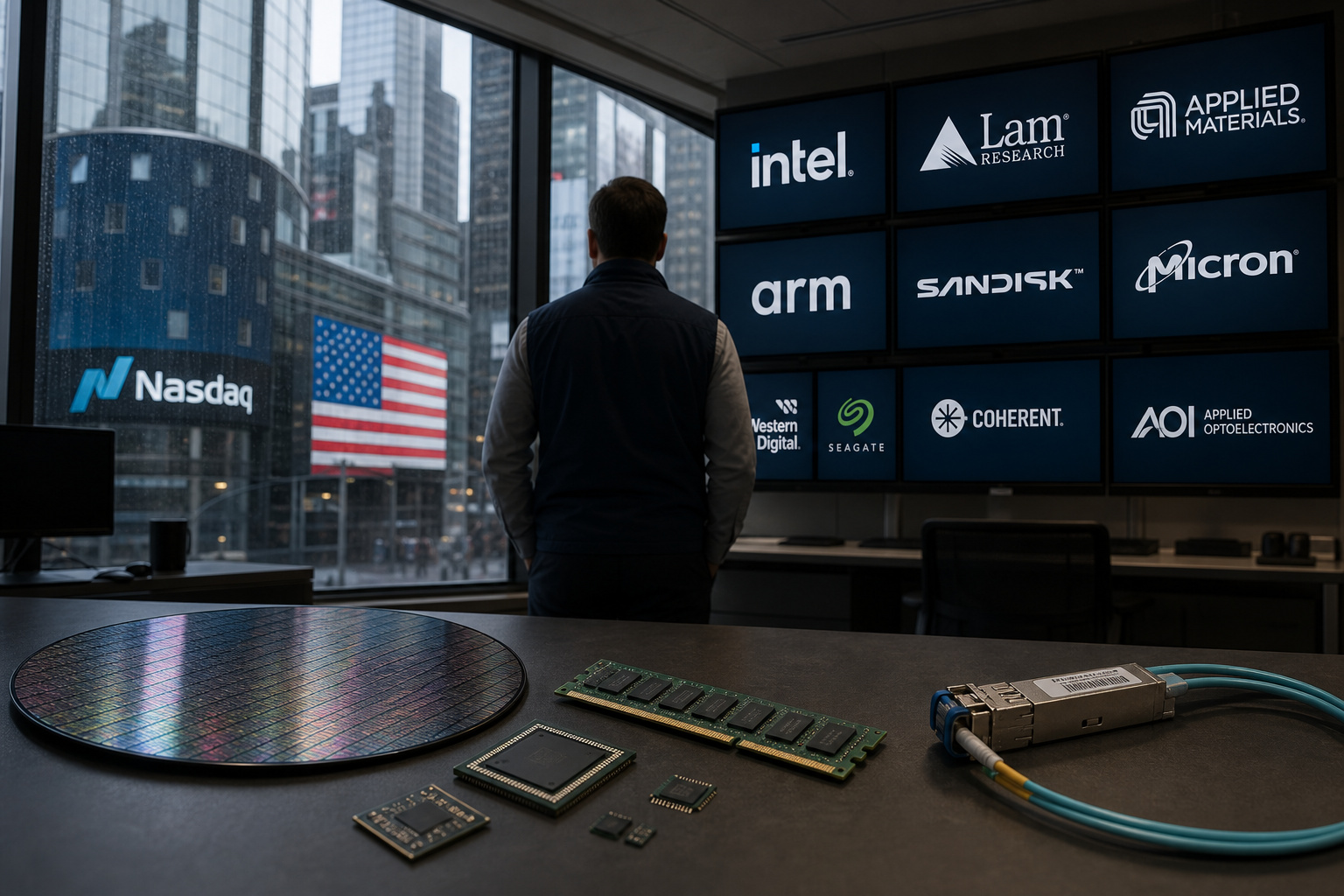
On August 10, according to market data from BIT (bit.com), U.S. stock premarket trading saw modest gains across semiconductor, memory, and optical communications sectors. Semiconductor stocks rose broadly: Lam Research (LRCX) gained 2.14%, Intel (INTC) rose 2.06%, Applied Materials (AMAT) advanced 2.26%, and Arm (ARM) added 1.63%. Memory stocks also climbed: Hynix (SKHY) was up 0.51%, Micron (MU) gained 1.35%, Western Digital (WDC) added 1.53%, SanDisk (SNDK) rose 2.12%, and Seagate (STX) gained 0.82%. Optical communications names led the gains: Astera Labs (ALAB) rose 1.89%, Applied Optoelectronics (AAOI) jumped 5.23%, Coherent (COHR) gained 4.23%, Credo (CRDO) added 2.42%, and Lumentum (LITE) rose 3.56%. The data reflects premarket moves on Monday, with AAOI posting the largest percentage gain among the highlighted stocks.

1370
US Premarket: Semiconductors, Memory, Optical Stocks Edge Higher; AAOI Up 5%
SoftBank
2026-08-06 08:23:06

SoftBank quarterly profit fell 18%, with Intel gains lifting results

SoftBank Group reported quarterly net profit of 347.3 billion yen for the period ended June, down 18% from a year earlier but well ahead of the market consensus of 166 billion yen. The gap was largely explained by a sizable unrealized gain on Intel shares, which SoftBank bought last year at $23 apiece. Intel rose 216% during the quarter, producing roughly 1.3 trillion yen, or about $8.5 billion, in unrealized investment gains. Those gains helped offset losses in parts of the Vision Fund portfolio and softer growth in profits tied to SoftBank’s OpenAI investment. At the same time, investor attention has turned to the group’s balance sheet as Masayoshi Son steps up spending on generative AI. SoftBank is expected to complete about $65 billion in cumulative investment in OpenAI by October. To fund that push, the company signed a one-year $40 billion bridge loan and arranged a $20 billion margin loan backed by its Arm stake. The report also highlighted broader concerns around the AI sector, including rising competition, uncertainty over business models after heavy infrastructure spending, and the impact of any delay to OpenAI’s IPO timeline on SoftBank’s valuation.

1040
SoftBank quarterly profit fell 18%, with Intel gains lifting results
Bitget UEX
2026-08-05 02:50:53

Bitget UEX daily: Strait deal hopes hit oil, Dow and S&P 500 reach fresh highs

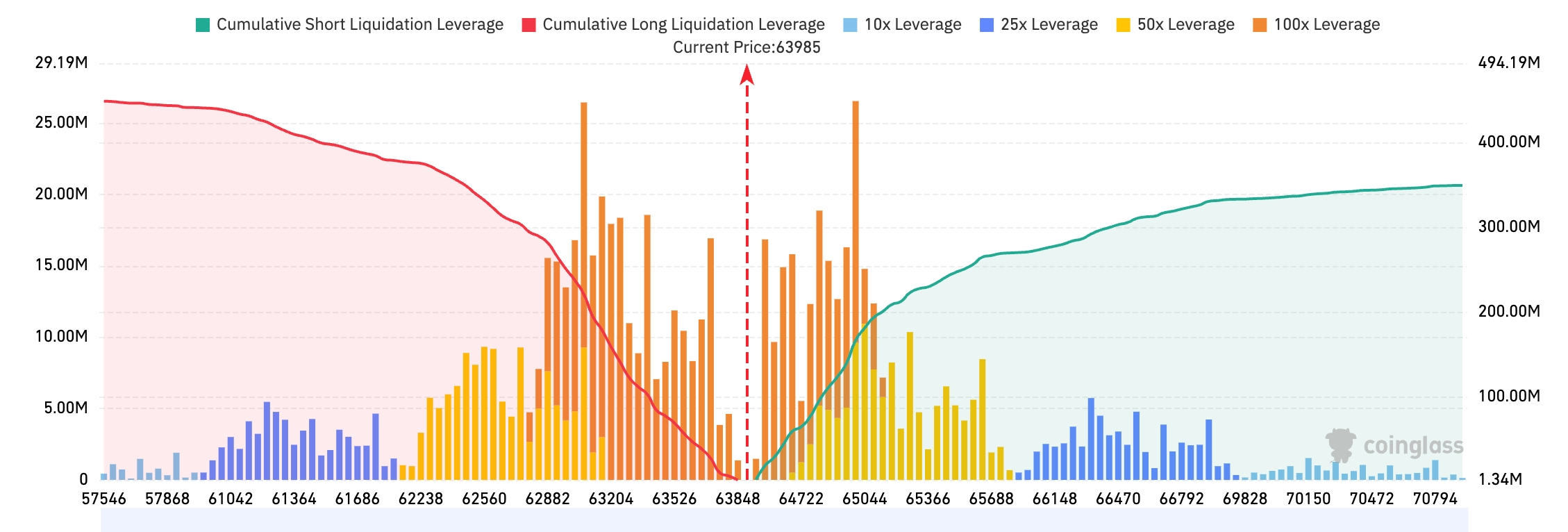
Bitget UEX’s Aug. 5 market note tracked a broad cross-asset move driven by easing geopolitical expectations and softer rate pressure. CME FedWatch data showed the probability of no rate change by September rising to 41.6%, while the chance of a cumulative 25-basis-point hike fell to 58.4%. At the same time, U.S. Treasury Secretary Scott Bessent said an agreement tied to the Strait of Hormuz could be reached on Aug. 4 or 5, helping keep pressure on crude prices and easing near-term inflation concerns. U.S. equities extended their rally, with the Dow closing at 54,085.88, up 1.71%, and the S&P 500 at 7,736.52, up 1.79%, both at record highs. The Nasdaq rose 2.59% to 26,584.99. Palantir stood out after reporting stronger-than-expected quarterly results and raising full-year guidance, while Intel, AMD, Micron and SanDisk also advanced as semiconductor and storage shares rebounded. In crypto, BTC was quoted around $639,850, up 0.91%, while ETH traded near $1,863, up 0.65%. Total crypto market capitalization was about $2.28 trillion, with 24-hour liquidations at $204 million. The report also highlighted spot BTC ETF flows, Glassnode supply concentration around the $61,000-$63,000 area, and a packed macro and earnings calendar featuring SanDisk, Western Digital, Circle and upcoming U.S. labor data.

1030
Bitget UEX daily: Strait deal hopes hit oil, Dow and S&P 500 reach fresh highs
Binance Spot
2026-08-04 20:30:16

Binance spot market swings sharply as PUMP hits a weekly high and LAZIO, HOME pull back

ChainCatcher reported, citing Binance spot market data, that crypto trading showed sharp price swings over the past 24 hours. PUMP posted a 25.96% gain and reached a new high for the week, making it one of the strongest movers in the latest session. At the same time, LAZIO and HOME both moved into a spike-and-pullback pattern, with 24-hour declines of 9.45% and 18.72%, respectively. On the downside, TST and WAXP touched new lows for the day, falling 10.31% and 8.88%. Several other tokens moved the other way. SPCXB hit the day’s high with a 9.79% increase, while INTCB, QCOMB and INTWB also reached their intraday highs, posting gains of 11.5%, 7.77% and 23.31%. The figures cited in the update came from Binance spot data referenced by ChainCatcher.

1070
Binance spot market swings sharply as PUMP hits a weekly high and LAZIO, HOME pull back
Nvidia
2026-08-04 13:37:10

AI coding agents are testing Nvidia’s CUDA moat, but the pressure is building first in inference

Infinity, a one-year-old startup founded by former Google Brain researcher Jeremy Nixon, used its AI research agent Ignition to build CUDA-like software for d-Matrix in 10 hours, according to the source article. The work focused on generating and optimizing inference kernels and related low-level software, not recreating the full CUDA stack that Nvidia has spent nearly two decades building. That distinction matters. CUDA is not just a programming model but a broad software platform spanning kernels, compilers, runtime, optimized libraries such as cuBLAS and cuDNN, debugging and validation tools, plus higher-level frameworks including PyTorch and TensorFlow. In large-scale training, where stability, cluster coordination and performance tuning are critical, the article argues Nvidia’s software edge remains hard to dislodge. Inference looks different. Marshall Choy, chief business officer at South Korea’s AI chip company Rebellions, said CUDA is no longer the decisive factor there and called it a contest in open-source software. Companies including d-Matrix, Rebellions, Cerebras, Amazon with Inferentia, Google with TPU and AMD with MI300X are all targeting that opening. Even so, executives and former Nvidia insiders cited in the piece said code generation is only part of the story. Validation, production-grade optimization, migration costs and Nvidia’s own use of AI agents still leave the CUDA moat far from broken.

1000
AI coding agents are testing Nvidia’s CUDA moat, but the pressure is building first in inference