
Top developments
Fed pricing cools slightly as traders wait for more data
CME FedWatch data cited in the Bitget UEX daily note showed the probability of no rate change by September rising to 41.6%, while the probability of a cumulative 25-basis-point hike fell to 58.4%. By October, the probability of a cumulative 25-basis-point hike stood at 53.9%, with a 50-basis-point hike at 15.5%.

The report said markets were still digesting Kevin Warsh’s reaffirmation of the 2% inflation target and the uncertainty around the policy path. A sharp pullback in oil has helped ease inflation worries, but labor data remains the key anchor for pricing.
Its takeaway was straightforward: easing rate expectations and lower oil prices are working in the same direction, giving risk assets some near-term support, though volatility could stay elevated until payrolls and other data are released.
Hormuz Strait deal expectations keep pressure on crude
U.S. Treasury Secretary Scott Bessent said an agreement related to the Strait of Hormuz could be reached on Aug. 4 or 5. Secretary of State Marco Rubio said talks had made progress, but were not yet finalized.
According to people familiar with the matter, Iran has softened its stance, dropping its demand for full control over two-way shipping. Instead, it is proposing to manage inbound vessels while retaining oversight over outbound traffic, and is also considering allowing European participation in demining work.
Brent crude fell back below $80 as the market priced in the possibility that the strait could reopen. The report said the expectation of easing tensions has continued to compress the geopolitical risk premium in oil, pushing prices sharply lower and reducing short-term inflation pressure. Whether an agreement is actually signed and how quickly shipping resumes remain the central variables.
White House advances AI framework, excludes open-source models
The White House’s voluntary AI safety testing framework defines “covered frontier models” as closed-source systems with the most advanced capabilities and national security risk. Open-source models are excluded, and the details of the framework are not planned for public release.
The White House is also expected to extend the waiver period under the Jones Act to ease gasoline price pressure. The current waiver expires on Aug. 16. The note added that Anthropic has signed another computing procurement deal in the tens of billions of dollars.
Bitget UEX said progress on the AI framework reduces longer-term uncertainty, though the exclusion of open-source models and the lack of public detail have drawn attention. An extension of the Jones Act waiver could help stabilize expectations for energy supply.
Market review
Commodities and FX
At the time of the report update, spot gold was around $4,081 per ounce, up 0.1%; spot silver was around $60.0 per ounce, up 0.23%; WTI crude was about $75.39 per barrel, down 0.51%; Brent crude was about $76.53 per barrel, down 0.36%; and the U.S. dollar index, or DXY, was around 99.85 with limited movement.
The report linked the move to Bessent’s comment that a deal was close, saying it pushed the oil risk premium lower again. WTI and Brent both extended their drop, which in turn eased inflation concerns. Gold and silver diverged, with silver showing stronger elasticity. The chain described in the note was: easing geopolitical tension, lower oil, softer inflation expectations, less aggressive Fed pricing, and firmer risk assets. Commodity volatility, it said, still depends heavily on whether a strait agreement is finalized and whether shipping resumes.
Crypto market performance
In digital assets, BTC was quoted around $639,850, up 0.91%, while ETH traded near $1,863, up 0.65%. Total crypto market capitalization was about $2.28 trillion.
Total liquidations over the past 24 hours were about $204 million, including roughly $137 million in short liquidations.
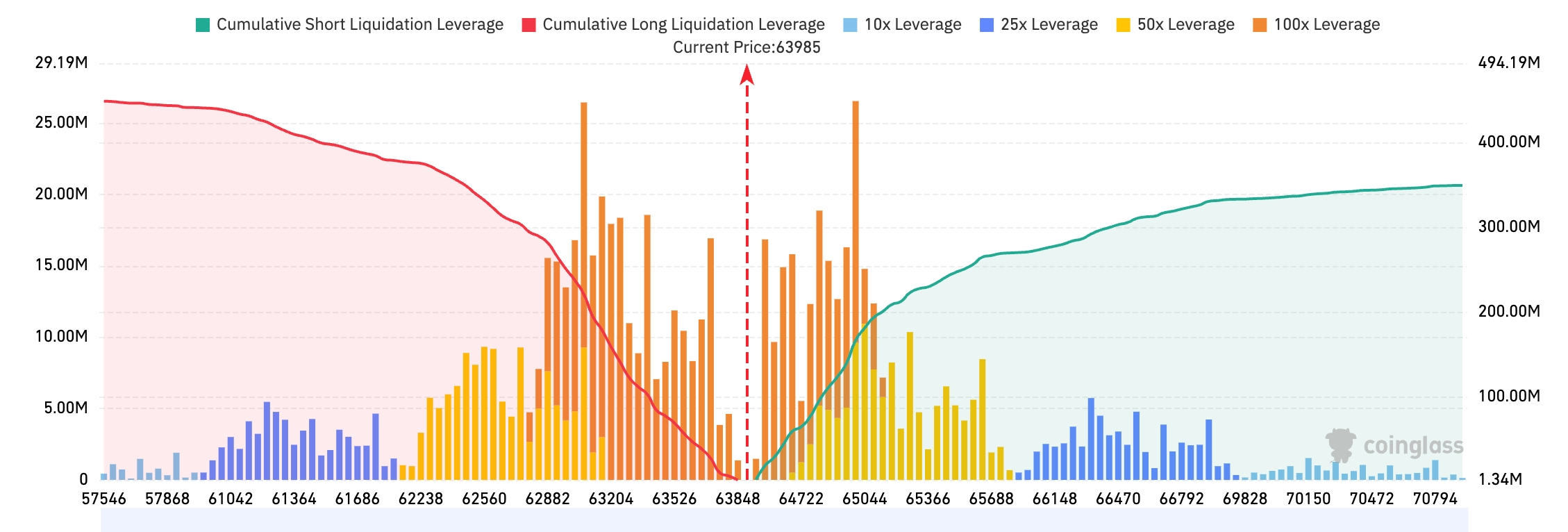
Bitget’s BTC/USDT liquidation map showed the current price around $63,985, with a large concentration of short liquidations between $64,500 and $65,500. A break above that area could trigger further short covering. On the downside, there is still notable long liquidation pressure between $62,000 and $63,500, leaving BTC in a dense liquidation zone and keeping short-term volatility risk elevated.
On ETF flows, spot BTC ETFs recorded net inflows of $170 million yesterday and dynamic net inflows of $40 million today. The report said easing geopolitical pressure and a rebound in U.S. tech stocks improved risk appetite and helped stabilize crypto. BTC held up better than ETH. Leveraged liquidations also eased, suggesting a more balanced market, though ETF flows remain a key constraint on upside. Lower oil prices and softer rate expectations offer macro support, but the short-term picture still looks range-bound, with the market watching how any Strait of Hormuz agreement feeds through to sentiment.
U.S. stocks post new records
The Dow Jones Industrial Average closed at 54,085.88, up 1.71%, a fresh all-time high. The S&P 500 finished at 7,736.52, up 1.79%, also setting a new record. The Nasdaq closed at 26,584.99, up 2.59%, led by tech and semiconductor names.
Among major tech stocks, NVDA ended at $211.94, up 2.56%; AAPL at $309.38, up 1.96%; MSFT at $492.81, up 1.06%; GOOGL at $377.65, up 1.11%; AMZN at $277.42, down 2.32%; META at $587.94, down 0.39%; and TSLA at $327.35, up 1.64%.
The note said all three major indexes rose on Tuesday, with the Dow and S&P 500 both hitting record highs. Semiconductor and memory stocks outperformed, and the Philadelphia Semiconductor Index gained more than 6%. Palantir jumped nearly 30% after earnings, becoming the day’s focal point, while Intel, AMD and other chip stocks moved higher as well. Amazon pulled back modestly, while Meta was little changed. The report attributed the move to easing geopolitical pressure and solid AI software earnings, with the gap between hardware and software performance narrowing and overall risk appetite improving.
Sector moves
Semiconductors and storage: Intel rose 11%, AMD 7%, Micron 8%, and SanDisk 11%. The report tied the move to improving sentiment around AI demand and easing geopolitical tension, with optimism around the storage cycle rebounding.
Optical communications: Applied Optoelectronics gained 19%, Coherent 12%, and Lumentum 9%. The note said demand for optical modules tied to AI data centers continued to attract capital.
AI application software: Palantir rose 29%, while Datadog and Shopify each gained 5%. The report said Palantir’s results and guidance reinforced the software monetization narrative.
Single-stock breakdown
Palantir (PLTR): earnings and guidance both beat
Palantir reported second-quarter revenue of $1.94 billion, above the $1.81 billion market expectation. Adjusted EPS came in at $0.41, ahead of the expected $0.35. U.S. commercial revenue jumped 149% year over year to $764 million, while U.S. government revenue increased 90%.
The company then lifted full-year revenue guidance to $8.15 billion-$8.16 billion from about $7.65 billion previously, and raised adjusted operating profit guidance to $4.89 billion-$4.90 billion. Its shares surged nearly 30% across after-hours and the following session.
Bitget UEX said the combination of a strong quarter and higher guidance gave fresh force to the AI software monetization trade. While investors have questioned the payback period on AI hardware spending, Palantir used commercial order growth and high profitability to show that software revenue can convert faster. That, the note argued, helps explain why the stock reacted more sharply than many semiconductor peers. It also flagged valuation as a point to watch, especially order conversion, U.S. commercial growth, and whether margin expansion can hold.
Intel (INTC): nearly 11% gain as chip sentiment improves
Intel rose nearly 11% on Tuesday, making it one of the session’s top semiconductor gainers, while the Philadelphia Semiconductor Index advanced more than 6%. The report noted that Intel had lagged rivals for a long time in AI transition and foundry progress, making this rebound more pronounced than the moves in Nvidia or AMD.
Its reading was that easing geopolitical expectations and better AI demand sentiment drew money back into chip stocks. As a lagging name that had underperformed previously, Intel offered more upside beta. The market has started reassessing its progress in advanced process catch-up, foundry customer expansion, and the rollout of government subsidies. The note described the move as highly trade-driven in the near term.
It added that the semiconductor cycle and the pace of downstream AI capital spending remain the key pricing variables. For Intel, the bounce looks more like sentiment repair and rotation for now, and future follow-through will depend on customer onboarding and whether foundry profitability improves.
Amazon (AMZN): modest pullback after a strong run
Amazon fell about 2.3% on Tuesday, ending its previous winning streak. The report said the company’s market value had earlier risen above $3 trillion for the first time, and that it had completed a full $50 billion investment in OpenAI.
The note said Amazon’s relative weakness against a strong backdrop for tech and semis looked more like technical profit-taking after a sharp run than any deterioration in fundamentals. The market is still focused on AWS growth and whether it matches the pace of capital expenditure, but the strategic logic of its OpenAI stake and AI infrastructure positioning has not changed. In the short run, funds appear more interested in higher-beta software and hardware names.
Nvidia (NVDA): rises with the broader chip group
Nvidia gained about 2.56%, moving higher with the Philadelphia Semiconductor Index, though trailing the bigger percentage moves seen in Intel and AMD. The report said its market value remained above $5 trillion.
Bitget UEX described Nvidia as highly sensitive to large customer capex guidance and geopolitical sentiment because of its role as a core AI compute supplier. In this case, the rebound looked more like a group move than a stock-specific catalyst. Compared with cloud software names where revenue has already come through, investors are still watching the payback period across the hardware chain, which kept Nvidia’s upside somewhat restrained.
Caterpillar (CAT): strong quarter lifts industrials
Caterpillar posted solid second-quarter results, with revenue and profit both ahead of expectations. Its stock rose sharply and helped lift the broader industrial sector. The company benefited from resilient demand in infrastructure, energy and mining equipment.
The report said that in a market dominated by AI themes, Caterpillar offered a separate proof point for growth tied to the real economy and capital spending. Lower oil prices can reduce customer costs, which in turn supports equipment demand expectations. In the report’s view, the strength in industrials alongside AI software suggests risk appetite is broadening beyond a single theme.
Market and project updates
According to CoinDesk, Joseph Goh, head of APAC at crypto investment bank Areta, said Samsung could become a major stablecoin distributor because “distribution is the true scarce resource.” He added that Samsung’s wallet announcement effectively locked in distribution, while SDS and Dunamu would provide the underlying infrastructure. Samsung is aiming to cover both U.S. dollar and Korean won stablecoins. Earlier, Samsung said it would add native stablecoin features to Samsung Wallet across more than 800 million Galaxy smartphones, including fiat-linked savings and payment accounts.
SpaceX CEO Elon Musk said on the company’s first earnings call that future SpaceX AI services would run “exclusively” on Nvidia systems. Musk said the company sees Nvidia’s Vera Rubin architecture as the “best AI computing architecture.” He also said SpaceX expects computing capacity to exceed 2 gigawatts by the end of this year and approach 10 gigawatts by the end of next year. The company plans to deploy Nvidia Vera Rubin NVL72 rack-scale systems on the ground and in space for the “Starmind” satellite project, with related satellite launches expected to begin next year.
Samsung Electronics unveiled its V10 Bonding V-NAND, or BV-NAND, prototype at the Future of Memory and Storage conference in Santa Clara, California. The chip has more than 400 layers and uses a new wafer-bonding architecture to improve storage density and performance.
Cloudflare is rolling out programmable wallets that let AI agents use stablecoins to pay for APIs, data and online content. Users can now claim a unique Cloudflare Wallet identifier, while funding and payment authorization functions will come later. The wallets are split into account wallets, where individuals and organizations deposit funds and control spending, and virtual wallets, which let agents make payments through API keys.
SpaceX released its first quarterly report since listing. Second-quarter revenue was $7.8 billion, above Wall Street expectations of $6.9 billion. Net loss narrowed to $541 million, and adjusted EBITDA reached $3.5 billion, nearly doubling from a year earlier. SEC filings showed SpaceX held 18,712 BTC. With Bitcoin down 33% in the second quarter, the value of that position fell from $1.64 billion at the end of 2025 to $1.1 billion, implying an unrealized paper loss of about $540 million. Capital expenditures for the quarter reached $18.4 billion, mainly for AI infrastructure. On Aug. 6, the day after the earnings release, about 912 million shares held by employees and early investors are set to unlock. In after-hours trading, SPCX fell 6% to $118 after closing the regular session up nearly 10%.
Glassnode data showed Bitcoin continuing to trade in a $60,000-$67,000 range. More than 3% of BTC supply, about 515,000 BTC, last moved near the $63,000 area. Another roughly 2% of supply, about 362,000 BTC, is concentrated around $61,000. Glassnode said only the $78,000-$82,000 range has a higher supply concentration than the $63,000 zone, which corresponds to the area near Bitcoin’s local high in May.
The report also said Bitcoin’s current price is almost aligned with its 200-week moving average. That average is around $63,657, while BTC itself is around $63,822, suggesting a zone of strong historical accumulation. On a 30-day cumulative trend score basis, all investor cohorts are in accumulation, with retail buying the strongest. Wallets holding more than 1,000 BTC are also showing clearer accumulation behavior.
Calendar to watch
Data and earnings
After the close, SanDisk, Western Digital and Circle are among the companies scheduled to report.
U.S. nonfarm payrolls and other labor-market data are also due this week.
Wednesday, Aug. 5
- U.S. July ADP employment report and ISM non-manufacturing PMI.
- Eli Lilly and Novo Nordisk results before the open, offering a read on the obesity-drug market.
- SanDisk and Western Digital after the close, with focus on enterprise SSDs, HBM and data-center storage demand.
- Circle, Disney before the open, and AppLovin, Figma and IonQ after the close.
Thursday, Aug. 6
- U.S. initial jobless claims and Challenger layoff data.
- A large SpaceX share unlock of about 9.115 billion shares, with the report saying the potential value is close to $100 billion and could test market liquidity.
- Remarks from Federal Reserve officials Musalem and Barkin.
- AAOI and MP earnings after the close.
Friday, Aug. 7
- U.S. July nonfarm payrolls, expected at 90,000 versus a prior reading of 57,000, and unemployment, expected at 4.3% versus 4.2% previously. The report said a reading above 100,000 could strengthen confidence in the labor market and lift September hike pricing.
- New York Fed one-year inflation expectations and other data.
- OKLO and VST earnings before the open.
Institutional view in the report
The note said analysts broadly see Bessent’s “Hormuz deal is close” comment as continuing to push down the crude risk premium, easing inflation concerns and supporting risk assets. Record highs in the Dow and S&P 500 reflect a mix of geopolitical easing and earnings delivery. Palantir’s outsized beat strengthened the AI software monetization theme, while sentiment in semiconductors and storage also improved. Crypto has stabilized alongside that broader move, though ETF flows remain relatively weak. The main themes, according to the report, are geopolitical easing and AI earnings, with close attention on whether a strait agreement is finalized and what the upcoming U.S. labor data shows.
The original note also stated that the content was compiled with AI search and manually checked before publication, and that it does not constitute investment advice. It added that data in the report may contain deviations and should be cross-checked against live market figures.