a16z Crypto2026-08-26 11:13:00a16z Crypto editor says AI-sounding writing is often just empty prose scaled upSteph Zinn of a16z Crypto argues that the debate over AI writing often starts from two weak assumptions: that machine-generated text can be reliably spotted through a fixed set of tells, and that any text carrying those tells must be bad. In her view, neither claim holds up. The real issue is that AI amplifies habits that have long existed in human writing, especially vague rhetoric, interchangeable phrasing, overbuilt structure, and repetitive punctuation. Zinn breaks the problem into four layers: rhetoric, voice, structure, and punctuation. She points to filler lines such as "what really matters is happening" and corporate phrases like "the next chapter of our journey" as examples of prose that sounds meaningful without saying much. She also warns against generic "Alexa voice" diction, writing that could be lifted out of one article and dropped into another unchanged, and structures that force ideas into prefabricated lists or signposted frameworks. Her conclusion is not that writers should obsess over catching AI, but that they should ask a more durable question: does a piece of writing do its job. AI can help with organization, research, and revision, she says, but writers should not give up specificity, personality, or even punctuation choices such as em dashes simply to avoid looking machine-assisted.1010
a16z2026-08-26 06:04:19a16z says the better test for AI writing is whether the text actually does its jobSteph Zinn of a16z Crypto argues that the current obsession with spotting "AI tells" rests on two shaky assumptions: that machine-written text can be identified through a stable set of giveaways, and that anything carrying those markers must be weak writing. In the essay, published in Chinese by TechFlow, she rejects both ideas and proposes a simpler standard: does the piece of writing actually accomplish what it is supposed to do? Zinn breaks common AI-style problems into four buckets — rhetoric, voice, structure, and punctuation — and says many of them long predate large language models. AI has not invented those habits so much as scaled them. Across the piece, she addresses founders and writers who use LLMs in practice, outlining when vague phrasing, generic tone, overbuilt structure, and repetitive punctuation get in the way of clear communication, and when some of those traits still make sense. Rather than treating AI as something to hide at all costs, she frames it as a tool that can help people draft, organize, and research, so long as the writer still edits for specificity, clarity, and purpose.480
Paul Graham2026-08-24 00:27:02Paul Graham says he would build an LLM from scratch at 17 instead of rushing to start a companyPaul Graham, the co-founder of Y Combinator, said that if he were 17 years old today, he would spend his time learning how to build a large language model from scratch and train the strongest model possible with whatever hardware he could access. In a follow-up post published about six minutes later, Graham added that he would not try to launch a startup at that age. His point, he said, was to build the knowledge base that could later lead to better startup ideas. Graham argued that strong startup ideas usually come from deep understanding of a field rather than deciding first to become a founder and then searching for a problem. In the AI era, his advice to younger builders was not to focus on calling APIs, wrapping ChatGPT, or quickly shipping an AI app, but to go deeper into how models work. The discussion grew beyond startup advice and drew responses from other users, including 19-year-old developer @prathamkode and Turing Award winner Yann LeCun. LeCun said he would try to understand why an LLM can help write an article but cannot clean a bedroom, then study the disciplines needed to build systems that can learn physical-world tasks efficiently.3790
Ox Alpha2026-08-23 02:15:10Anonymous model Ox Alpha draws attention after coding tests place it near top-tier systemsAn anonymous model called Ox Alpha has quickly become a focal point in the AI community after appearing on OpenRouter with a 1 million-token context window, multimodal input support for text, images, and video, tool use, and free access for now. What pushed it into the spotlight was not its listing, but its coding performance. Developer Ben Davis tested the model on 10 DeepSWE tasks and reported that it solved eight, for an 80% pass rate. In the comparison he shared, Fable 5 Max scored 65%, GLM-5.3 Max and Grok 4.6 xhigh each scored 62%, and GPT-5.6 Sol Max came in at 52%. A later run by other developers on a different DeepSWE subset produced a result of about 63%, which left Ox Alpha’s exact standing unresolved because the task sets and runtime configurations were not identical. At the same time, speculation about the model’s identity has centered on Zhipu. Analysts pointed to matching video-token behavior with GLM-5V-Turbo, a consistent 75-token gap versus GLM-5.3 across 25 prompts, and other product traits that resemble GLM routing and agent behavior. Ben Davis said he was 99% sure the model was GLM-5.x, but neither OpenRouter nor Zhipu had publicly responded as of publication. Separate debate has also formed around another anonymous model, korrine, now being tested on Code Arena.1710
Andrew Ng2026-08-22 08:22:50Andrew Ng maps the six skills AI engineers need to turn probabilistic models into reliable systemsAndrew Ng, founder of DeepLearning.AI and a Stanford professor, has expanded his AI Engineering Skills Map and put “building and deploying AI applications” at the center of the role. He breaks the job into six areas: LLM foundations, grounding models with data, agentic systems, evaluation-driven development, production operations, and machine learning foundations. Ng says the key difference between AI software and traditional software is uncertainty: engineers cannot fully predict what a model will say or decide, so the real challenge is combining probabilistic components into a dependable system. He argues that AI development is far more iterative than conventional software work. Teams need to build small pieces, inspect outputs, analyze failures, and choose the next experiment carefully. That is why evaluation sits at the center of his framework. Ng also says strong AI engineers need to understand how LLMs tokenize input, generate output, and fail in practice, when to use retrieval, knowledge graphs, semantic layers, or tool calls, how to design agent workflows and guardrails, how to run systems in production, and why classic machine learning still matters.1460
Pangram2026-08-20 17:43:27Pangram CTO says post-training and safety guardrails make LLM text easier to detectPangram Chief Technology Officer Bradley Emi said the recognizable writing style often associated with large language models is not a sign of weak capability. Instead, he said post-training and safety guardrails sharply narrow how these models can express themselves, making their output easier to identify. Emi added that base models, before those constraints are applied, already show much broader variety in writing. The comment points to model tuning and safety controls as key factors behind the detectable patterns seen in LLM-generated text, rather than any inherent inability to produce diverse language. The Decoder was cited as the source for the remarks.1170
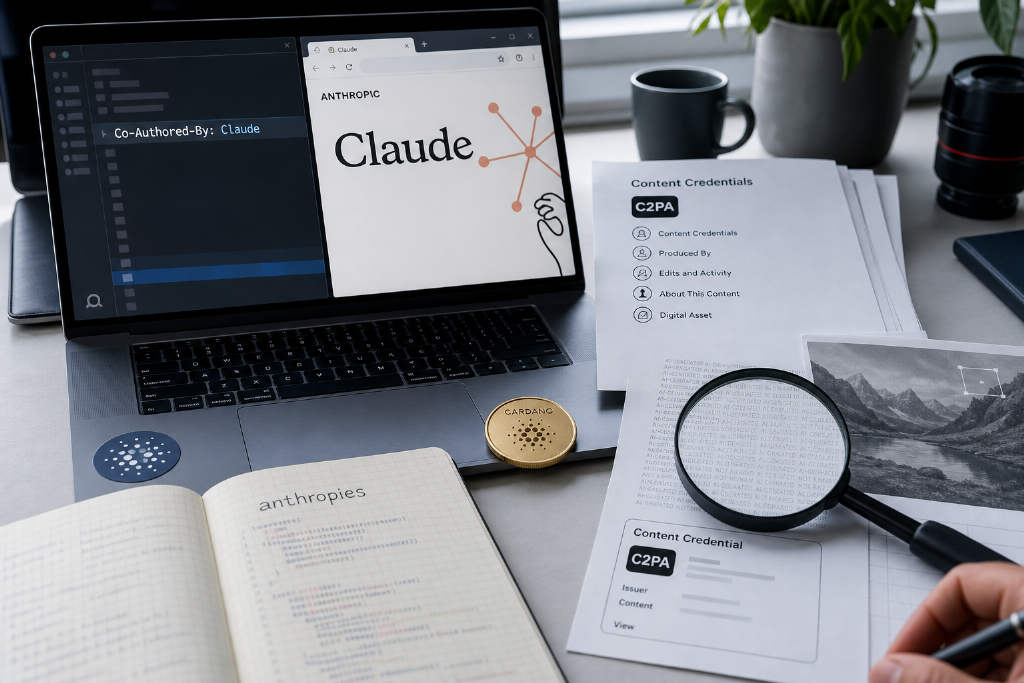
Cardano2026-08-16 08:04:24Charles Hoskinson unveils open-source project anthropiesCardano founder Charles Hoskinson said in a post on X that he has launched an open-source project called anthropies. The project is aimed at building a toolkit that can work with most large language models, or LLMs, to handle watermarks and related markers found in outputs from Anthropic and Claude. According to the project’s README, the toolkit is designed to distinguish among three types of signals: statistical watermarks embedded in text, C2PA content credentials attached to images, and the "Co-Authored-By: Claude" attribution that can appear in Git commits. The README also includes a limitation. It says the project cannot guarantee complete evasion of Anthropic’s undisclosed detection mechanisms. The announcement was reported by Odaily in a technology update. No additional project details were disclosed in the news brief.1500
Vals AI2026-08-15 12:01:00Vals AI raises $40 million in Series A led by Andreessen HorowitzVals AI, an AI evaluation startup, said it has raised $40 million in Series A funding at a post-money valuation of $400 million. The round was led by Andreessen Horowitz, with existing investors 8VC, Pear VC, and Bloomberg Beta participating again. New investors in the round include HRT Ventures and Next Ladder Ventures. Founded by Rayan Krishnan and Langston Nashold, the company positions itself as an independent evaluator and scorekeeper for large language models. Vals AI works with experts in law, finance, healthcare, and coding to score model outputs in real business settings, while limiting access to its private test sets to reduce benchmark gaming and training directly to the test. The company said its evaluation results have been included in model cards from OpenAI, Anthropic, Google, Meta, and xAI, and that enterprise customers use those results to choose models for production deployments. Vals AI also said its 2025 revenue grew 8x year over year, its customer count doubled, its team tripled in six months, and it launched the code evaluation tool Vals Smith, frontier risk evaluations, and Vals Index 2.0 for expanded economic measurement.1380