NG.CASH2026-09-28 13:12:56Brazilian fintech NG.CASH raises $15 million in strategic round led by Blockchain CapitalBrazilian fintech company NG.CASH has completed a $15 million strategic financing round, according to PR Newswire, with Blockchain Capital leading the investment. The company said its total funding has now exceeded $65 million since it was founded in 2021. NG.CASH also disclosed that it holds two licenses issued by Brazil’s central bank: one for direct credit operations and another as a payment institution. At the same time, it is applying for a virtual asset service provider license. Since launching in 2021, the company has surpassed 10 million accounts, while transaction volume on its platform has reached several billion dollars. The latest round adds to NG.CASH’s capital base as it expands its regulated financial and digital asset business in Brazil.340
Vietnam2026-09-21 03:04:47Vietnam plans crypto licensing regime with Austria cooperation on regulatory frameworkVietnam and Austria plan to work together on building a cryptocurrency regulatory framework, according to a Techub News item citing CoinPost. The talks took place in Vienna on the 15th, where Vietnam Deputy Finance Minister Nguyễn Đức Chi met Mariana Kühnel, executive director of Austria’s Financial Market Authority. The two sides discussed exchanges of supervisory experience in financial market oversight as well as directions for bilateral cooperation. Chi said Vietnam has already drafted an experimental legal framework related to cryptocurrencies and is preparing to introduce a licensing system for crypto service providers. He added that Vietnam will draw on regulatory experience from Austria and the European Union as it develops the framework. The report did not disclose additional details about the scope, timeline, or implementation of the planned licensing regime.400
Vietnam2026-09-19 08:46:52Vietnam targets first crypto service provider licenses in 2026 after talks with AustriaVietnam said it plans to issue its first licenses for crypto asset service providers in 2026 under a pilot legal framework, part of a broader push to modernize the country’s financial market. The plan was discussed during a Sept. 15 meeting in Vienna between Deputy Finance Minister Nguyen Duc Chi and Mariana Kuhnel, executive director of Austria’s Financial Market Authority, according to Vietnam’s State Securities Commission. Vietnamese officials said the country is refining its regulatory system to address new asset classes and technological change, and expects to approve the first digital asset platforms under the pilot framework in 2026. State Securities Commission Chair Vu Thi Chan Phuong said Vietnam is drawing on recommendations from the Financial Action Task Force and regulatory models used by European Union institutions, with a focus on risk management, investor asset protection and anti-money laundering. Separately, Vietnam is also considering a restructuring of stock trading boards, including the SME segment, while updating support policies for small and medium-sized enterprises, which account for about 99% of operating businesses in the country.540
Vietnam2026-09-19 08:38:47Vietnam plans first crypto service licenses in 2026 under pilot frameworkVietnam plans to issue licenses to its first group of crypto-asset service providers in 2026 under a pilot legal framework, while also allowing the first digital asset platforms to begin operating. The update was reported by ChainCatcher. The plan was discussed as Vietnam’s Deputy Minister of Finance Nguyen Duc Chi met Mariana Kuhnel, executive director of Austria’s Financial Market Authority, in Vienna. The two sides discussed bilateral cooperation and exchanges on financial regulatory experience. Vu Thi Chan Phuong, chair of Vietnam’s State Securities Commission, said the regulatory mechanism will cover both service providers and investor transactions. The main areas named were risk management, protection of investor assets, and anti-money laundering. Kuhnel also proposed that the two sides hold online technical workshops and strengthen coordination through the International Organization of Securities Commissions, or IOSCO.490
MiniMax2026-09-14 09:58:00Why Genspark’s M3-based PPT model may change how the market judges MiniMaxGenspark’s decision to train its own PPT model on top of MiniMax M3 has become the starting point for a broader reassessment of MiniMax’s position in the open-model market. On Sept. 10, Genspark released Gen-1 Slides, a model built for presentation generation, developed with Fireworks and now used as the default option in Genspark AI Slides standard mode. The article argues that this move matters because it goes beyond API switching. It shows an application company was willing to spend engineering effort and GPU budget on post-training, a much stronger signal than simply trying an open model. The piece lays out why M3 fit the task: open weights, multimodal support, long context, coding and agent capabilities, plus a model size that remained trainable for an application company. It also cites Fireworks data showing Genspark Slides consumes more than 1 trillion tokens a month, making inference cost a material business issue. In Genspark’s tests, Gen-1 Slides averaged $0.44 in model calling cost per PPT, versus $4.16 for Opus 5, while slightly improving average score and download rate. The article also links this to MiniMax H3’s open-weight release and the downstream ecosystem that followed, from ComfyUI support to H3 Max, FastH3 and H3-World. Its conclusion is that MiniMax should be judged not only by benchmarks, but by how many companies are willing to keep building, fine-tuning and shipping products on top of its models.1070
Brazil centra2026-09-14 08:11:23Brazil Central Bank Sets Much Higher Capital Floor for VASPs in Final RulesBrazil’s central bank has set a sharply higher minimum capital requirement for virtual asset service providers, or VASPs, in its final rulebook. The threshold now ranges from about 10.8 million to 37.2 million reais, depending on business scope and risk, equivalent to roughly $2.11 million to $7.2 million. That is well above the 1 million to 3 million reais range proposed in the public consultation draft, or about $195,000 to $586,000. The final framework also adds requirements covering governance, internal controls, anti-money laundering measures, audits, and ongoing reporting. Industry estimates cited in the report put the current number of related companies in Brazil at around 150 to 300. Of those, only about 20 to 25 are seen as either capable of meeting the standards or willing to apply. The report says the number that may ultimately secure a license could be closer to 10. Some smaller platforms have already shut down their retail businesses or restructured those operations as the higher compliance burden takes shape.1050
Brazil Centra2026-09-14 07:51:07Brazil central bank raises VASP licensing capital threshold, industry expects only about 10 approvalsBrazil’s central bank has set much higher capital requirements for virtual asset service providers under its final licensing rules, lifting the minimum threshold to roughly 10.8 million to 37.2 million Brazilian reais, or about $2.11 million to $7.2 million, depending on business model and risk. That compares with 1 million to 3 million reais, or about $195,000 to $586,000, in the earlier consultation draft. The final framework also adds requirements covering governance, internal controls, anti-money laundering procedures, auditing and ongoing reporting. Industry estimates cited in the report put the number of existing related companies in Brazil at around 150 to 300. Of those, only about 20 to 25 are seen as either qualified or willing to apply for a license, and the final number of approvals may end up at roughly 10. Some smaller platforms have already ended or restructured their retail businesses as the bar for compliance rises.1240
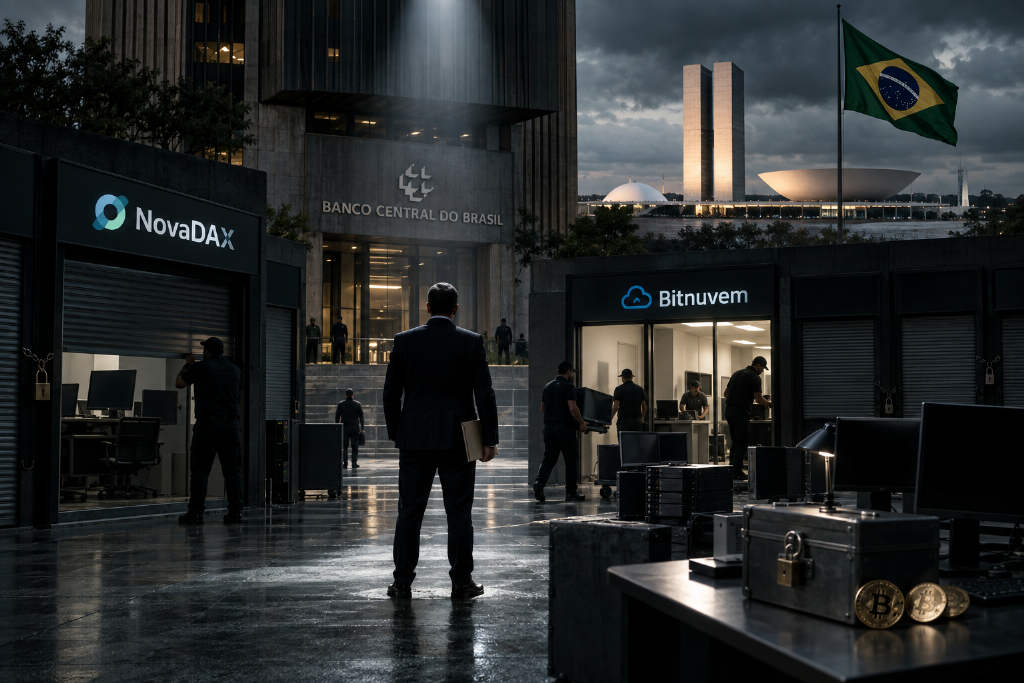
Brazil Centra2026-09-13 13:26:00Brazil central bank capital rules could push about 290 crypto exchanges out of the marketBrazil’s central bank has set capital requirements for crypto exchanges as high as 37.2 million Brazilian reais, or about $7.2 million, according to Bitcoin.com. The report said that out of roughly 200 to 300 virtual asset service providers operating locally, only 10 to 25 appear qualified to apply under the new framework. It added that the number of firms that may actually secure a license could end up near 10. Companies must file applications by Oct. 30, and those that do not apply will have 30 days to wind down operations. The report also noted that several platforms, including Bitnuvem and NovaDAX, have already announced restructurings or an end to retail operations. At the same time, those companies did not attribute their decisions to the new capital rule. The figures point to a sharp contraction in the number of operating exchanges if the requirements are enforced as described.910