OpenAI
Oct 16, 2026

OpenAI and Anthropic back Simons Foundation effort to help mathematicians scrutinize AI-assisted research

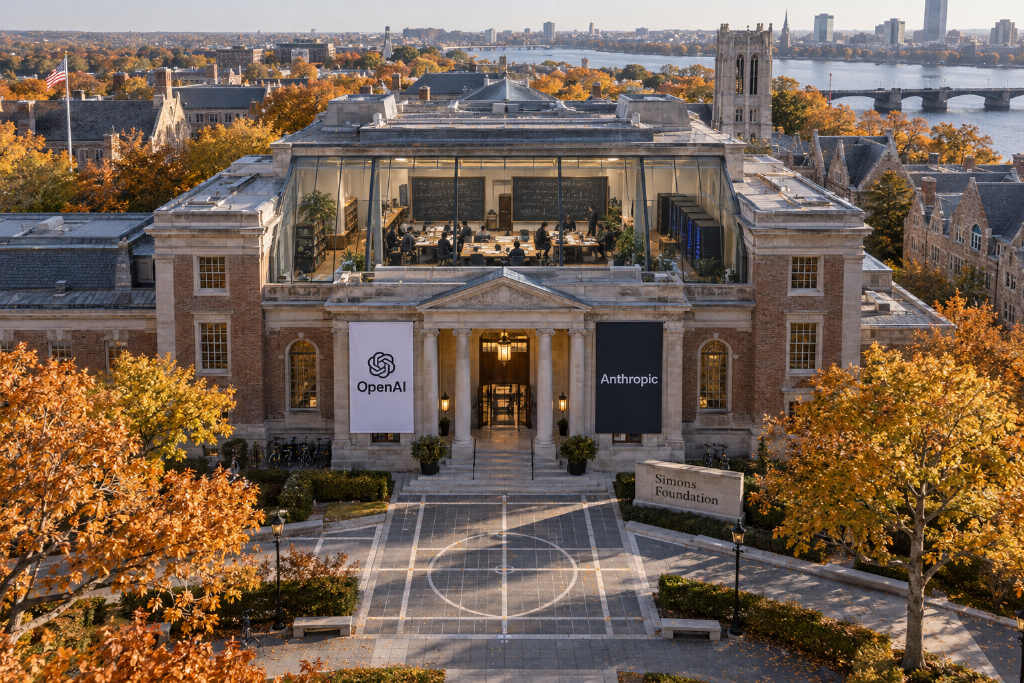
The Simons Foundation said on Oct. 15 that it is partnering with OpenAI and Anthropic on a $15 million package of funding and resources aimed at helping the mathematics research community evaluate AI-assisted results, share experience using new tools, and develop norms for how AI should be used in mathematical research. OpenAI separately said it will contribute $5 million, along with model access and compute resources. According to the announcement, the Simons Foundation will manage and distribute the resources through open calls for proposals, support for workshops, and related programs. The effort is intended to help researchers assess recent AI-assisted outputs, learn how to use new tools, compare perspectives, and build shared standards for community use. Support is set to extend beyond mathematics to basic science more broadly. The announcement also draws a distinction between the full $15 million total and cash contributions: it describes the amount as combined funding and resources, not as an all-cash donation from the AI companies. OpenAI also said its recent math research has been accompanied by materials for external review, including Lean formal proofs, while acknowledging that the way it releases research will continue to evolve based on community feedback.
1010
OpenAI and Anthropic back Simons Foundation effort to help mathematicians scrutinize AI-assisted research
Balaji
Oct 15, 2026

Balaji says AI is rapidly advancing math, with biomedicine as the next frontier

Balaji said in a post on X that artificial intelligence is moving quickly in mathematics and in theoretical physics problems that are, in his view, fundamentally mathematical. He argued that human mathematicians may eventually need months or even years to verify papers produced by AI, and added that mathematics itself could become a branch of computer science through Lean. He said the next scientific frontier after mathematics and physics will be chemistry, especially biology and medicine. According to Balaji, AI can rapidly synthesize and analyze omics data and research literature, raising the level of ambition in biomedical work. He linked that direction to labs talking about a goal to “cure all diseases.” Balaji also named Midjourney, Chan Zuckerberg and Anthropic as groups already working in this area, and said he expects more participants to join over time.

1330
Balaji says AI is rapidly advancing math, with biomedicine as the next frontier
OpenAI
Oct 15, 2026

OpenAI’s Navier-Stokes proof faces another reversal as mathematicians question the assumed method

OpenAI’s claimed breakthrough on the Navier-Stokes equations has taken another turn. A new follow-up report from Scientific American says mathematicians studying the company’s 166-page proof increasingly believe the final argument did not use the so-called “Spanish route” that many people, including OpenAI executives, had initially described. The earlier view was that OpenAI had extended a line of work associated with Spanish mathematicians Diego Córdoba and Luis Martínez-Zoroa, who explored how carefully constructed smooth forcing could drive a fluid system toward blowup. OpenAI’s result also relied on smooth forcing, which helped fuel the assumption that both efforts followed the same path. According to experts interviewed by Scientific American, that picture now looks incomplete. While both approaches use external forcing, researchers say OpenAI appears to construct that forcing in a substantially different way. The report also says OpenAI may not have fully understood the proof its own system produced when it announced the result on September 8. The system generated Lean formalization alongside the paper, allowing step-by-step verification of logical correctness, but that did not resolve the deeper question of mathematical understanding. The episode has sharpened a broader concern already raised by mathematicians including Terence Tao: AI may now be producing new proofs faster than humans can interpret them.

930
OpenAI’s Navier-Stokes proof faces another reversal as mathematicians question the assumed method
OpenAI
Oct 12, 2026

OpenAI’s release of 722 math manuscripts triggers backlash from Fields Medalist Hugo Duminil-Copin

OpenAI’s publication of 722 AI-generated mathematics manuscripts on GitHub has sparked a sharp reaction from parts of the academic community, including 2022 Fields Medal winner Hugo Duminil-Copin, who said the release hit areas he has studied for years. According to the disclosed figures, the manuscripts span 372 result families and include 377 new proofs. OpenAI said most of the work was produced by a single unreleased internal model trained from Aug. 28, with each result requiring compute roughly equal to about three hours of ChatGPT Pro reasoning. The release did not go unchallenged. After publication, several mathematicians said some manuscripts may not actually prove the conclusions they claim. OpenAI withdrew three papers two days later, leaving 719 in the repository. The episode has widened a debate over what counts as mathematical progress: whether value lies only in a finished proof, or also in the failed attempts, new concepts, tools, and cross-field links that emerge during the search. It has also raised concerns about the future training of graduate students and postdocs, and whether open academic exchange could weaken if researchers fear that informal ideas shared in talks, emails, or discussions may be harvested and turned into machine-led breakthroughs.

1380
OpenAI’s release of 722 math manuscripts triggers backlash from Fields Medalist Hugo Duminil-Copin
OpenAI
Oct 11, 2026

OpenAI posts 722 math manuscripts on GitHub, claiming a proof of the four-dimensional Kakeya conjecture

OpenAI has released 722 mathematical manuscripts on GitHub in a single batch, with one set of papers claiming proofs related to the three-dimensional Kakeya maximal function conjecture and the four-dimensional Kakeya conjecture. According to Techub News, the three-dimensional work builds on prior research by Hong Wang and Joshua Zahl and strengthens the result to the maximal function setting. The four-dimensional paper claims to push the lower bound on the Hausdorff dimension of the relevant set to the full dimension of 4. None of the manuscripts has gone through peer review or formal verification so far. The release quickly drew criticism from parts of the academic community. A joint statement issued by the Human Mathematics Association, led by Terence Tao, strongly urged mathematicians to stop working with OpenAI and said the mass release was a display of power rather than scholarship. Other scholars took a different view, saying the move could push mathematical research toward developing new concepts and conjectures.

1080
OpenAI posts 722 math manuscripts on GitHub, claiming a proof of the four-dimensional Kakeya conjecture
OpenAI
Oct 11, 2026

OpenAI’s release of 722 math papers leaves researchers saying verification could take years

Four days after OpenAI published 722 AI-generated mathematics manuscripts on GitHub, mathematicians told The Verge that the archive appears to contain real and potentially significant results, but sorting out which claims actually hold may take years. OpenAI posted the papers on Oct. 7 and withdrew three the next day, while also noting that only 300 of 719 main results were accompanied by Lean formalization, or about 42%. The company’s own README said unformalized results may contain problems. Interviewed researchers described the release as astonishing, unprecedented and surreal. At the same time, they pointed to immediate limits: formal verification does not automatically mean the statement checked by a computer fully matches the claim made in a paper, and none of the work has gone through peer review. The update log also showed errors had already surfaced, including a sign mistake in a paper on Weil classes that led to the withdrawal of two related papers tied to the Hodge conjecture. Beyond correctness, the release is shaking career plans. Some mathematicians said grant proposals and long-running projects may have been wiped out overnight, with early-career researchers, PhD students and non-tenured academics facing the heaviest pressure.

1060
OpenAI’s release of 722 math papers leaves researchers saying verification could take years
Terence Tao
Oct 11, 2026

Terence Tao blog debate puts AI’s role in mathematics under scrutiny

A debate over artificial intelligence and the future of mathematics has erupted around Fields Medalist Terence Tao’s blog, where researchers, commentators and adjacent disciplines are arguing over what mathematicians should be valued for once machines can generate proofs at scale. The discussion gained momentum after a widely circulated video showed Tao calling for AI development to slow down, saying the current pace was "crazy" and describing the shift as an "extreme nonlinear dynamic." The timing drew extra attention because Tao had only recently been promoting SAIR, an open-source mathematics model project. At the center of the debate is a guest essay by 3Blue1Brown founder Grant Sanderson, who argues that proofs and problem-solving have long served as proxy metrics rather than the true end of mathematics. In his framing, the real goal is to deepen human understanding. If AI can produce proofs without understanding them, then proof production alone loses value as the main yardstick for academic contribution. Sanderson proposes a stronger focus on what he calls "motivational exposition," along with new "open-ended exposition problems," changes to PhD defenses, and a broader rethink of tenure standards. The response has been mixed: some physicists welcomed the shift toward understanding, while some mathematicians warned that eloquence should not eclipse raw problem-solving talent, and others argued AI may eventually become strong at exposition too.

1340
Terence Tao blog debate puts AI’s role in mathematics under scrutiny
OpenAI
Oct 10, 2026

OpenAI’s release of 722 math papers sparks backlash from researchers

OpenAI’s October 6 release of 722 mathematical manuscripts has triggered a fierce response from parts of the global math community. Scott Aaronson, a theoretical computer scientist at the University of Texas at Austin and an ACM Fellow, described the moment as a "mathematical apocalypse" in a blog post that quickly circulated across academia. Terence Tao later reposted a joint statement led by AHM that openly criticized OpenAI and urged mathematicians to stop working with the company. The dispute is not only about whether AI systems can solve major open problems. It is also about how those results were released, how readable the proofs are, and what role human understanding still plays if machines can generate arguments that experts struggle to parse without help from other AI tools. Aaronson’s post highlighted examples including a full proof of the Unique Games Conjecture, derandomization results such as L=BPL, and a new matrix multiplication bound of O(n^(9/4)). Another point in the debate is what was missing. Aaronson noted that the released papers appeared to span number theory, combinatorics, and quantum complexity, but not cryptography. He said AI companies are already examining whether their latest internal models can break major cryptographic protocols, raising broader questions about security if those capabilities advance beyond public view.

1240
OpenAI’s release of 722 math papers sparks backlash from researchers
Total 86 items
Go topage