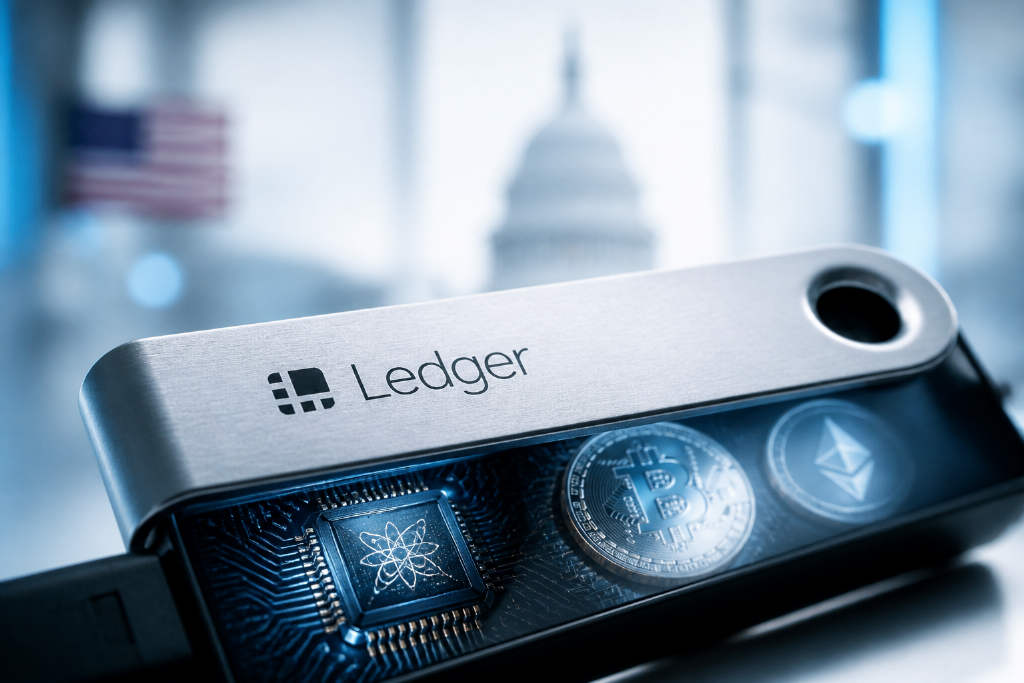
Ledger2026-08-24 21:02:53Ledger CTO outlines how NIST post-quantum signatures could affect blockchain securityLedger’s chief technology officer has commented on the National Institute of Standards and Technology’s post-quantum signature approach, according to a Techub News item citing Crypto Briefing. The scheme is designed to address the potential threat that quantum computing poses to cryptography, a core layer of blockchain security. The report says adoption of the standard could reshape the security model for blockchains and may also alter transaction costs. It could require users to adjust as networks integrate or react to new cryptographic requirements. Techub noted that the implications would be especially relevant for major blockchain networks such as Bitcoin and Ethereum. No additional technical details, implementation timeline, or cost estimates were provided in the source summary.1130
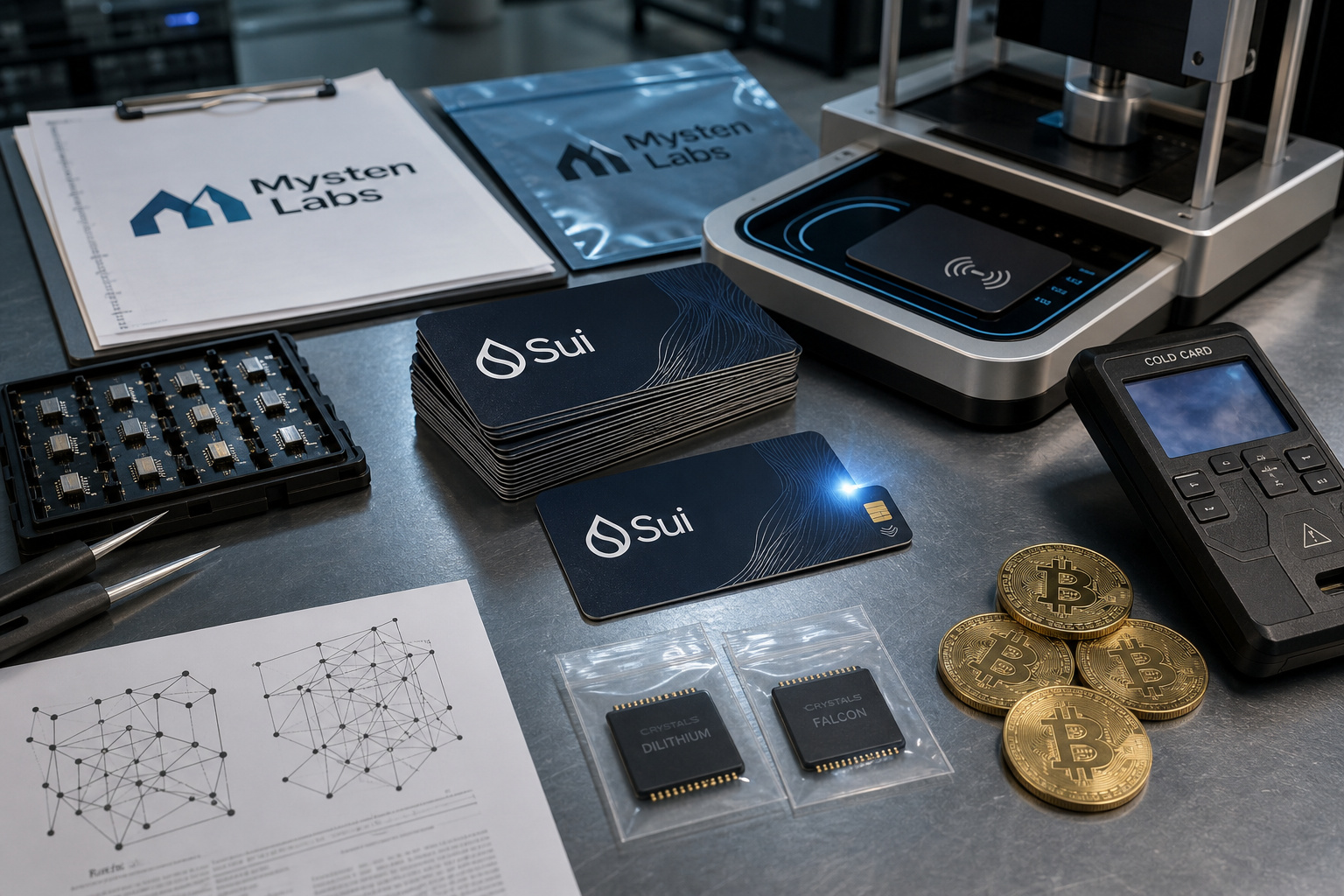
Quantum-safe2026-08-11 22:32:57Sui Co-Founder Leases Secret Factory to Build Quantum-Safe Wallet CardsKostas Chalkias, co-founder and chief cryptographer of Sui developer Mysten Labs, has leased a specialized factory in a secret location to mass-produce quantum-safe hardware wallet cards for the Sui network. The goal is a per-card key cost of less than $10, with NFC quantum signing taking one to two seconds. Chalkias said he is pursuing the project in his personal time and may subsidize cards for users who cannot afford them. The move comes partly in response to the Coldcard hardware wallet event, where Coinkite disclosed a firmware flaw dating back to a 2021 update that bypassed the hardware RNG and generated keys via a predictable process tied to device serial numbers. Attackers have drained roughly 2,055 BTC, or about $130 million, from more than 7,700 addresses since July 30. Separately, Sui plans to adopt two NIST-approved quantum-resistant signature schemes - one for everyday accounts and one for high-value Move vaults - allowing existing users to rotate to quantum-safe keys from their original recovery phrase without migrating to a new wallet. The story was first reported by Bitcoin.com News.1910
Starknet2026-08-07 12:46:56Starknet Completes Quantum-Resistant Signature Transfer on MainnetStarknet has completed a test transfer on mainnet using a quantum-resistant signature mechanism. A wallet account employing the scheme carried out a real transaction with fees of around $0.06, and the transfer can be verified on a block explorer. StarkWare said the account remains experimental and unaudited, intended mainly for research. The milestone was made possible by Starknet's account model, which treats each account as a smart contract. Unlike chains that hard-code signature algorithms at the protocol layer, Starknet accounts can define their own accepted signature schemes. That allows users to upgrade from traditional elliptic curve signatures to quantum-resistant ones without a hard fork, asset migration, or address changes. StarkWare also warned that most blockchains are exposed to quantum computing risks because both wallet signatures and underlying verification rely on elliptic curve cryptography. If a large-scale quantum computer appears, Shor's algorithm could break those systems. Starknet's ecosystem now supports quantum-resistant signatures based on Falcon-512, a scheme within NIST's post-quantum cryptography standardization efforts, with implementations driven by ecosystem teams and OpenZeppelin.1940
Sui2026-08-06 13:09:32Sui to Deploy Quantum-Safe Vaults on Mainnet This Year, Adds NIST-Approved Post-Quantum SignaturesSui announced plans to bring quantum-safe vaults to its mainnet within this year, introducing two NIST-approved post-quantum signature schemes. ML-DSA-65 will serve as the native protocol signature for regular accounts, while the hash-based SLH-DSA-SHA2-128s is designated for high-value vaults within Move smart contracts. The move responds to the potential threat quantum computing poses to existing elliptic curve cryptography. According to Sui, because Sui keys are deterministically derived from seeds, users can upgrade to quantum-safe keys using their existing recovery mnemonic. An already live address-alias feature lets current accounts update authorization keys without moving assets. The quantum-safe vaults are slated for mainnet deployment this year, with native ML-DSA-65 accounts expected on testnet by year-end. Account authentication is targeted for mainnet in Q1 2027. Sui said the upgrade is incremental and optional, leaving existing accounts and contracts unaffected.1970
Anthropic2026-07-28 20:45:38Anthropic says Claude found new attacks on HAWK and reduced-round AESAnthropic said an unreleased version of its Claude Mythos model uncovered two previously unknown cryptographic attacks, including one against HAWK, a post-quantum digital signature scheme now in the third round of the U.S. National Institute of Standards and Technology’s competition. According to the company, Claude identified a symmetry in HAWK’s structure that cuts the cost of recovering a secret key in the smallest configuration from 2^64 operations to 2^38, a roughly 67 million-fold reduction. Anthropic said fixing the issue would require roughly doubling HAWK’s key size, which would undercut the compactness and speed that make the scheme attractive for blockchains and other systems sensitive to signature size. The company also described a separate result on a 7-round research version of AES-128, where Claude was asked to avoid all five established families of AES cryptanalysis and invent a new approach. Anthropic said the model eventually produced a technique called “Möbius Bridge,” reducing one of the nine key bytes an attacker previously needed to guess. It also reported that Claude broke 13 rounds of LEA, though deployed LEA uses 24 rounds. Anthropic said it disclosed the findings to the algorithms’ authors and relevant U.S. government and industry partners before publication, and coordinated the HAWK finding with NIST.1980
Stellar2026-07-24 05:30:16Stellar Outlines Quantum-Safe Upgrade Roadmap: Full Protocol Transition by 2027Stellar unveils its Quantum Preparedness Plan (QPP), introducing NIST-approved signatures for Soroban accounts in 2026 and native quantum-safe signers for all accounts by 2027, preserving existing addresses and history.270
AI regulation2026-07-22 18:45:14FLARE-AI Launches to Track AI Harms as MITRE and US Lawmakers Push Reporting StandardsThe open-source FLARE-AI platform is now live, giving the public a place to report and track AI-related harms. Its launch comes as US lawmakers propose a bill directing NIST to create reporting standards and a centralized AI flaw database.1740
Policy Regula2026-07-21 02:36:40CAISI chief Chris Fall exits after three months as U.S. AI standards unit sees third leadership change in half a yearThe U.S. Center for AI Standards and Innovation, or CAISI, has lost another leader, with director Chris Fall stepping down after only three months in the role. The Commerce Department did not give a reason for the resignation and said only that the appointment had always been temporary. Fall is the third person to cycle through the job in a little over six months, following Collin Burns, who lasted less than a week, and David Sacks, the White House AI and crypto czar who left in March. CAISI, housed under the National Institute of Standards and Technology, is meant to set technical standards for AI models, test capabilities, and identify cybersecurity risks. Yet several high-profile U.S. AI oversight actions in recent months unfolded without the agency playing a visible role, including the temporary restrictions on Anthropic’s Mythos and Fable models and the White House’s Gold Eagle vulnerability coordination mechanism. The latest leadership turnover also comes as debate intensifies in Washington over Chinese open-source AI models after Moonshot released a new version of Kimi that reportedly matched leading frontier systems in benchmark performance.1750