Chainlink
Oct 29, 2026

Chainlink launches 24/7 pricing service for tokenized traditional assets

Chainlink has rolled out Chainlink 24/7, a new pricing service designed to provide onchain market data for traditional assets such as stocks and commodities during weekends and holidays. The service is delivered through Data Feeds and Data Streams. During regular market hours, it uses existing 24/5 session data, while after traditional markets close it aggregates quotes from multiple perpetual futures venues to create a continuous price reference. Aave is listed as an initial launch partner and is integrating 24/7 Data Feeds into its institutional lending platform, Horizon, to support round-the-clock pricing for tokenized real-world asset collateral, starting with heavily traded U.S. stocks. Chainlink also said its 24/5 service already provides delayed pricing for nearly half of tokenized equities and supports pricing for more than $1.6 billion worth of tokenized stocks across six chains for projects including Ondo, xStocks, Robinhood, and Coinbase.


850
Chainlink launches 24/7 pricing service for tokenized traditional assets
Canton Foundation
Oct 29, 2026

Canton Foundation approves nearly 15.8 million CC grant to RedStone for institutional pricing standard

The Canton Foundation has approved a grant of nearly 15.8 million Canton Coin to blockchain oracle provider RedStone, worth about $1.55 million at the time, to build an open-source pricing tool for institutional users called the Canton Access and Privacy Standard, or CAPS. The proposal, released Thursday, is designed to let institutions value trades using shared market prices without revealing their agreed settlement amounts to data providers. RedStone will publish reference prices that can be used to calculate trade values, with initial development covering tokenized funds, private market assets, and structured products. The pricing calculation and authorization modules will be released under the Apache 2 open-source license so other data providers can adapt them. Canton Foundation executive Viv Diwakar said support for open-source efforts such as CAPS can help create a shared privacy and authorization framework that allows multiple data providers to serve the network. RedStone has provided pricing data for Canton since December 2025 and has worked with ecosystem participants including Temple Digital Group. Canton Network previously said it had connected more than 600 institutions, including Goldman Sachs, DTCC, BNY Mellon, and Franklin Templeton, with roughly $9 trillion in monthly transaction processing volume.

1260
Canton Foundation approves nearly 15.8 million CC grant to RedStone for institutional pricing standard
Oracle
Oct 29, 2026

Oracle jumps while Alphabet slides as markets reassess AI spending and cash flow

Oracle and Alphabet moved in opposite directions over Oct. 28-29 as investors took a harder look at whether heavy AI spending is producing acceptable returns. Oracle shares closed up 10.73% on Oct. 28, with intraday gains topping 13%, after the company outlined when capital expenditures could peak, when free cash flow could turn positive, and when reliance on outside financing may ease. By contrast, Alphabet fell more than 10% in premarket trading on Oct. 29 after reporting third-quarter revenue and profit below expectations and posting negative free cash flow for a second straight quarter. Oracle said capital spending should peak in fiscal 2027, its current fiscal year, through fiscal 2028, then decline in fiscal 2029. CFO Hilary Maxson said free cash flow is expected to turn positive in the second half of fiscal 2028 and exceed $30 billion in fiscal 2029. The company also said it expects no longer needing external financing to support growth starting in fiscal 2029, with net debt to annual core profit falling below 3.5x. Microsoft landed between the two: first-quarter capex rose 30% year over year to $45.2 billion, below analyst expectations, while free cash flow fell 27% but remained positive at $18.63 billion.

560
Oracle jumps while Alphabet slides as markets reassess AI spending and cash flow
Bernstein
Oct 29, 2026

Bernstein says low crowding in software is opening a stock-picking window

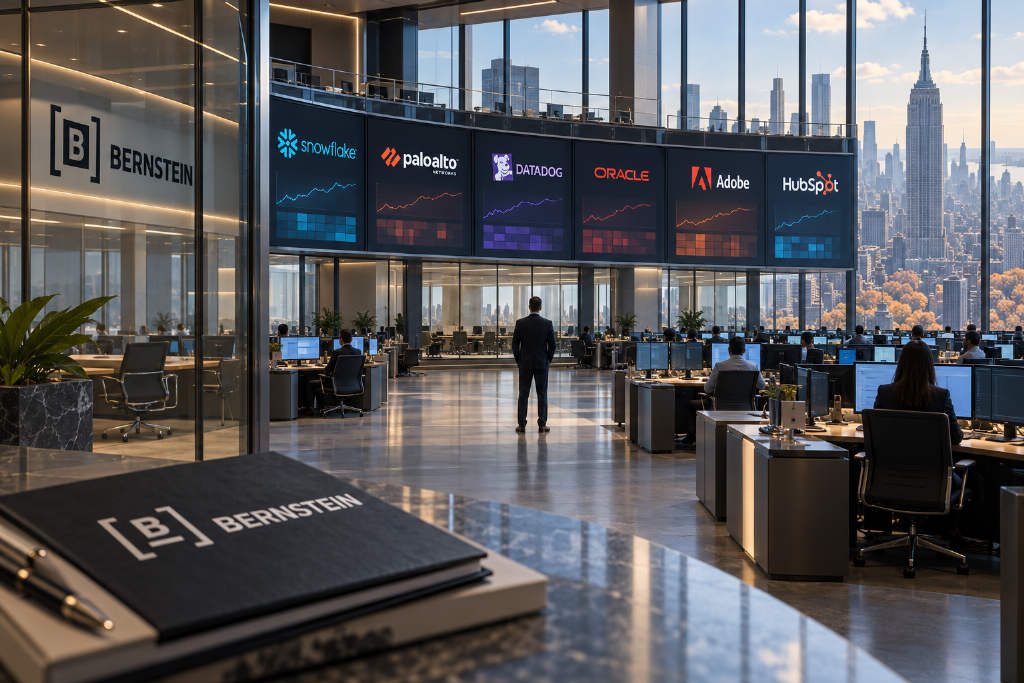
Bernstein said in a report dated Oct. 28, 2026 that crowding across the software sector remains well below its long-term historical range, even after a pickup in the third quarter. The firm used the sharp reversal in crowded trades this year as a lens on positioning, noting that the cumulative return gap between the most crowded quintile and the least crowded quintile was positive 51.0% in the first half, then swung to negative 30.2% in the second half. Within software, Bernstein said money is starting to return to companies with stable results or renewed acceleration, but the rebound is selective rather than broad. It highlighted higher relative crowding scores for Snowflake, Palo Alto Networks and Datadog, while Oracle, Adobe and HubSpot screened as less crowded. The report argued that usage growth and evidence of AI monetization are helping attract capital back to some names, though rising crowding can also mean optimism is already being priced in. Bernstein also said investors still need to weigh valuation, execution and business durability. It pointed to ServiceNow and Atlassian as examples of application software names where improving operating results matter more than AI narrative alone, while Oracle and HubSpot showed that low crowding by itself does not lead to the same conclusion across companies.

600
Bernstein says low crowding in software is opening a stock-picking window
AI infrastructure
Oct 28, 2026

AI infrastructure stocks rebound as Anthropic spending estimates and Broadcom financing reshape the trade

U.S. AI infrastructure names rallied on Oct. 27 as investors reassessed what matters most in the buildout cycle: not just whether demand exists, but how visible that demand is, who finances it, and whether it can turn into durable cash flow. The Philadelphia Semiconductor Index rose 3.6%, with all 30 constituents closing higher. Broadcom gained 4.00%, Oracle rose 3.55%, Cerebras climbed 10.10%, and CoreWeave added 7.94%, while NVIDIA was up only 0.90%. Two developments drove the move. First, media summaries of Anthropic’s IPO filing pointed to long-term compute and infrastructure arrangements estimated as high as $807 billion, including cloud services, equipment leases, procurement agreements, and future capacity plans. Second, Broadcom disclosed a $63 billion financing structure involving Bank of America, Blackstone, Citigroup, and Morgan Stanley. Under the arrangement, an SPV will buy Broadcom XPU AI accelerators and networking gear and lease them to Anthropic, with deliveries expected to begin in 2027. The market response suggests investors are placing a premium on demand visibility and financing pathways. But the article’s core point is narrower: contract size is not recognized revenue, financing commitments are not risk-free cash, and rising orders do not automatically produce better shareholder returns. Delivery schedules, utilization, customer payment capacity, residual values, and free cash flow remain the key tests.

1040
AI infrastructure stocks rebound as Anthropic spending estimates and Broadcom financing reshape the trade
Federal Reserve
Oct 29, 2026

Fed Holds Rates Steady as Big Tech Earnings Split and AI Infrastructure Names Stay Strong

The Federal Reserve left its target range for the federal funds rate unchanged at 3.75% to 4.00% in a 10-2 vote, with Cook and Hammack favoring a 25-basis-point increase. The statement said economic activity was expanding strongly, capital investment remained solid, and inflation was still elevated. Markets are now looking to upcoming GDP and PCE data for a fresh read on growth resilience and the likely rate path. After the close on Oct. 28 U.S. time, Microsoft and Alphabet posted earnings that triggered sharply different early reactions. Microsoft rose more than 4% at one point, while Alphabet fell more than 7%. The divergence pushed investors to look beyond cloud growth alone and focus more closely on how revenue, capital spending and cash recovery line up across the AI supply chain. In crypto, BTC traded around 81,156.84 USDT, up 0.47% over 24 hours, while ETH changed hands near 2,356.59 USDT, up 0.41%. Total crypto market capitalization stood at about $2.74 trillion, down 2.31% as of 08:45 Beijing time. The report also highlighted liquidation zones for BTC and ETH, Glassnode’s estimated U.S. spot BTC ETF aggregate cost basis near $81,500, and Strategy’s disclosed average BTC acquisition cost of about $75,446.

590
Fed Holds Rates Steady as Big Tech Earnings Split and AI Infrastructure Names Stay Strong
US stocks
Oct 29, 2026

U.S. stocks close higher as AI names gain, with Oracle up 10.73%

U.S. stocks finished modestly higher, according to data cited by Odaily from MSX.COM. The Dow Jones Industrial Average rose 0.19%, the S&P 500 added 0.28%, and the Nasdaq gained 0.27% at the close. The VIX volatility index, often tracked as a fear gauge, fell 3.48%. AI-related stocks posted broad gains in the session. Oracle led the group with a 10.73% rise. CoreWeave climbed 7.32%, Tempus AI advanced 6.18%, Micron added 5.86%, and Arm rose 4.1%. Odaily also noted that MSX is a major RWA trading platform. The platform has listed hundreds of RWA tokens, covering popular U.S. stock and ETF tokenized assets including NVIDIA, GOOGL, MSFT, AMZN, META, TSM, and AMD.

690
U.S. stocks close higher as AI names gain, with Oracle up 10.73%
US stocks
Oct 28, 2026

U.S. stocks close higher Wednesday as SK Hynix jumps 13% and New Oriental drops 12.7%

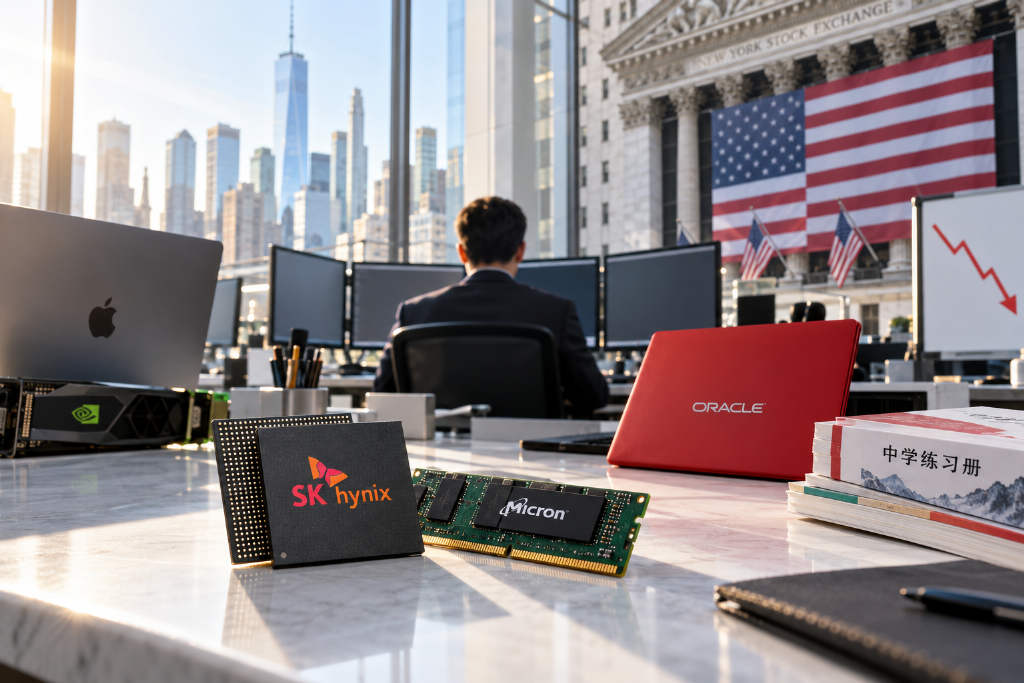
U.S. equities finished Wednesday in positive territory, according to market data cited by ChainCatcher from Gate. The Dow Jones Industrial Average rose 0.19%, the S&P 500 gained 0.28%, and the Nasdaq Composite added 0.27% at the close. Among individual names, SK Hynix climbed 13%, Micron Technology rose nearly 6%, and Oracle advanced 10.5%. Apple and Nvidia each fell around 1%. The Nasdaq Golden Dragon China Index closed down 1.83%, while New Oriental dropped 12.7%. The move left the major U.S. benchmarks modestly higher overall, even as several China-related stocks and select large-cap tech names ended lower.

620
U.S. stocks close higher Wednesday as SK Hynix jumps 13% and New Oriental drops 12.7%
Total 284 items
Go topage