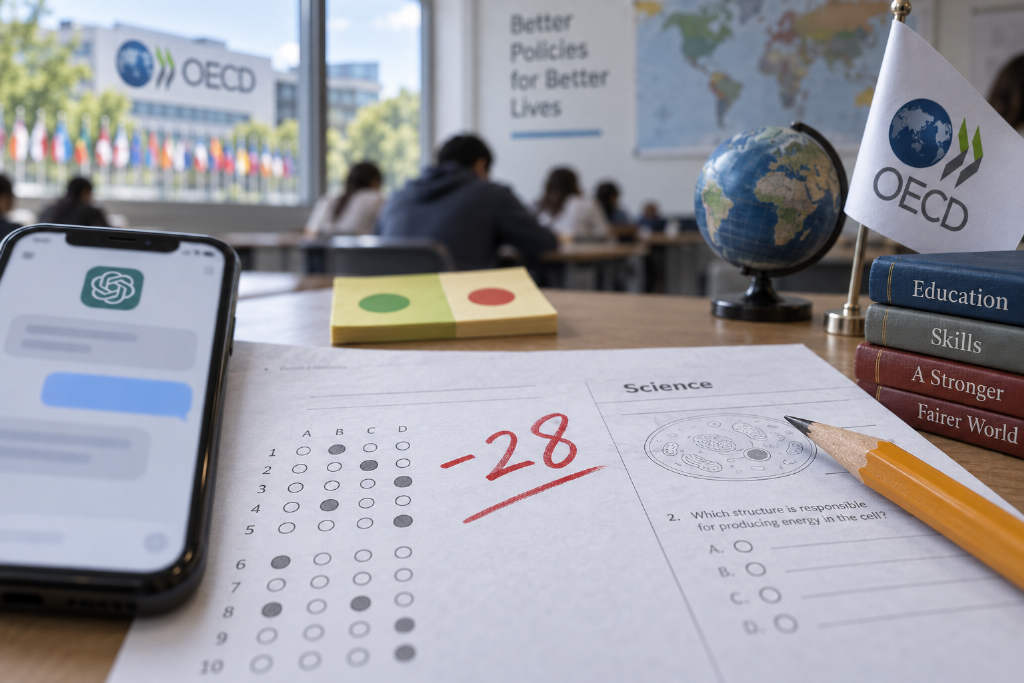
OECD’s largest-ever PISA test finds daily AI homework use linked to 28-point lower scores
The Organisation for Economic Co-operation and Development, or OECD, released its PISA 2025 results on Sept. 8, offering the first large-scale look at student performance after generative AI became widely available. The assessment covered more than 760,000 15-year-old students across 91 countries and economies, making it the biggest PISA exercise on record. According to the results, students who used AI for homework every day or almost every day scored 481 points in science, compared with 509 points for those who rarely or never used AI in that context. After adjusting for socioeconomic status, the gap stood at 28 points, which the report described as roughly equivalent to one and a half years of schooling. Across all use cases, the science-score gap between AI users and non-users was about 20 points. The findings were not entirely one-directional. Students who used AI about once a week to support learning posted the strongest results, at roughly 500 points, forming an inverted U-shaped pattern. OECD education and skills chief Andreas Schleicher said the issue was not AI itself, but whether students were taught how to evaluate AI-generated information. Among daily AI users, those who had regular classroom training on assessing AI outputs recovered 13 points in science scores.