StarkWare2026-09-26 16:54:17StarkWare challenge cuts estimate for quantum-safe Bitcoin compute by 79%TheDefiant reported that an AI-assisted challenge run by StarkWare reduced an estimate tied to quantum-safe Bitcoin computation by 79%. The report drew a clear line around what the result does and does not cover. It said the contest focused on offchain GPU work rather than Bitcoin transaction fees, meaning the revised estimate applies to a computing task outside the fee market on the Bitcoin network. The article also noted that the method remains experimental and still requires a direct path to a miner, which leaves an important practical condition attached to the approach. Beyond those points, the source did not provide additional technical details in the supplied text. The publication also stated that its articles are stored on Filecoin.260
Ethereum2026-09-09 15:40:59Vitalik says recursive STARK mempool could cut costs for quantum-safe signatures and private transfersVitalik said in a post on X that he wants Ethereum to include the recursive STARK mempool proposal, EIP-8288, in the network’s I-star upgrade. He described the proposal as a possible next step after Frames. According to his post, the design would move quantum-safe signature data off-chain, which could reduce signature costs. He also said gas costs for quantum-safe private transactions could fall from around 10 million to the tens of thousands. The proposal works by using frames and recursive STARKs to aggregate transaction dependencies. Under that setup, nodes would send one STARK of roughly 100 KB to 300 KB during each time period. The added on-chain overhead, he said, would be one STARK plus 96 bytes for each statement that needs to be proven.880
StarkWare2026-08-26 23:11:55StarkWare executes first quantum-safe transaction on Bitcoin mainnetStarkWare said it has successfully executed the first quantum-safe transaction on the Bitcoin mainnet, a step the company described as significant for blockchain efforts to build resistance against future quantum threats. The announcement points to a security issue that has drawn growing attention across the crypto sector: the possibility that advances in quantum computing could one day weaken existing cryptographic protections used by cryptocurrency networks. According to StarkWare, the latest transaction shows progress toward addressing that risk on Bitcoin itself rather than in a test setting. The company also said there is an urgent need to develop quantum-resistant solutions that are both scalable and cost-effective. The update was cited by Crypto Briefing and carried by Techub News.870
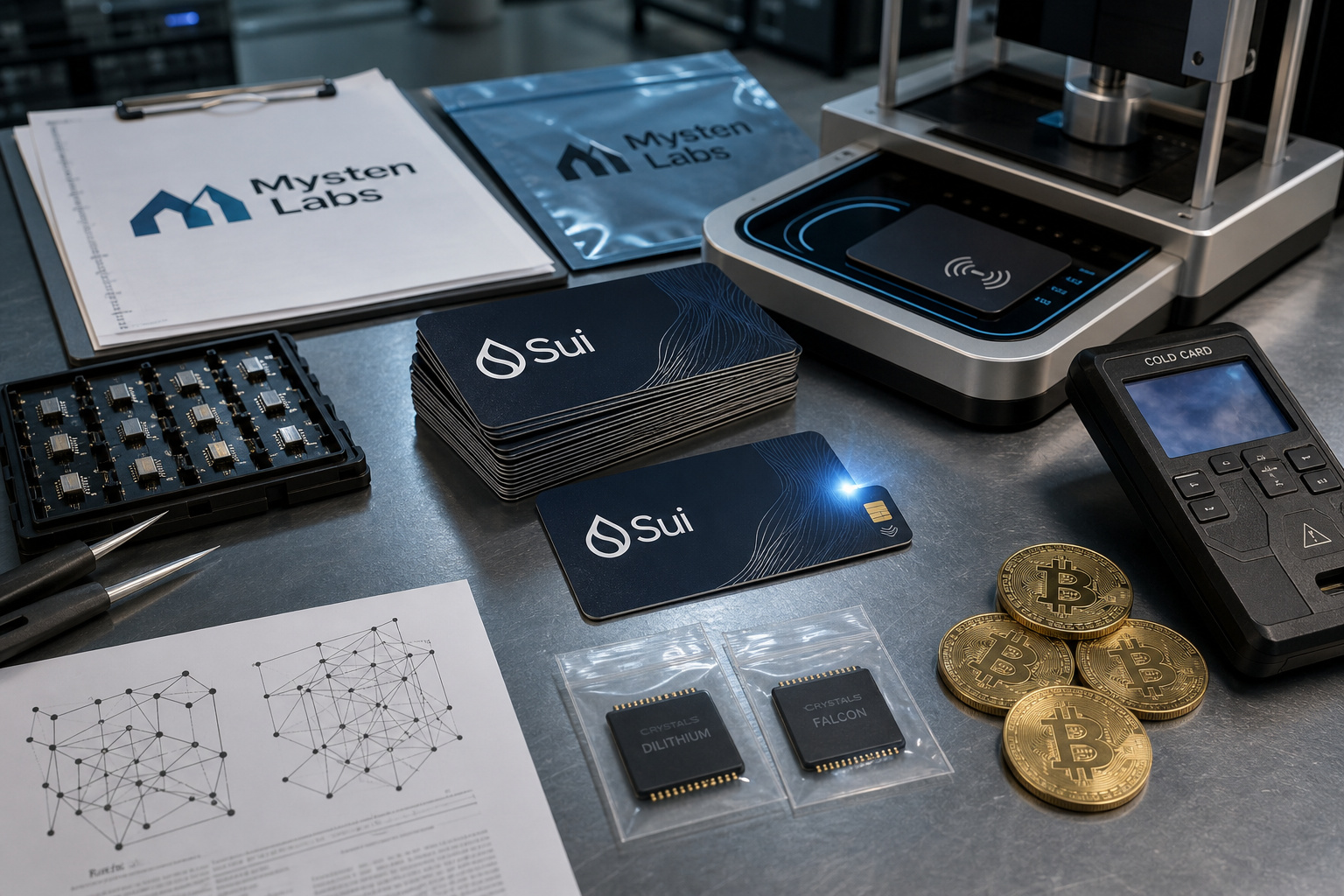
Quantum-safe2026-08-11 22:32:57Sui Co-Founder Leases Secret Factory to Build Quantum-Safe Wallet CardsKostas Chalkias, co-founder and chief cryptographer of Sui developer Mysten Labs, has leased a specialized factory in a secret location to mass-produce quantum-safe hardware wallet cards for the Sui network. The goal is a per-card key cost of less than $10, with NFC quantum signing taking one to two seconds. Chalkias said he is pursuing the project in his personal time and may subsidize cards for users who cannot afford them. The move comes partly in response to the Coldcard hardware wallet event, where Coinkite disclosed a firmware flaw dating back to a 2021 update that bypassed the hardware RNG and generated keys via a predictable process tied to device serial numbers. Attackers have drained roughly 2,055 BTC, or about $130 million, from more than 7,700 addresses since July 30. Separately, Sui plans to adopt two NIST-approved quantum-resistant signature schemes - one for everyday accounts and one for high-value Move vaults - allowing existing users to rotate to quantum-safe keys from their original recovery phrase without migrating to a new wallet. The story was first reported by Bitcoin.com News.1920
Sui2026-08-06 13:09:32Sui to Deploy Quantum-Safe Vaults on Mainnet This Year, Adds NIST-Approved Post-Quantum SignaturesSui announced plans to bring quantum-safe vaults to its mainnet within this year, introducing two NIST-approved post-quantum signature schemes. ML-DSA-65 will serve as the native protocol signature for regular accounts, while the hash-based SLH-DSA-SHA2-128s is designated for high-value vaults within Move smart contracts. The move responds to the potential threat quantum computing poses to existing elliptic curve cryptography. According to Sui, because Sui keys are deterministically derived from seeds, users can upgrade to quantum-safe keys using their existing recovery mnemonic. An already live address-alias feature lets current accounts update authorization keys without moving assets. The quantum-safe vaults are slated for mainnet deployment this year, with native ML-DSA-65 accounts expected on testnet by year-end. Account authentication is targeted for mainnet in Q1 2027. Sui said the upgrade is incremental and optional, leaving existing accounts and contracts unaffected.1980
Stellar2026-07-24 05:30:16Stellar Outlines Quantum-Safe Upgrade Roadmap: Full Protocol Transition by 2027Stellar unveils its Quantum Preparedness Plan (QPP), introducing NIST-approved signatures for Soroban accounts in 2026 and native quantum-safe signers for all accounts by 2027, preserving existing addresses and history.290
Bitcoin2026-07-23 04:45:14BTQ Launches Bitcoin Quantum Testnet, the First Quantum-Safe Fork in Bitcoin HistoryBTQ Technologies has launched Bitcoin Quantum, a permissionless fork testnet that replaces ECDSA with ML-DSA and increases block size to 64 MiB. The clean-slate fork aims to provide a testing ground for quantum resistance without affecting the Bitcoin mainnet.510
BitGo2026-07-22 08:13:14BitGo Tests Quantum-Safe MPC Wallet Signing with Silence Labs Using ML-DSABitGo and Silence Laboratories completed a post-quantum MPC transaction simulation using the NIST-standard ML-DSA algorithm for institutional crypto custody. The test comes as BitGo prepares for a $200M IPO and as the industry gears up for quantum-resistant upgrades.1990