REIT

VanEck
2026-08-11 04:03:04

VanEck’s Matthew Sigel says AI infrastructure is not a bubble, while institutional disappointment with L1s is weighing on crypto

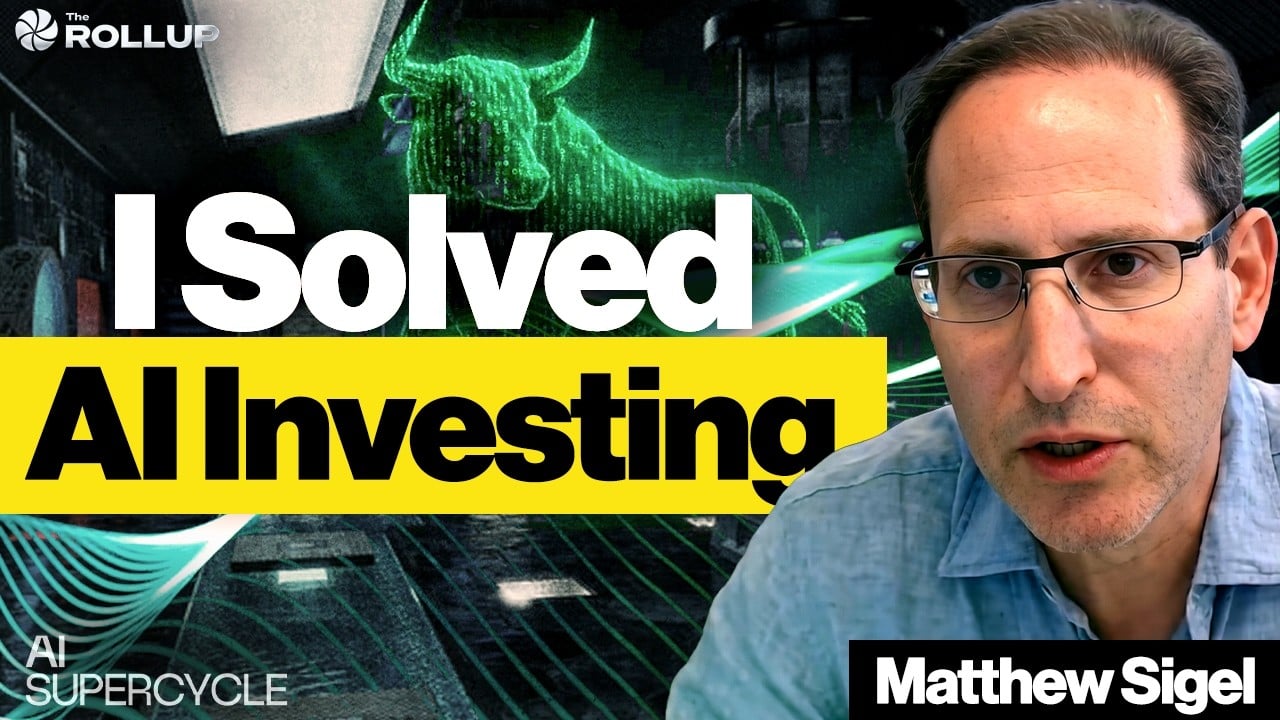
Matthew Sigel, head of digital assets research at VanEck and manager of the VanEck Onchain Economy ETF (NODE), said the current AI infrastructure trade should not be viewed as a replay of the 19th-century railroad bubble. In his view, the key difference is funding: this cycle is backed by private-sector contracts, multi-year backlog, customer prepayments, and in some cases customer-supplied GPUs, rather than government-led land grants and speculative bond issuance. Sigel said the four largest cloud providers now hold more than $2 trillion in signed backlog, with Microsoft and Oracle accounting for roughly half. Sigel also argued that crypto’s weak tone is not mainly a macro story. He said institutions have grown disappointed with major Layer 1 networks after many tokens doubled following the election without a breakout application or a clear wave of new capital formation. VanEck has reduced exposure to Solana, ETH, and other mainstream L1s since the election, while paying closer attention to enterprise-chain efforts tied to Circle, Stripe, Robinhood, and even Wells Fargo. He said regulated institutions do not want to place significant value directly on open networks and often need to support several chains at once, which weakens the winner-take-all case for any single L1. On portfolio positioning, Sigel said NODE has outperformed Bitcoin by nearly 100 percentage points over the past 15 months, largely by identifying the undervalued power and land controlled by Bitcoin miners shifting toward AI data center use.

1080
VanEck’s Matthew Sigel says AI infrastructure is not a bubble, while institutional disappointment with L1s is weighing on crypto
Bank of Ameri
2026-08-10 03:32:47

BofA says Bull & Bear at 9.7 leaves little upside, urges investors to rotate or step back

Bank of America said its Bull & Bear indicator rose to 9.7 in its August 6 Flow Show report, the highest level since 2021 and near a sell signal, as policy support for financial conditions clashes with rising political and valuation risks. Over the past week, cash funds took in $53.7 billion, equity funds drew $32.9 billion, and bond funds added $23.1 billion, while crypto saw $600 million of inflows and technology funds posted their first outflow in six weeks. The bank argued that the market’s main tension now lies between liquidity backstops on one side and stretched sentiment, widening AI hyperscaler credit spreads, and midterm election uncertainty on the other. Its recommendation was not to add risk but to "retreat or rotate" out of risk assets and into defensive sectors, duration-sensitive assets, and the U.S. dollar. BofA also said midterm elections are the biggest macro variable for the second half, while July nonfarm payrolls could shape the rate outlook and determine whether duration and defensive trades become a contrarian opportunity.

1780
BofA says Bull & Bear at 9.7 leaves little upside, urges investors to rotate or step back
Bank of Ameri
2026-08-10 03:01:13

BofA’s Michael Hartnett stays tactically bearish but strategically bullish on stocks

Bank of America chief investment strategist Michael Hartnett said in the latest Flow Show report that his market view remains split between short-term caution and a longer-term pro-risk allocation. Tactically, he said investors should rotate out of risk assets and toward defensive assets, duration trades and the U.S. dollar. Strategically, he is still sticking with a long-stocks, short-bonds stance because, in his view, U.S. policymakers now treat equities as a systemically important asset that is too big to fail. Hartnett noted that BofA’s bull-and-bear indicator rose from 9.4 to 9.7, its highest level since the meme-stock bubble in early 2021, pointing to extremely optimistic sentiment. At the same time, he flagged growing stress signals from credit markets, including widening credit spreads and CDS for AI hyperscale data center operators, along with the first net outflow from tech stocks in six weeks. He also outlined what could end the current bull run: a bond-market selloff marked by rising yields and a weaker dollar, or a more immediate warning sign of rising yields paired with falling bank stocks. In the political and macro backdrop, Hartnett said gold remains a hedge against tail risks tied to the U.S. election cycle, while Republican control of the Senate would be a positive market outcome.

1180
BofA’s Michael Hartnett stays tactically bearish but strategically bullish on stocks
Nick Maggiull
2026-07-19 01:20:52

Nick Maggiulli says the stock market question starts with when you need the money

As excitement around artificial intelligence keeps lifting U.S. equity valuations, some investors have stayed fully invested while others have sat on cash, worried they could be buying near the top. In an interview cited by ABMedia, Just Keep Buying author Nick Maggiulli revisited the argument that made him well known: keep buying through market cycles. His point, though, was not that valuation no longer matters or that every AI stock is fairly priced. It was that investors often ask the wrong first question. Maggiulli said the more useful test is time horizon. Money that may be needed within the next few years for a home down payment, wedding, education, childcare, or other defined expenses should not be exposed to stock-market volatility in the same way as long-term capital. By contrast, money that will not be used for 10 years, 20 years, or until retirement can usually tolerate more short-term swings. He also said he keeps about 2% of his portfolio in Bitcoin, rebalancing around that target rather than trying to trade price moves. Across the interview, he argued against holding large cash balances solely to wait for a crash and said investor behavior matters as much as theory when deciding whether to invest a lump sum all at once or phase it in over time.

1080
Nick Maggiulli says the stock market question starts with when you need the money
ChainFeeds
2026-07-18 01:55:56

ChainFeeds roundup tracks Bitcoin sell pressure, Base’s finance thesis and CZ’s long-term crypto view

ChainFeeds’ July 18 research roundup brings together five separate threads shaping crypto discussion right now: Bitcoin’s on-chain reset, Base’s pitch to builders, the attempt to merge creator influence with memecoins, the trade-off between distribution and neutrality for developers, and CZ’s latest argument that crypto should be treated as foundational technology rather than a short-term speculative trade. In the first piece, Glassnode says Bitcoin is showing “green shoots” as long-term holder sell pressure cools from its cycle peak. The report argues that rising real rates, not broad risk-off sentiment, have been the main macro headwind, while a decline in entity-adjusted realized losses from long-term holders marks the first notable easing in the capitulation process this cycle. Base Build, in a letter to builders, lays out a wide view of on-chain global finance spanning payments, stablecoins, credit, tokenized assets, derivatives, prediction markets and AI agents. It argues that blockchains are suited not just to replicate traditional finance, but to redesign issuance, settlement and machine-native economic activity. The package also includes Ansem’s case for tokenized creator networks, Jonah Burian’s warning that corporate chains can offer user access at the cost of platform dependence, and comments from CZ, who says that even if he started over, he would still build an exchange and would not frame crypto as something to “exit.”

1320
ChainFeeds roundup tracks Bitcoin sell pressure, Base’s finance thesis and CZ’s long-term crypto view
Policy and Re
2026-07-17 02:14:00

July 17 crypto policy and market roundup: SEC proposes e-delivery rule, CFTC probes Kalshi-linked trades

A broad set of crypto, payments, regulatory and AI developments emerged between July 16 and July 17. CoinGecko’s 2026 second-quarter report showed total crypto market capitalization fell 12.6% to $2.1 trillion by the end of June, while stablecoin market cap slipped 1.6% to $305.1 billion, marking its first decline since Q3 2023. Centralized exchange spot volume dropped 27.9% to $1.95 trillion, but prediction market notional volume rose 48.7% to $113.8 billion. In Washington, the U.S. Securities and Exchange Commission proposed a new Regulation E-Delivery framework that would let issuers, broker-dealers and investment advisers default to electronic delivery for a wide range of required disclosures, with a 60-day public comment period after publication in the Federal Register. Separately, the Commodity Futures Trading Commission is investigating whether trading on Kalshi involving alleged early access to Trump speech content may have relied on nonpublic information. Corporate and product announcements also accelerated. Visa launched its Visa Stablecoin Platform, while Flex raised $70 million for its stablecoin-based cross-border banking platform. Crypto.com disclosed a $400 million strategic investment from Citadel Securities at a $20 billion valuation, and T. Rowe Price launched TKNZ, described as the first actively managed multi-token spot crypto ETF. Binance, MoonPay, Alpaca, Fireworks, Ethena and several other firms also announced new listings, acquisitions, funding rounds or ecosystem expansions.

1800
July 17 crypto policy and market roundup: SEC proposes e-delivery rule, CFTC probes Kalshi-linked trades